
Imagine trying to buy a house, but the bank refuses to process your payment because they don't recognize the currency you're using. That is the daily reality for millions of people living in countries with strict cryptocurrency restrictions. You want to participate in the digital asset economy, but your local laws say "no." So, what do you do? Do you ignore the rules and risk jail time? Or do you find a way to stay compliant while still accessing these markets?
The answer lies in a compliance-first approach. This isn't about finding loopholes to break the law; it's about understanding exactly where the line is drawn and staying on the safe side of it. As we move through 2026, the global regulatory landscape is shifting fast. With nearly 100 jurisdictions passing or considering crypto laws, as reported by the Financial Action Task Force (FATF) in mid-2025, the old advice of "just use an anonymous exchange" is dangerous and outdated.
Understanding the Spectrum of Restrictions
Not all bans are created equal. To trade safely, you first need to know which category your country falls into. The world doesn't split neatly into "allowed" and "banned." It’s more like a gradient from total prohibition to heavy regulation.
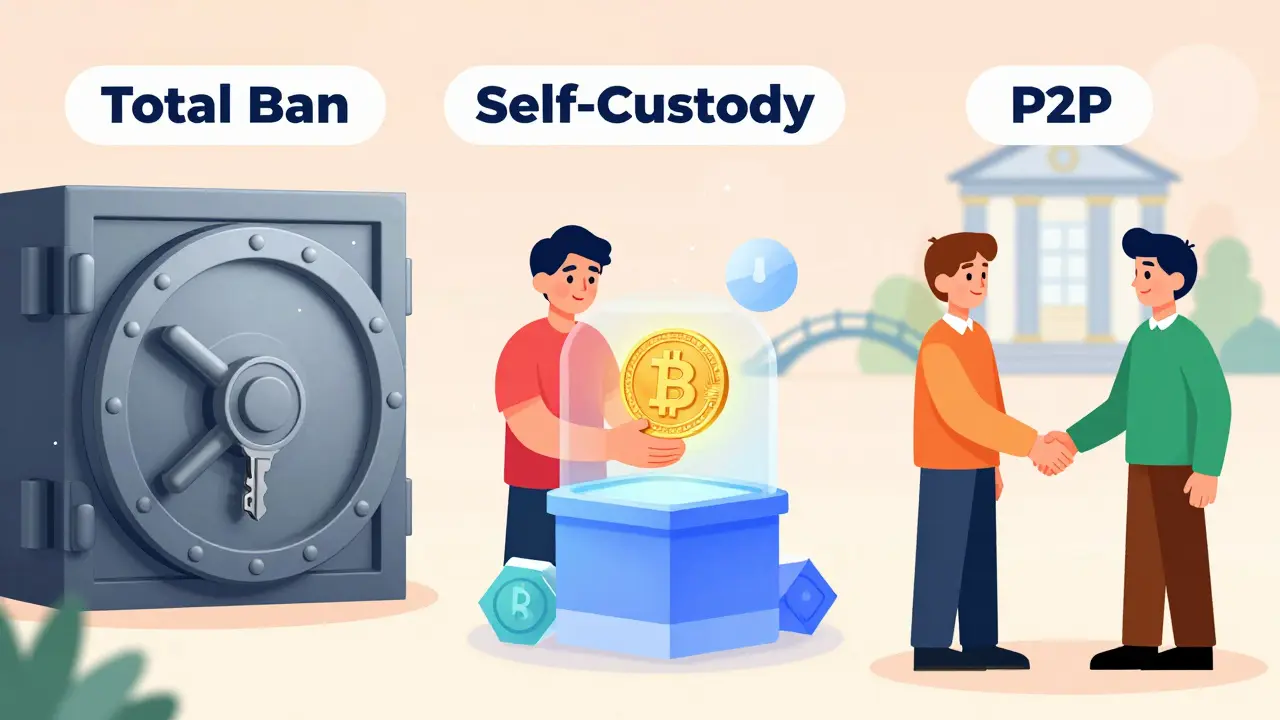
At the extreme end, you have countries with complete bans. As of late 2025, nations like Afghanistan, Algeria, Bangladesh, China, Egypt, Kuwait, Nepal, and North Macedonia have implemented comprehensive prohibitions. In Bangladesh, for example, the central bank has explicitly banned usage, trade, and possession. Violators face legal proceedings under anti-money laundering laws. If you live here, the only truly compliant option is often to abstain entirely until laws change.
Then there are countries with partial restrictions. China offers a fascinating case study. While trading on centralized exchanges and mining are strictly prohibited due to concerns over financial stability and energy consumption, personal holdings in self-custody wallets are not explicitly banned. This creates a narrow window for compliance: you can hold assets, but you cannot easily trade them locally without violating banking regulations.
Nigeria presents another complex scenario. The Central Bank of Nigeria issued circulars prohibiting financial institutions from facilitating crypto payments. However, this is a ban on *banking services* for crypto, not necessarily a criminalization of holding crypto itself. This distinction forces users toward peer-to-peer (P2P) methods or offshore platforms, increasing fraud risks but also highlighting the demand for compliant pathways.
| Country/Region | Regulatory Status | Key Restriction | Compliance Pathway |
|---|---|---|---|
| Bangladesh | Total Ban | Possession, Trade, Usage | Avoidance / Legal Consultation |
| China | Partial Ban | Trading, Mining | Self-Custody Holdings Only |
| Nigeria | Banking Ban | Financial Institution Facilitation | P2P / Offshore Exchanges |
| Indonesia | Commodity Classification | Not Legal Tender | Regulated Commodity Exchanges |
The Power of Self-Custody and Non-Custodial Solutions
In many restricted environments, the biggest hurdle isn't owning crypto-it's moving fiat currency (like dollars or euros) in and out of exchanges. When banks block these transactions, centralized exchanges become risky points of failure. This is where self-custody becomes your best friend.
Using a non-custodial wallet means you control your private keys. No company holds your funds. In jurisdictions like China or Argentina, where individual wallet usage is tolerated even if exchange trading is scrutinized, self-custody allows you to maintain exposure to digital assets without interacting with prohibited intermediaries. You aren't "trading" in the traditional sense; you are holding an asset class that the law may not explicitly forbid possessing.
However, be careful. Just because you can hold Bitcoin doesn't mean you can use it to pay for groceries if your country, like Tanzania, advises against its use and declares the local shilling as the only legal tender. Always check if "usage" is banned, not just "trading."
Decentralized Finance (DeFi) as a Compliance Alternative
If centralized exchanges are blocked, what then? Enter Decentralized Finance (DeFi). DeFi protocols operate on blockchain networks without a central intermediary. For traders in restricted countries, this can offer a layer of separation from local banking restrictions.
Data from the Chainalysis 2025 Global Crypto Adoption Index reveals interesting trends. Jordan ranks first in DeFi value received, despite having lower rankings in retail centralized services. This suggests that users in restrictive or emerging markets are turning to decentralized protocols to bypass traditional financial barriers. Venezuela shows the opposite trend, ranking high in centralized services but low in DeFi, indicating varied user preferences based on infrastructure and education.
But does DeFi mean you are exempt from local laws? Not necessarily. While the protocol itself may be borderless, *you* are subject to your local jurisdiction. Using DeFi might avoid banking blocks, but it doesn't erase tax obligations or potential legal scrutiny if authorities decide to crack down on decentralized activities. The key is to view DeFi as a tool for access, not a shield against liability.
Global Standards: The FATF and Travel Rule
You can't talk about compliance without mentioning the Financial Action Task Force (FATF). This international body sets standards for combating money laundering and terrorist financing. Their "Travel Rule" requires virtual asset service providers (VASPs) to share customer information during transactions.
By June 2025, 99 jurisdictions had passed or were drafting crypto-related laws, largely driven by FATF recommendations. Even in restricted countries, regulators are increasingly focused on Anti-Money Laundering (AML) and Counter-Terrorist Financing (CTF). If you are trading, ensuring your activities are transparent and traceable (where legally required) can actually help legitimize the space. Demonstrating robust AML controls might influence future regulatory evolution, as seen in Indonesia's shift toward commodity classification.
Geographic Arbitrage and Relocation Strategies
For some, the most compliant path is to move. Geographic arbitrage involves relocating to a crypto-friendly jurisdiction. But this isn't as simple as buying a plane ticket. You must consider:
- Exit Rules: Does your home country restrict taking assets abroad?
- Entry Rules: What are the immigration and visa requirements of the destination?
- Tax Implications: How will your new home treat capital gains?
Countries like Bermuda, Australia, and Panama have positioned themselves as crypto hubs. Bermuda’s Digital Asset Business Act provides clear guidance, while Panama imposes no capital gains tax on crypto transactions. Australia offers a regulatory sandbox for innovation. If you are serious about long-term crypto engagement, researching these jurisdictions could be part of your compliance strategy.

Practical Steps for Traders in Restricted Zones
So, how do you put this into practice today? Here is a checklist for navigating restricted markets:
- Read the Law: Don't rely on rumors. Find the official central bank or ministry of finance statements. Is possession banned? Is trading banned? Is payment usage banned?
- Consult Local Experts: Hire a lawyer who specializes in financial technology. The cost is worth it compared to the risk of criminal charges.
- Use Reputable Platforms: If exchanges are allowed, use those registered with local authorities (like Bappebti in Indonesia). Avoid unregulated offshore sites that promise anonymity at the cost of security.
- Prioritize Security: Use hardware wallets for storage. Enable two-factor authentication. In restricted markets, scams target desperate users.
- Monitor Changes: Regulations evolve. Follow updates from bodies like the FATF and local financial news. What was illegal yesterday might be regulated tomorrow.
The Future of Compliance in Restricted Markets
The trend is moving away from blanket bans toward structured regulation. Hong Kong’s Stablecoins Ordinance, effective August 2025, and Singapore’s Financial Institutions (Miscellaneous Amendments) Act show that governments want control, not chaos. They want to tax, monitor, and protect consumers.
For traders in restricted countries, this means patience and precision. The era of wild west crypto is ending. By adopting a compliance-first mindset, you protect yourself from legal peril and contribute to the broader acceptance of digital assets. You prove that crypto users are responsible citizens, not criminals. And in the long run, that advocacy helps open doors for everyone.
Is it illegal to own Bitcoin in China?
No, owning Bitcoin in a self-custody wallet is not explicitly illegal in mainland China. However, trading Bitcoin on centralized exchanges and mining are strictly prohibited. Users must ensure they do not engage in commercial trading activities to remain compliant.
What is the FATF Travel Rule?
The FATF Travel Rule is a global standard requiring virtual asset service providers (VASPs) to collect and share originator and beneficiary information for transactions above a certain threshold. This aims to prevent money laundering and terrorist financing across borders.
Can I use DeFi to bypass banking restrictions in my country?
Technically, yes, DeFi operates independently of traditional banks. However, using DeFi does not exempt you from local laws regarding asset ownership or taxation. You should consult legal experts to understand the risks associated with decentralized protocols in your specific jurisdiction.
Which countries have completely banned cryptocurrency?
As of late 2025, countries with complete bans include Afghanistan, Algeria, Bangladesh, China (trading/mining), Egypt, Kuwait, Nepal, and North Macedonia. Regulations can change, so always verify current local laws.
How does Indonesia regulate cryptocurrency?
Indonesia classifies cryptocurrencies as commodities, not legal tender. They are traded on regulated exchanges overseen by Bappebti. While you cannot use crypto to pay for goods directly, investment trading is permitted under strict consumer protection and AML guidelines.