
You’re holding USDT in your wallet, earning absolutely nothing. Meanwhile, the traditional financial world offers around 4-5% annual yield on short-term government bonds. What if you could bridge that gap without leaving the blockchain? That’s exactly what Staked USDT (stUSDT) promises: a way to turn idle stablecoins into yield-bearing assets by tapping into real-world assets (RWAs).
But before you move your capital, you need to understand how this works. Is it safe? How do you actually earn rewards? And why does the token price sometimes dip below $1? This guide breaks down the mechanics of STUSDT, its governance model, and what you need to know before staking your USDT.
The Core Concept: Turning Stablecoins into Yield Machines
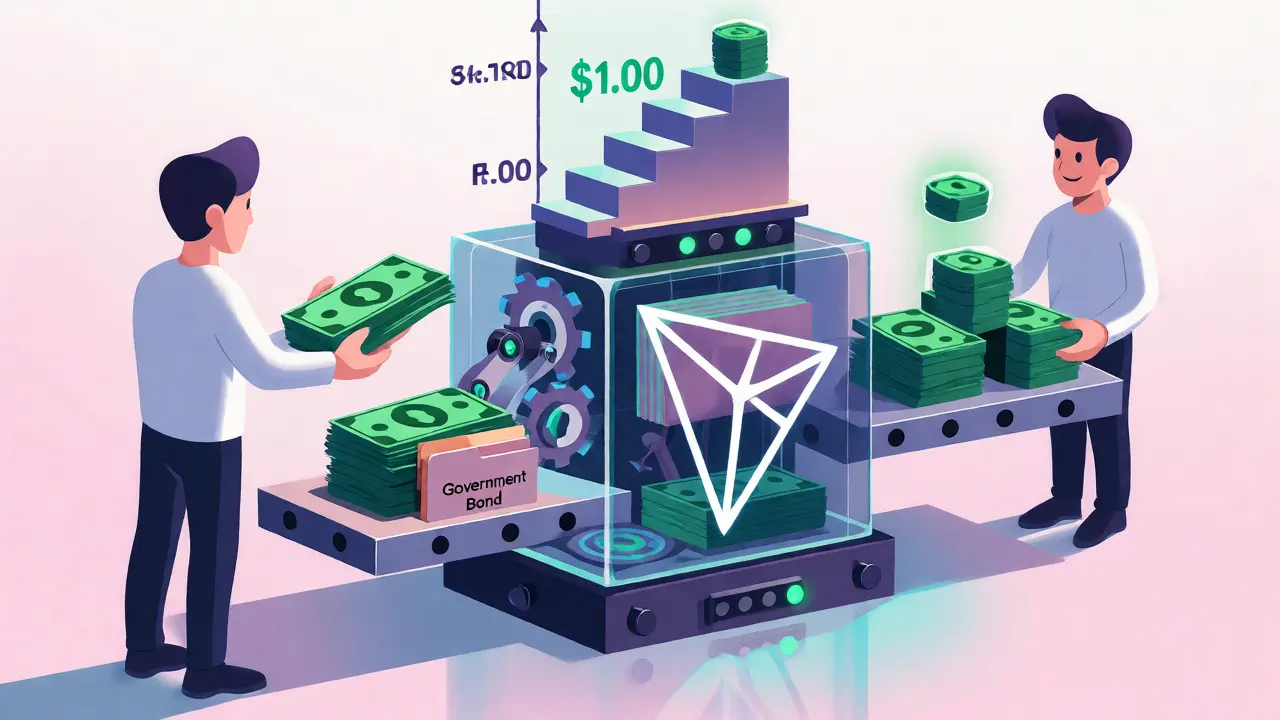
Standard stablecoins like Tether (USDT) are designed for stability, not growth. They hold their value against the dollar but don’t generate interest for the holder. Staked USDT is different because it functions as a rebasing real-world asset protocol. When you deposit USDT into the stUSDT contract, you receive STUSDT tokens at a 1:1 ratio. These tokens aren't just receipts; they represent a claim on a pool of funds invested in low-risk instruments like short-term government bonds.
The magic happens through a mechanism called "rebasing." Instead of the token price skyrocketing above $1 to reflect accrued interest, the number of STUSDT tokens in your wallet increases over time. If you hold 100 STUSDT today, you might hold 100.5 STUSDT next month, assuming the underlying assets performed well. The target price remains near $1.00, but your balance grows. This design mimics how compound interest works in traditional banking, but it’s fully automated via smart contracts on the TRON network.
How the Protocol Works: From Deposit to Reward
The workflow is straightforward, leveraging the speed and low cost of the TRON blockchain. Here is the step-by-step process:
- Deposit: You connect a compatible wallet, such as TronLink, to the stUSDT dApp. You send USDT (or TrueUSD/TUSD) to the stUSDT-RWA Contract.
- Minting: The smart contract locks your stablecoins in a reserve pool and mints an equivalent amount of STUSDT tokens directly to your wallet.
- Investment: Asset Managers allocate these pooled funds into off-chain real-world assets, primarily short-term government bonds. This generates the yield.
- Rebasing: Periodically, the protocol adjusts the supply of STUSDT. Your token balance increases proportionally to the yield generated by the bond portfolio.
- Redemption: When you want out, you burn your STUSDT tokens to receive back the original USDT plus any accrued yield, typically at a 1:1 exchange rate.
This architecture relies heavily on trust in the off-chain managers who handle the actual bond purchases. Unlike pure DeFi protocols that lend crypto to other crypto users, stUSDT bridges the gap between on-chain liquidity and off-chain traditional finance (TradFi).
Governance and Security: Who Controls the Assets?
Decentralization is a key selling point for many crypto projects, but how decentralized is stUSDT really? The protocol operates under an RWA DAO (Decentralized Autonomous Organization) framework. According to the v1.1 whitepaper updated in January 2026, this DAO governs critical aspects like investment strategies, asset management mechanisms, and data disclosure policies.
However, it’s crucial to note that the initial allocation and management of assets are handled by designated Asset Managers. These entities are responsible for selecting the specific government bonds and ensuring compliance with regulatory standards. To mitigate price feed risks, the protocol uses oracle networks like Chainlink and WinkLink on TRON. These oracles monitor the stability of USDT, ensuring that the collateral backing STUSDT remains sound. If the price of USDT deviates significantly from $1, the system can trigger protective measures to maintain the peg.
Market Metrics and Liquidity: Is It Easy to Trade?
As of late 2026, STUSDT has established a modest but active footprint in the crypto market. The token is tracked on major aggregators like CoinGecko and CoinMarketCap, with a circulating supply hovering around 60-63 million tokens. This translates to a market capitalization in the range of $60 million to $63 million.
Liquidity is where potential investors should pay close attention. While the token is listed on centralized exchanges like MEXC, Bitget, and HTX, the primary trading venue is decentralized. SunSwap V2, a leading DEX on TRON, hosts the most active STUSDT/USDT trading pair. However, daily trading volumes on SunSwap have historically been low, often ranging from single digits to double digits in USD terms. For example, in September 2026, 24-hour volume was reported at just $6.65 on some trackers.
| Metric | Value | Source/Context |
|---|---|---|
| Price Target | $1.00 USD | Pegged to USDT |
| Actual Price Range | $0.987 - $1.01 | Minor deviations due to liquidity |
| Circulating Supply | ~60-63 Million | Fluctuates with rebases and redemptions |
| Primary Network | TRON (TRC-20) | Also supports Ethereum (ERC-20) |
| Main DEX | SunSwap V2 | Low volume indicates long-term holders |
Low trading volume suggests that most users are buying STUSDT to hold for yield rather than trade actively. This is consistent with its design as a savings instrument. However, if you plan to exit a large position quickly, you might face slippage on decentralized exchanges due to thinner order books.

Risks and Considerations: What Could Go Wrong?
No financial product is risk-free, and stUSDT carries specific risks distinct from holding plain USDT.
- Off-Chain Risk: Since the yield comes from real-world bonds, you are exposed to the performance of the off-chain asset managers. If they fail to manage the portfolio correctly or face regulatory hurdles in traditional finance, the yield could drop or the redemption process could be delayed.
- Depeg Events: While the target is $1.00, market prices have dipped as low as $0.987. This small discount reflects market sentiment and liquidity constraints. In extreme market stress, maintaining the peg requires sufficient reserves and confidence.
- Smart Contract Risk: As with any DeFi protocol, bugs in the smart contracts could lead to fund loss. Always check for recent audits and security assessments.
- Regulatory Uncertainty: The intersection of crypto and traditional finance is heavily scrutinized. Changes in regulations regarding tokenized securities or stablecoins could impact the protocol’s operations.
It’s also worth noting that while the protocol aims for 1:1 redemption, specific rules may apply during unstaking. Lock-up periods or fees defined by the DAO could affect your immediate access to funds.
Who Should Use Staked USDT?
STUSDT is ideal for crypto-native savers who want to earn passive income on their stablecoin holdings without engaging in high-risk lending or liquidity provision. If you already hold USDT on TRON and believe in the stability of short-term government bonds, this protocol offers a streamlined way to capture TradFi yields.
Conversely, if you need instant, deep liquidity for frequent trading, the current low volume on secondary markets might be a drawback. High-frequency traders may find better execution elsewhere. But for long-term holders looking to combat inflation and put idle capital to work, STUSDT presents a compelling case study in the growing Real World Assets sector.
Is STUSDT the same as regular USDT?
No. Regular USDT is a stablecoin backed by reserves but doesn't inherently pay interest to holders. STUSDT is a receipt token representing staked USDT that earns yield from real-world assets like government bonds. Its balance grows over time via rebasing, whereas regular USDT balances remain static unless traded.
Which networks support Staked USDT?
STUSDT is primarily deployed on the TRON network using the TRC-20 standard, which offers low transaction fees and fast settlement. It also has compatibility with the Ethereum network via the ERC-20 standard, allowing for cross-network participation, though TRON is the main hub for activity.
How do I earn rewards with STUSDT?
You earn rewards automatically through a rebasing mechanism. When the underlying asset managers generate profit from investments (like government bonds), the total supply of STUSDT increases. Your individual wallet balance of STUSDT tokens increases proportionally, effectively compounding your yield without needing to claim rewards manually.
Where can I buy or trade STUSDT?
The primary decentralized exchange for STUSDT is SunSwap V2 on the TRON network. It is also listed on several centralized exchanges including MEXC, Bitget, and HTX. However, trading volumes are relatively low compared to major stablecoins, so be mindful of slippage when trading large amounts.
Is STUSDT safe to use?
Safety depends on multiple factors. The protocol uses smart contracts audited for security and relies on oracles like Chainlink and WinkLink for price feeds. However, there is inherent risk in off-chain asset management and regulatory changes. Users should perform their own due diligence, review the latest whitepaper, and understand that past performance of the underlying bonds does not guarantee future results.