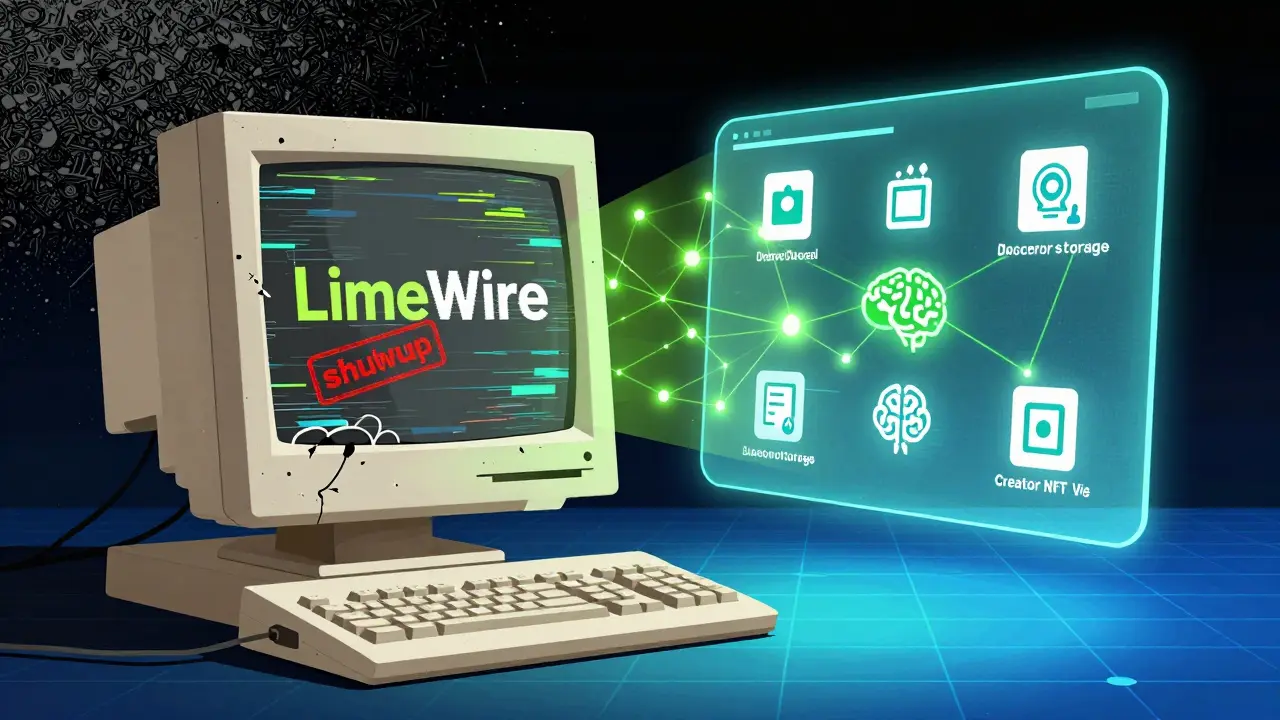

Remember the early 2000s? You probably remember LimeWire. It was everywhere. Students used it to download music, friends shared movies, and parents worried about viruses. Then came the lawsuits, the shutdown, and silence. Fast forward to today, and the name is back-but not for piracy. Today, LimeWire is a Web3 platform, and its native currency is the LimeWire Token, ticker LMWR. This isn't just a nostalgic rebrand; it’s a pivot into decentralized storage, AI services, and creator memberships built on the Algorand blockchain.
If you’re seeing LMWR pop up on exchanges like Kraken or Binance.US, you might be wondering: Is this the same old file-sharing app? What does the token actually do? And is it worth your attention? Let’s break down what LimeWire has become, how LMWR fits into the puzzle, and whether this project delivers real utility or just rides on legacy fame.
The Evolution: From P2P Piracy to Web3 Platform
To understand where LimeWire is now, we have to look at where it started. The original LimeWire launched in the late 1990s as a peer-to-peer (P2P) file-sharing client. By its peak in the mid-2000s, it had over 50 million monthly users. It was free, fast, and incredibly popular. But it also facilitated massive copyright infringement. In 2010, after years of legal battles with the Recording Industry Association of America (RIAA), the courts ordered LimeWire to shut down permanently.
For more than a decade, the brand sat dormant. Then, new management acquired the rights. Instead of trying to resurrect a piracy tool-a dead end in today’s streaming world-they pivoted hard toward Web3 technology. The modern LimeWire is a multi-blockchain platform focused on three pillars:
- Creator Memberships: Artists and brands can sell exclusive access and content as on-chain assets (NFTs).
- Decentralized Storage: A network called LimeWire Network offers S3-compatible storage for files.
- AI Services: Integration of artificial intelligence tools for file sharing and computing.
This shift transforms LimeWire from a liability-prone file-sharer into a compliant infrastructure provider. The key difference? Users and creators now own their data and assets via blockchain technology, rather than relying on centralized servers that can be seized or shut down.
What Does the LMWR Token Actually Do?
Tokens are only valuable if they have use cases. If LMWR were just a speculative coin with no function, it would likely fade away. Fortunately, the project has defined specific utilities for the token within its ecosystem. Here is how LMWR works in practice:
- Payments and Fees: You use LMWR to pay for transactions on the LimeWire platform. This includes buying memberships, accessing premium content, or paying for storage space on the LimeWire Network.
- Governance: Holders can participate in decision-making processes regarding the future development of the protocol. This gives the community a say in how the platform evolves.
- Loyalty Rewards: The project offers an annualized reward system ranging from 8% to 12% for holders who lock up their tokens. These rewards come from the pre-allocated Ecosystem Fund, not from inflationary minting.
- Validator Staking: For those running nodes on the LimeWire Network, LMWR is used to stake and secure the decentralized storage layer.
Essentially, LMWR acts as the fuel for the engine. Whether you are a fan buying exclusive concert footage from a musician or a developer storing enterprise data, you interact with the token.
Tokenomics: Supply, Allocation, and Changes
Understanding the supply dynamics is crucial for any crypto investor. There is some confusion here because the numbers changed between the initial whitepaper and current market data. Let’s clear that up.
Original Plan vs. Reality: The initial whitepaper announced a fixed maximum supply of 1 billion LMWR. However, current data from major aggregators like CoinMarketCap and CoinGecko shows a maximum supply of approximately 633.04 million LMWR. This suggests that either a significant portion of the supply was burned, or the tokenomic model was revised before full circulation. The circulating supply sits around 457.5 million LMWR.
Allocation Breakdown: According to Kraken’s analysis of the project’s structure, the tokens are distributed as follows:
- 43% Ecosystem Fund: This large chunk covers treasury operations, community rewards, and an artist fund. It is split further into 15% for the treasury, 15% for community rewards, and 13% for artists.
- Public Sale: About 100 million tokens (roughly 10-15% of total supply depending on which max supply figure you use) were sold in May 2023 across three price tiers ($0.16, $0.20, and $0.30).
- Team and Advisors: Standard allocations for the founding team and strategic partners, usually subject to vesting schedules to ensure long-term commitment.
The lack of ongoing inflation is a positive signal. No new coins will be mined. The value relies entirely on demand from users needing storage, memberships, and governance rights.

Technical Architecture: Built on Algorand
One of the smartest moves LimeWire made was choosing Algorand as its base layer. Why Algorand? Because it offers high speed, low transaction fees, and pure proof-of-stake consensus. This is critical for a platform that wants to handle millions of micro-transactions for content tips or small storage payments without clogging the network or charging exorbitant gas fees.
However, LimeWire didn’t stop there. They built a multi-chain architecture. While the core logic runs on Algorand, the platform supports assets from Ethereum and Polygon. This interoperability is vital. Many creators already hold NFTs or digital assets on Ethereum. By bridging these ecosystems, LimeWire allows fans to use their existing Web3 wallets and assets seamlessly.
For example, when you buy LMWR on Binance.US, you deposit via the Ethereum network (as an ERC-20 token). But once it hits the LimeWire platform, it interacts with the Algorand-based infrastructure. This cross-chain capability ensures liquidity and accessibility without sacrificing performance.
| Feature | LimeWire (LMWR) | Traditional File Sharing (e.g., Dropbox) |
|---|---|---|
| Ownership | User-owned via Blockchain/NFTs | Platform-controlled |
| Censorship Resistance | High (Decentralized) | Low (Centralized Servers) |
| Cost Structure | Variable (Crypto Fees + LMWR) | Fixed Monthly Subscription |
| Monetization for Creators | Direct Sales + Secondary Royalties | Revenue Share Models |
Market Performance and Risk Factors
Let’s talk numbers, because nostalgia doesn’t pay bills. LMWR has experienced extreme volatility, which is typical for mid-cap altcoins but deserves careful scrutiny.
Price History: When LMWR launched in May 2023, it saw a massive spike. CoinMarketCap records an all-time high (ATH) of $1.92 on May 15, 2023. CoinGecko lists a slightly different ATH of $1.79 in April 2024. As of mid-2026, the token trades significantly lower, hovering around $0.013. That represents a drawdown of over 99% from its peak.
Current Metrics: * Market Cap: Approximately $6-$32 million (varies by aggregator due to circulating supply discrepancies). * Ranking: Between #1055 and #1149 globally. * Volume: Daily trading volume remains steady at roughly $2 million, indicating active interest despite the price drop.
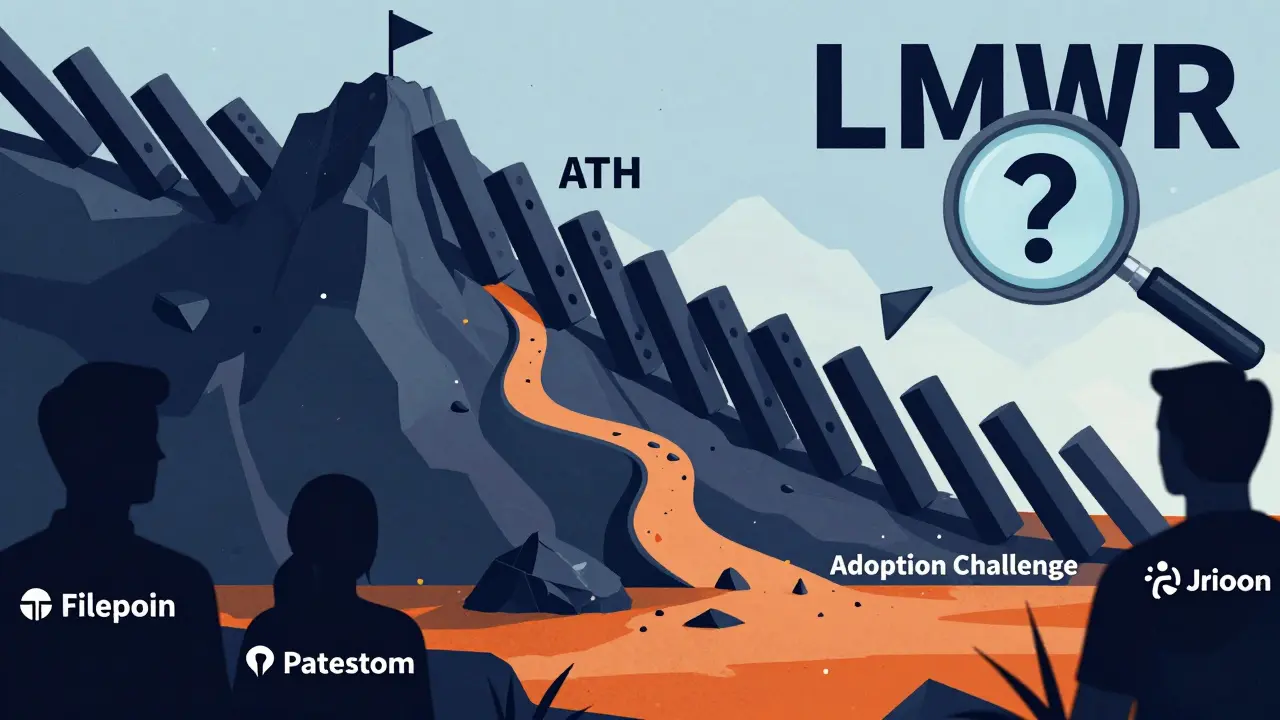
Risks to Consider: 1. Vatility: A 99% drop means early investors lost almost everything. The asset is highly speculative. 2. Adoption Uncertainty: While LimeWire claims 5 million users, independent verification of active daily users is limited. Are these users actively using the storage/AI features, or just holding old accounts? 3. Regulatory Landscape: Like all utility tokens, LMWR operates in a gray area. While it aims to be a utility token, regulators could view certain aspects (like staking rewards) differently depending on jurisdiction. 4. Competition: The decentralized storage space is crowded with players like Filecoin, Arweave, and Storj. The creator economy has giants like Patreon and emerging Web3 platforms like Audius. LimeWire must differentiate itself strongly to survive.
How to Buy and Use LMWR
If you decide to proceed, here is the practical path. LMWR is listed on several major exchanges, making it relatively accessible compared to obscure tokens.
Step 1: Choose an Exchange You can buy LMWR on Kraken, KuCoin, Bybit, Crypto.com, Gate.io, and Binance.US. For US residents, Binance.US and Kraken are often the most straightforward options due to regulatory compliance.
Step 2: Deposit Funds Fund your exchange account with USD, USDT, or another supported cryptocurrency. Note that on Binance.US, LMWR deposits/withdrawals occur via the Ethereum network.
Step 3: Purchase LMWR Search for the LMWR/USDT pair and execute your trade. Be mindful of slippage if you are moving large amounts, as liquidity is moderate.
Step 4: Withdraw to Wallet (Optional but Recommended) For security, move your tokens to a non-custodial wallet that supports Algorand or Ethereum (depending on which version you hold). If you plan to use the LimeWire platform directly, you may need to bridge your tokens to the Algorand network.
Step 5: Utilize the Ecosystem Once you have LMWR, you can: * Stake it for loyalty rewards (8-12% APY). * Pay for storage on the LimeWire Network. * Buy creator memberships and NFTs.
The Future: AI and Enterprise Storage
LimeWire isn’t resting on its laurels. The roadmap points toward a heavy integration of Artificial Intelligence. The company describes LMWR as the "backbone" of an AI-enhanced file-sharing ecosystem. This implies future use cases where LMWR pays for AI-driven tasks-such as automatic tagging of media files, intelligent search across decentralized storage, or even AI-generated content creation.
Furthermore, the LimeWire Network is positioning itself for enterprise adoption. With S3 compatibility, developers can integrate LimeWire’s storage into their apps just like they would with Amazon AWS. The plan is to open broader developer access in 2026. If they succeed in attracting businesses for cheap, censorship-resistant storage, the demand for LMWR could stabilize and grow organically, moving beyond pure speculation.
The challenge is execution. The tech stack is solid, and the brand recognition is unmatched. But turning 5 million users into active, paying participants in a Web3 economy is a steep hill to climb. Keep an eye on developer activity and actual storage usage metrics, not just price charts.
Is LimeWire LMWR a good investment?
Investing in LMWR carries high risk. The token has dropped over 99% from its all-time high. While the project has real utility in storage and creator economies, it competes with established players. Only invest what you can afford to lose, and focus on the long-term adoption of their technology rather than short-term price pumps.
What blockchain is LMWR on?
LMWR is primarily built on the Algorand blockchain for its main platform functions due to low fees and high speed. However, it also exists as an ERC-20 token on Ethereum for exchange listings and interoperability with other chains like Polygon.
Can I mine LMWR tokens?
No, you cannot mine LMWR. The token has a fixed maximum supply (currently reported as ~633 million) and uses a proof-of-stake mechanism for staking rewards. New tokens enter circulation only through scheduled releases from the Ecosystem Fund, not mining.
How do I earn rewards with LMWR?
You can earn loyalty rewards by staking your LMWR tokens within the LimeWire ecosystem. The annualized yield ranges from 8% to 12%, funded by the Community Rewards pool allocated during the token sale. This is distinct from traditional blockchain staking rewards.
Is the original LimeWire app still available?
The original P2P file-sharing app was shut down in 2010 and is not available. The current LimeWire is a completely different Web3 platform focused on legal content creation, decentralized storage, and AI services. Do not attempt to download old versions of the software, as they may contain malware.
Where can I buy LMWR?
LMWR is listed on several major exchanges including Kraken, Binance.US, KuCoin, Bybit, Crypto.com, and Gate.io. You can also buy it through fintech apps like Revolut, though fees may be higher.

Comments (6)

- pankaj chawla
- June 12, 2026 AT 19:30 PM
Great breakdown of the tokenomics, but let's be real about the competition here. Filecoin and Arweave have been in the decentralized storage game for years with actual developer mindshare. LimeWire is betting everything on nostalgia and brand recognition, which is a risky play in Web3 where utility beats vibes every time. I'd love to see them partner with some major indie artists to drive real usage rather than just hoping retail investors remember downloading MP3s in 2005.

- Jessica Lane
- June 14, 2026 AT 03:12 AM
I appreciate the detailed analysis provided here. It is quite fascinating how the platform has pivoted from its controversial past to a legitimate Web3 infrastructure provider. The integration of AI services alongside decentralized storage seems like a forward-thinking approach that could genuinely benefit creators who are often underserved by traditional platforms. However, one must remain cautious given the extreme volatility mentioned in the article. A 99% drop from ATH is not something to take lightly, regardless of the underlying technology or potential utility. It serves as a stark reminder that market sentiment can shift rapidly in this sector.

- Charles Pawlikowski
- June 14, 2026 AT 04:43 AM
honestly this whole web3 thing is just another way for tech bros to scam people :P i remember limewire back in the day and it was awesome because you could get whatever you wanted without paying some greedy record label now they want us to buy tokens to store files?? sounds like a joke to me. american innovation used to mean building things not creating fake money for insiders to cash out on. stay away from this garbage unless you want to lose your shirt

- Andrea Burd
- June 15, 2026 AT 20:01 PM
please tell me no one is actually falling for this hype train again. the tokenomics are a mess with all these discrepancies in supply numbers. typical shady crypto project behavior. i dont have time to read through all that fluff about ai and blockchain synergy when the price chart looks like a heart attack monitor. just another overvalued asset waiting to crash harder. yawn.

- Akeem Whittaker
- June 16, 2026 AT 12:11 PM
It is important to look beyond the noise and focus on the technical fundamentals. The choice of Algorand as the base layer is strategic due to its low fees and high throughput, which are essential for micro-transactions in a creator economy model. While the price action has been brutal, the development team continues to push updates on their S3-compatible storage solution. If they can secure enterprise contracts for censorship-resistant data hosting, the narrative shifts from speculation to utility. Keep an eye on their GitHub activity and partnership announcements rather than just the daily candle charts.

- Manish Prajapat
- June 16, 2026 AT 18:57 PM
The philosophical implication of reviving a name associated with piracy into a tool for ownership is profound. We are witnessing a transformation from consumption without consent to creation with sovereignty. The token acts not just as currency but as a vote of confidence in a decentralized future. Yet, we must ask if the market is ready to pay for freedom when convenience is so cheaply offered by centralized giants. The risk is high, but the reward is participating in the redefinition of digital rights.