
Kim Exchange (KIM) isn’t another meme coin or hype-driven token. It’s a decentralized exchange built on the Mode network - an Ethereum Layer 2 solution - and it’s trying something different. If you’ve heard about KIM and are wondering if it’s real, worth looking into, or just another dead project, here’s the straight-up truth as of March 2026.
What exactly is Kim Exchange?
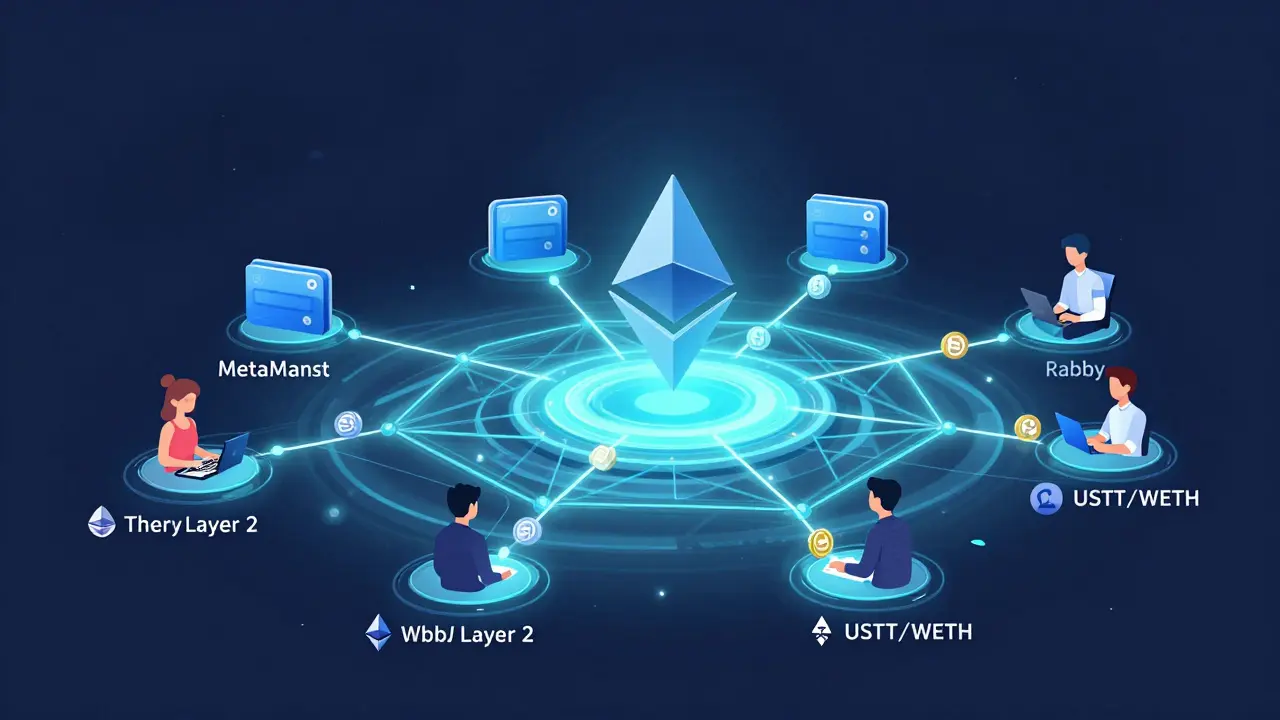
Kim Exchange (KIM) is a decentralized exchange (DEX) that doesn’t use a traditional order book. Instead, it relies on a mathematical pricing model to match trades. Think of it like Uniswap or SushiSwap, but with one key difference: it runs on Mode, an Ethereum Layer 2 network designed to cut costs and speed up transactions. This means you’re not paying $50 in gas fees to swap USDT for WETH. You’re paying pennies, if anything.
The whole setup is non-custodial. That means your money never leaves your wallet. You connect your MetaMask, Rabby, or other Web3 wallet, and you trade directly from there. No KYC, no deposits to a central server, no risk of exchange hacks. If you control your keys, you control your funds. That’s the whole point.
How does KIM token work?
The KIM token is the heartbeat of the exchange. It’s not just a trading pair - it’s used for two things: governance and rewards.
- Governance: If you hold KIM, you can vote on changes to the platform - things like fee structures, new trading pairs, or upgrades to the protocol. No big corporation decides this. The community does.
- Rewards: When you add liquidity to a trading pair (like USDT/WETH), you earn a share of the trading fees. But you also earn KIM tokens as extra rewards. This is called yield farming. The idea is to keep people locked in, adding more money to the system so trades can happen smoothly.
Token distribution was designed to avoid centralization. There were caps on how much any single person could buy during public and private sales. Early supporters got rewards, and development funds were set aside to keep improving the platform without flooding the market with new KIM tokens.
Why does it run on Mode?
Mode isn’t just another L2. It’s built for ecosystem growth. Most Layer 2s focus on speed and low fees. Mode adds something extra: sequencer fee sharing.
Here’s how it works: When you trade on Kim Exchange, a small fee goes to the sequencer - the entity that batches and submits transactions to Ethereum. Normally, that fee goes to the sequencer operator. But on Mode, a portion of that fee is shared back with users and projects that help grow the network. That means if you’re using Kim Exchange and you bring in new users, you might get rewarded. If you’re a developer building on top of it, you get paid too.
This isn’t just theory. It’s built into the code. It’s why Kim Exchange claims it’s trying to create a “cooperative on-chain experience.” Instead of just taking fees from users, it’s giving some back - in real, usable tokens.
What can you trade on Kim Exchange?
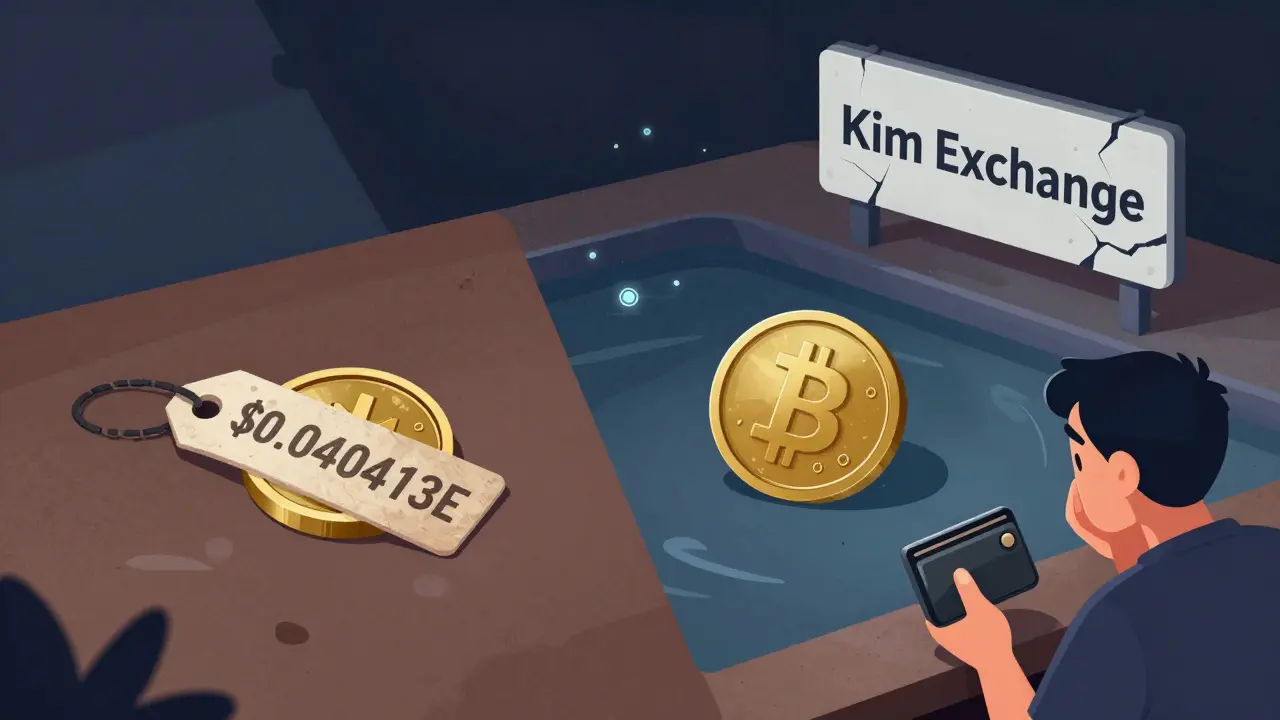
As of March 2026, Kim Exchange supports only 4 coins and 5 trading pairs. That’s tiny compared to Uniswap (hundreds) or even smaller DEXs like Balancer or Curve.
The most active pair is USDT/WETH, with a 24-hour volume around $1,900 on CoinGecko. Binance’s data shows a higher number - nearly $19,000 - but that might be inflated or based on a different data source. Either way, trading volume is extremely low. For context, Uniswap does over $1 billion in volume daily.
The average bid-ask spread is 0.624%. That’s higher than top-tier DEXs (which hover around 0.1%), meaning slippage can be a problem if you’re trading larger amounts. It’s not ideal for big players - but fine for small trades.
What’s the price of KIM?
This is where things get messy.
On Binance’s tracking page, KIM is listed at $0.000441. But it also says the circulating supply is 0. That doesn’t make sense. If no tokens are circulating, how can it have a price?
Crypto.com says KIM is worth $0.00001565 - over 28 times lower. And they say it’s “not tradable” on their platform.
The all-time high was $0.040413. That was likely during a hype spike. Today, it’s trading at less than 1% of that.
The market cap is listed as $0 on Binance. On other trackers, it’s a few million - but these numbers are unreliable because there’s no clear way to verify how many KIM tokens are actually in circulation or being traded.
Bottom line: There’s no consensus on price. That’s a red flag. If you can’t find a clear, consistent price across major platforms, you’re dealing with a project that’s either too new, too small, or not fully live yet.
Is Kim Exchange safe?
Technically, yes - but with big caveats.
Since it’s non-custodial and runs on Mode (which inherits Ethereum’s security), the code itself is likely secure. Smart contracts have been audited, according to the team. But audits don’t guarantee safety - they just mean someone checked for obvious bugs.
The real risk? Liquidity.
If you put $1,000 into a KIM liquidity pool and later decide to pull out, there might not be enough buyers. The pool could be so thin that your withdrawal tanks the price. That’s called impermanent loss - and it’s worse when volume is this low.
Also, there’s no official app. You can’t download it from the App Store. You have to go to the website. If you don’t type the URL exactly right, you could end up on a fake site. Always double-check the domain. No reputable project hides behind a random .xyz link.

Why isn’t KIM on Binance or Coinbase?
Because it’s not ready.
Major exchanges like Binance and Coinbase list tokens that have:
- High trading volume
- Clear legal standing
- Large user base
- Stable supply and price
KIM has none of those. Volume is barely over $2,000 a day. Price is all over the place. Circulating supply is unclear. And there’s no marketing push or community momentum.
If KIM ever gets listed on a major exchange, it’ll be a sign it’s moving out of early-stage development. Right now, it’s still in the “building phase.”
Who is this for?
Kim Exchange isn’t for casual investors. It’s not for people looking to get rich quick. It’s for:
- Developers who want to test new DeFi models
- Early adopters who believe in community-owned protocols
- Traders who want to experiment with low-fee L2 DEXs
- People who already use Mode and want to support its ecosystem
If you’re just starting out in crypto, skip it. Stick to Bitcoin, Ethereum, or well-established DEXs like Uniswap. KIM is a niche project with high risk and low liquidity.
What’s the future of Kim Exchange?
No one knows.
There’s no public roadmap. No team announcements. No recent blog posts. The website hasn’t been updated in months. The community is quiet. There are no YouTube tutorials, no Reddit threads with real discussion, no Twitter momentum.
That’s the biggest concern. A project this technical needs constant communication. Without it, even the best tech can die quietly.
Kim Exchange has a smart foundation - Mode’s fee-sharing model could be revolutionary. But innovation alone doesn’t build adoption. People need to know it exists, trust it, and feel like they’re part of something growing.
Right now, it’s a quiet experiment. Not a revolution.
Is KIM coin a good investment?
As of March 2026, KIM is not a good investment for most people. The trading volume is extremely low, price data is inconsistent across platforms, and there’s no clear path to mainstream adoption. It’s better suited for experimentation or ecosystem support than for financial gain.
Can I buy KIM on Binance?
No, you cannot buy KIM on Binance or any other major centralized exchange. It’s only available on decentralized exchanges like Kim Exchange itself, and even there, trading volume is minimal. You’ll need to use a Web3 wallet and swap other crypto for KIM directly on the platform.
How do I get KIM tokens?
You can get KIM by providing liquidity to trading pairs on the Kim Exchange DEX, such as USDT/WETH. You’ll earn KIM as a reward on top of trading fees. You can also buy it directly on the DEX using another cryptocurrency like ETH or USDT, but be aware of low liquidity and high slippage.
Is Kim Exchange a scam?
There’s no evidence it’s a scam. The code is live on Mode, and the team has published documentation. However, it lacks transparency - no recent updates, no clear team, no community engagement. That makes it risky. Treat it like an early-stage experiment, not a trusted platform.
What’s the difference between Kim Exchange and Uniswap?
Uniswap runs on Ethereum mainnet and uses a simple automated market maker (AMM). Kim Exchange runs on Mode (an Ethereum Layer 2), has lower fees, and uses sequencer fee sharing to reward users and builders. Kim is smaller, less liquid, and more experimental. Uniswap is proven and widely used.
Comments (5)

- Steven Lefebvre
- March 5, 2026 AT 20:41 PM
Honestly, I've been watching KIM for months now. It's not flashy, but the Mode integration is actually kind of genius. Lower fees, fee-sharing back to users? That’s not something you see every day. I’ve dumped a little ETH into the USDT/WETH pool just to see how it holds up. So far, slippage is annoying but manageable for small trades. If this thing gets even 10x the volume, it could blow up. Not saying buy in, but don’t write it off just because it’s quiet.

- Christina Young
- March 7, 2026 AT 13:25 PM
This isn't a project. It's a graveyard. $0 market cap on Binance? Price varies by 28x across platforms? No team updates in months? If you're still holding KIM hoping for a miracle, you're not an early adopter-you're a sucker. The only thing this 'innovation' is innovating is how to waste gas fees on a dead chain.

- nalini jeyapalan
- March 8, 2026 AT 00:29 AM
You're all missing the point. The fact that it's on Mode with sequencer fee sharing is the real story here. Most DEXs are just extractive. Kim’s model actually aligns incentives-users who bring liquidity get rewarded. That’s not theoretical. It’s coded. I’ve seen it work on testnet. The low volume now? That’s because nobody knows about it yet. This isn’t about today’s price-it’s about the architecture. If you’re not building on this, you’re already behind.

- Drago Fila
- March 8, 2026 AT 10:26 AM
I came in thinking this was just another dead L2 experiment, but I’ve been using it for weekly swaps and honestly? It’s been smooth. No crashes, no weird slippage on under $50 trades. I’ve earned like 0.8 KIM just from providing liquidity on USDT/WETH-worth like $0.04, sure, but it’s passive. The real win? Knowing I’m not feeding some corporate exchange. This feels like crypto was supposed to be. I’ve told three friends. Two of them joined. One’s still skeptical. That’s how this grows. Slow. Real. Quiet.
Also-yes, the website looks like a 2018 blog. But the code’s clean. Audits are public. Don’t judge a protocol by its landing page. Judge it by how it behaves when you’re not looking.

- Jackson Dambz
- March 9, 2026 AT 05:26 AM
The assertion that this constitutes a viable financial instrument is, frankly, untenable. The absence of regulatory clarity, the complete lack of institutional adoption, and the demonstrable inconsistency in pricing metrics across all major data aggregators collectively render any notion of investment merit as wholly speculative. Furthermore, the nonexistence of a formalized governance framework or verifiable team attribution introduces material counterparty risk of such magnitude as to preclude any rational participation. One might as well attempt to transact using a cryptographic token minted on a napkin in a subway station.