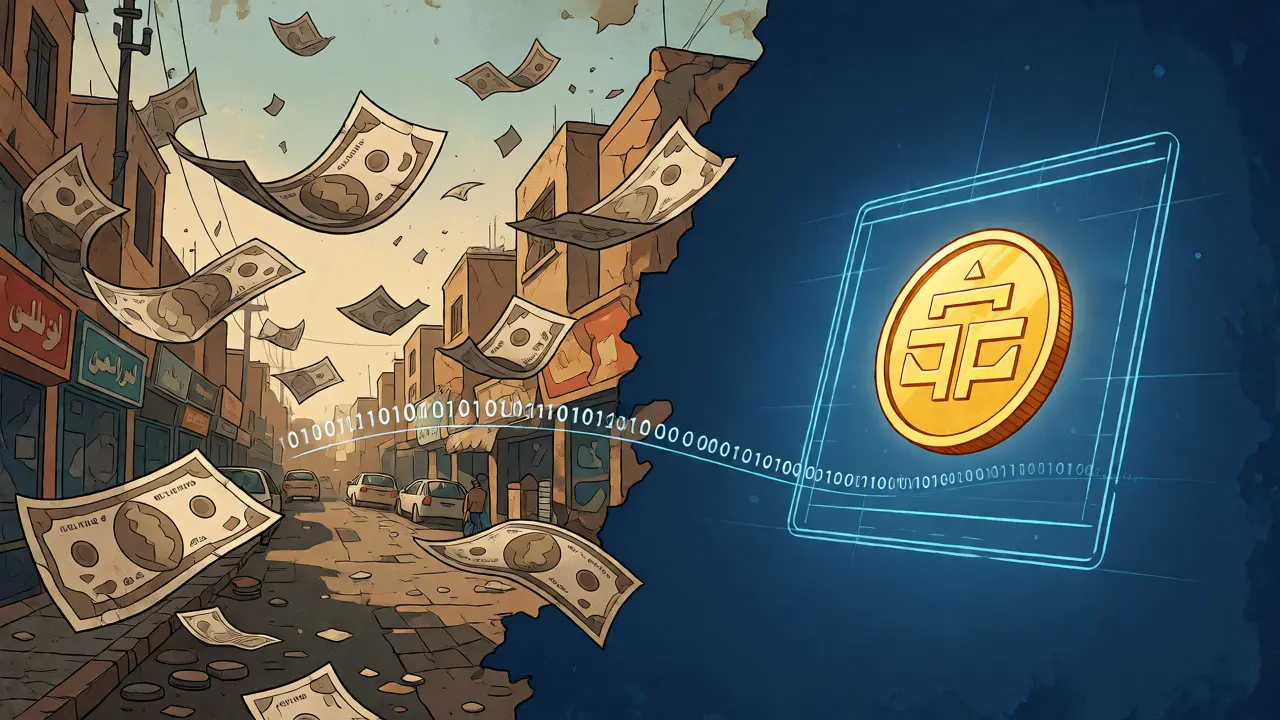

Imagine trying to buy groceries or pay rent in a country where your local currency loses value almost daily. Now imagine doing that with a digital token that claims to be pegged 1:1 to that same unstable currency. That’s the core premise of IRR (TOMAN), a niche blockchain-based cryptocurrency token designed to mirror the Iranian rial and facilitate transactions within Iran's economy. But here’s the catch: while it markets itself as a stablecoin, its price action and market data often tell a different story.
If you’ve stumbled upon this token while browsing decentralized exchanges or tracking obscure assets on CoinMarketCap, you’re probably wondering if it’s a legitimate financial tool or just another ghost town project. The answer isn’t black and white. IRR (TOMAN) exists at the intersection of geopolitical economic pressure, blockchain experimentation, and extremely thin liquidity. It’s not trying to compete with USDT or USDC for global dominance; instead, it aims to solve a very specific problem for users dealing with the Iranian monetary system. Let’s break down what this token actually is, how it works, and why its data looks so strange.
The Core Concept: Why Link Crypto to the Rial?
Most people know Bitcoin as "digital gold" or Ethereum as a platform for apps. Toman takes a different route. It is a stablecoin linked to the Iranian national currency, intended to provide a stable medium of exchange for users navigating the Iranian economic environment. The logic seems sound on paper: if the Iranian rial is volatile due to inflation and sanctions, having a digital representation of it on a fast, cheap blockchain like the BNB Smart Chain could make everyday payments easier and more transparent.
The project positions itself as part of the ZEDX neobanking network, which claims to bridge traditional fiat assets into the digital realm. The goal is financial inclusion-allowing people who might not have access to traditional banking rails to participate in the economy using crypto tools. However, unlike major stablecoins backed by USD reserves, IRR’s stability relies on a claimed 1:1 relationship with fiat reserves that are rarely audited publicly. This lack of transparency is the first red flag for any serious investor.
Technical Backbone: BEP-20 on BNB Chain
Technically, IRR (TOMAN) isn’t running on its own custom-built blockchain. It is a BEP-20 token deployed on the BNB Smart Chain, inheriting its security, speed, and transaction fee model from the Binance ecosystem. If you’re familiar with Ethereum’s ERC-20 standard, think of BEP-20 as its cousin on the BNB chain. This means:
- Low Fees: Transactions cost fractions of a cent compared to Ethereum.
- Fast Settlements: Blocks are produced quickly, allowing for near-instant transfers.
- Compatibility: Any wallet that supports BNB Chain (like MetaMask or Trust Wallet) can hold IRR tokens.
Because it’s a smart contract on an existing chain, the project doesn’t need to manage its own validators or consensus mechanism. Security is inherited from BNB Chain’s proof-of-staked-authority model. But this also means the token is entirely dependent on the underlying infrastructure. There’s no independent layer-1 innovation here-it’s purely a financial instrument wrapped in code.
Tokenomics and the Supply Mystery
Here is where things get confusing. Data providers disagree on basic facts about IRR’s supply. Most sources agree on a Total Supply of 100 billion tokens. But what does that mean for circulation?
| Metric | CoinMarketCap View | Coinbase/LiquidityFinder View |
|---|---|---|
| Total Supply | 100 Billion | 100 Billion |
| Circulating Supply | ~100 Billion (Self-reported) | 0 (Data Gap) |
| Price per Token | ~$0.000009986 | ~$0.00000950 - $0.00001290 |
| 24h Volume | Low/Variable | $0 USD (often reported) |
Why the discrepancy? Some platforms show a circulating supply of zero, implying that while the tokens exist in the smart contract, they aren’t actively trading in significant volumes. Others report full circulation. This inconsistency suggests either poor data integration between exchanges and aggregators or a market so thin that volume figures round down to zero. For a user, this means you might see a price listed, but when you try to sell, there might be no buyers.
Is It Actually Stable? The Volatility Paradox
A stablecoin should stay close to $1 (or its pegged unit). IRR (TOMAN) has struggled with this definition. Historical data shows it hitting an all-time high of roughly $0.000073 in April 2023 and dropping to lows around $0.000009. While these numbers look tiny, the percentage swings are massive. In some months, it has dropped over 60% against USDT.
This volatility undermines its primary selling point. If you’re holding IRR to avoid inflation, but the token itself fluctuates wildly against other cryptocurrencies, you haven’t really hedged your risk-you’ve just swapped one type of uncertainty for another. The lack of public audits makes it hard to verify if the project actually holds the necessary rial reserves to back the tokens. Without that trust anchor, the price is driven mostly by speculation and minimal arbitrage activity.
Use Cases and Real-World Adoption
The marketing materials talk big about "harmonizing traditional assets" and enabling cross-border payments via the ZEDX network. The idea is to help Iranian businesses bypass some of the friction caused by international sanctions by using crypto rails. In theory, a merchant in Tehran could accept IRR, and a supplier in Dubai could receive it, settling the trade without moving physical cash across borders.
However, evidence of real-world adoption is scarce. Unlike USDC, which powers DeFi protocols worth billions, IRR lacks:
- Major Exchange Listings: It’s not on Coinbase or Binance directly for spot trading in most regions.
- Merchant Networks: There are no widely known case studies of large retailers accepting it.
- Institutional Use: No banks or fintech giants have announced partnerships.
Most activity appears to come from speculative traders rather than utility users. The community sentiment is quiet, with few active discussions on Reddit or Twitter compared to even minor altcoins.
Risks and Red Flags
If you’re considering buying IRR (TOMAN), keep these risks in mind:
- Liquidity Risk: With reported volumes often hitting $0, exiting a position could be difficult. You might have to sell at a steep discount to find a buyer.
- Transparency Issues: No named founders, no clear corporate registration, and no public reserve audits. Who is actually managing the funds?
- Regulatory Uncertainty: Operating in the Iranian economic sphere brings complex legal challenges regarding sanctions and compliance that aren’t addressed in the project’s documentation.
- Data Reliability: As shown above, even the basic supply metrics are disputed. Trusting the price feed requires trusting the aggregator, which may not be accurate for such small-cap assets.
Final Verdict: Niche Experiment or Dead End?
IRR (TOMAN) is a fascinating case study in localized cryptocurrency. It attempts to solve a genuine problem-currency instability in Iran-but struggles with execution and transparency. It’s not a scam in the traditional sense, but it’s far from a robust financial product. For now, it remains a micro-cap asset suitable only for those willing to take extreme risks on obscure projects. Don’t expect it to replace your dollar savings anytime soon.
What is the main purpose of IRR (TOMAN)?
The main purpose of IRR (TOMAN) is to serve as a digital stablecoin linked to the Iranian rial. It aims to facilitate payments and financial transactions within the Iranian economy, offering a blockchain-based alternative to traditional banking methods affected by inflation and sanctions.
Which blockchain does IRR (TOMAN) use?
IRR (TOMAN) operates on the BNB Smart Chain as a BEP-20 token. This means it leverages the security and speed of the BNB network rather than running on its own independent blockchain.
Is IRR (TOMAN) a stablecoin?
It is marketed as a stablecoin pegged 1:1 to the Iranian rial/toman. However, due to low liquidity and lack of public audits, its price has historically shown significant volatility against other cryptocurrencies, challenging its classification as a truly stable asset.
Who founded IRR (TOMAN)?
Public information is limited. Sources describe the team as "Iranian tech enthusiasts" or claim founders with experience in economics, but no specific individual names or registered corporate entities are widely disclosed in major crypto databases.
Where can I buy IRR (TOMAN)?
IRR (TOMAN) is traded on smaller, decentralized exchanges and select centralized platforms that support BNB Chain tokens. Major exchanges like Coinbase track its price but do not always offer direct trading pairs. Always check current listings before attempting to purchase.