
Imagine buying Bitcoin in early 2024 and watching it double by late 2025. You want to sell, but you hesitate. Why? Because selling just one day too early could cost you thousands in taxes. This is the core reality for anyone who chooses to HODL (Hold On for Dear Life) their digital assets. The term originated from a typo on a 2013 BitcoinTalk forum, but today it represents a specific financial strategy with major tax consequences.
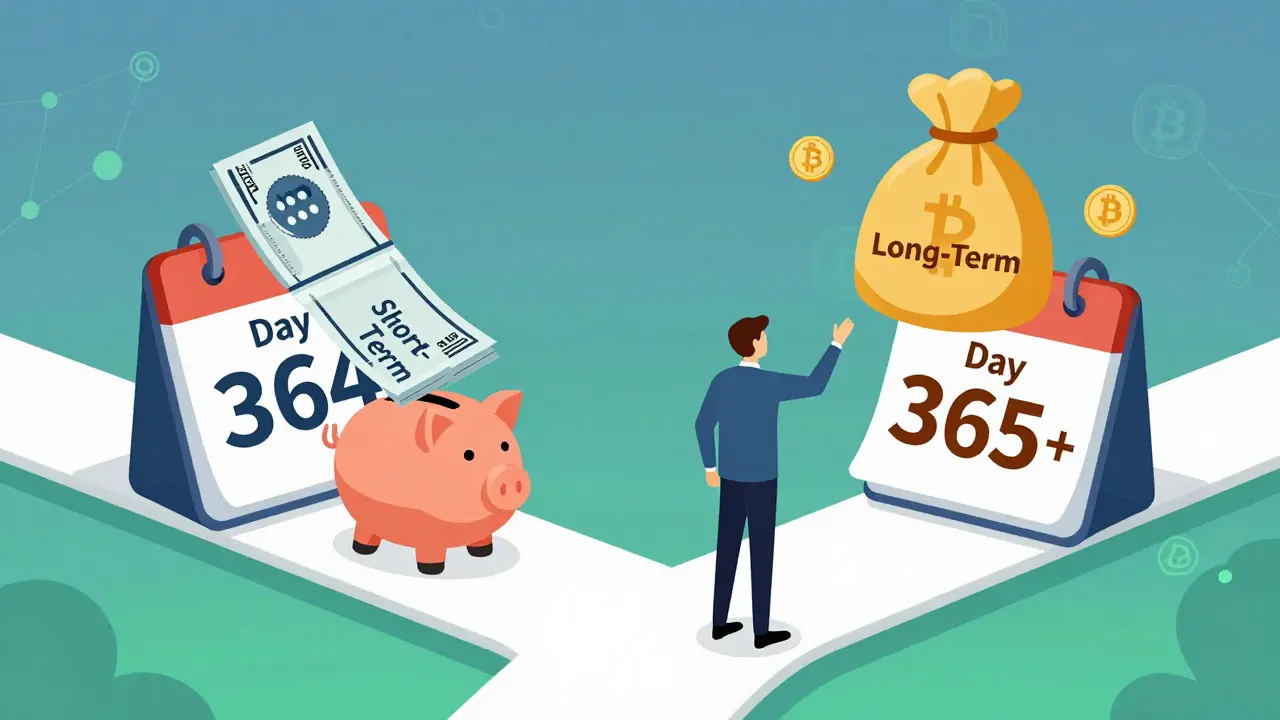
In the United States, the Internal Revenue Service (IRS) does not view cryptocurrency as money. It views it as property. This simple classification creates a massive divide between active traders and long-term holders. If you hold your crypto for more than one year before selling, trading, or spending it, you qualify for preferential long-term capital gains rates. If you sell before that one-year mark, you pay ordinary income tax rates, which are significantly higher. Understanding this timeline is the single most important factor in managing your crypto tax bill.
The One-Year Threshold: Your Biggest Tax Lever
The difference between short-term and long-term capital gains is stark. Short-term gains apply to assets held for one year or less. These profits are taxed at your standard income tax bracket, which can range from 10% to 37%. Long-term capital gains apply to assets held for more than one year. These rates are capped at 0%, 15%, or 20%, depending on your total taxable income.
For many investors, waiting an extra few days or weeks to cross the 365-day mark saves a substantial portion of their profit. For example, if you are a single filer earning $80,000 a year, your ordinary income tax rate might be 22%. However, your long-term capital gains rate would likely be 15%. That 7% difference on a large gain adds up quickly. High-income earners see even bigger savings, potentially dropping from a 37% short-term rate to a 20% long-term rate.
| Filing Status | 0% Rate Threshold | 15% Rate Range | 20% Rate Threshold |
|---|---|---|---|
| Single | $0 - $48,350 | $48,351 - $533,400 | $533,401+ |
| Married Filing Jointly | $0 - $96,700 | $96,701 - $600,050 | $600,051+ |
Note that these thresholds adjust slightly each year for inflation. Always check the current IRS guidelines for the exact numbers when filing. If your income falls below the lower threshold, you may pay zero percent in capital gains tax on your crypto profits, provided you have held the asset for over a year.
New Reporting Rules: Form 1099-DA Changes Everything
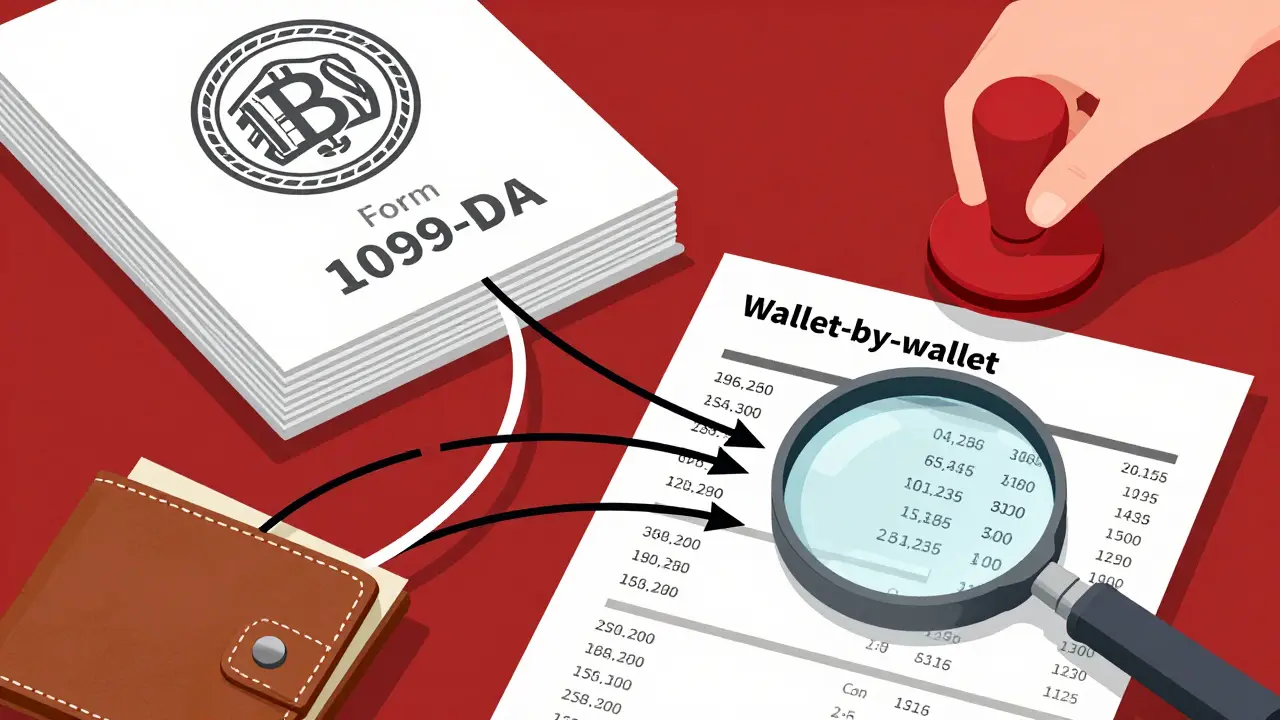
The landscape changed dramatically starting January 1, 2025. The Infrastructure Investment and Jobs Act mandated new reporting requirements for digital assets. Brokers and exchanges must now issue Form 1099-DA to both the IRS and taxpayers. This form reports gross proceeds from your sales and exchanges. Starting January 1, 2026, these forms will also include cost basis information.
This means the era of flying under the radar is over. Exchanges like Coinbase and Kraken are now required to track your transactions meticulously. If you sell crypto on an exchange, they report it. But what happens when you move crypto between your own wallets? This is where things get tricky. The IRS requires a "wallet-by-wallet" accounting method for transfers made after 2025. Previously, investors could use a universal average cost method. Now, you must track the specific coins moving from Wallet A to Wallet B to maintain accurate cost basis records.
If you transfer Bitcoin from your personal cold wallet to an exchange to sell it, you do not trigger a taxable event at the moment of transfer. However, you must document that transfer to prove your original purchase date and price. Without this record, you cannot claim long-term capital gains status. The burden of proof is on you, even if the exchange provides some data.
What Counts as a Disposal?
A common misconception is that you only owe taxes when you sell crypto for dollars. In reality, any disposal of crypto triggers a tax event. This includes:
- Selling crypto for fiat currency (USD, EUR, etc.).
- Trading one cryptocurrency for another (e.g., swapping ETH for BTC).
- Spending crypto on goods or services.
- Gifting crypto to someone else (though rules vary for small gifts).
When you trade Bitcoin for Ethereum, the IRS sees two events: you sold Bitcoin (realizing a gain or loss) and bought Ethereum. To calculate the gain, you need the fair market value of the Bitcoin at the time of the trade. If you held that Bitcoin for more than a year, you apply long-term rates. If less, you apply short-term rates. Keeping a detailed log of every transaction, including dates and USD values at the time of acquisition, is essential.

State-Level Variations and Future Outlook
While federal tax law applies nationwide, state laws differ. Some states follow federal treatment, while others have unique rules. For instance, Missouri passed legislation in May 2025 to eliminate capital gains tax on cryptocurrency, creating a potential advantage for residents. However, you still owe federal taxes. Other states may treat crypto differently or have higher income tax rates that impact your overall liability.
Looking ahead, regulatory clarity continues to evolve. Proposals like the Build Back Better Bill have discussed exemptions for microtransactions under $200, though such measures remain subject to congressional approval. As enforcement increases, with the IRS sending more notices to non-compliant taxpayers, staying organized is crucial. The goal is not to avoid taxes illegally, but to optimize your legal obligations through strategic holding periods and accurate record-keeping.
Practical Steps for HODLers
To maximize your tax efficiency, start by organizing your records. Use software that can import transaction histories from multiple exchanges and wallets. Ensure your cost basis calculations align with the wallet-by-wallet method required for post-2025 transfers. Review your portfolio annually to identify assets approaching the one-year mark. Consider selling smaller positions first if they are close to the threshold, allowing larger holdings to continue appreciating tax-deferred.
Consult with a tax professional who specializes in cryptocurrency. The rules are complex and changing rapidly. A qualified advisor can help you navigate Form 1099-DA, manage state-specific requirements, and plan for future tax liabilities. By treating your crypto holdings with the same rigor as traditional investments, you protect your profits and stay compliant with evolving regulations.
Is HODLing cryptocurrency tax-free?
No, HODLing is not tax-free. You defer taxes until you dispose of the asset, but you still owe capital gains tax upon sale. The benefit of HODLing is qualifying for lower long-term capital gains rates if you hold for more than one year.
Do I pay taxes if I just move crypto between my own wallets?
No, transferring crypto between wallets you control is not a taxable event. However, you must keep detailed records of the transfer to maintain accurate cost basis and holding period documentation for future sales.
What is the difference between short-term and long-term crypto gains?
Short-term gains apply to assets held for one year or less and are taxed at ordinary income rates (10%-37%). Long-term gains apply to assets held for more than one year and are taxed at preferential rates (0%, 15%, or 20%).
How does Form 1099-DA affect my crypto taxes?
Form 1099-DA requires exchanges to report your crypto sales and exchanges to the IRS. Starting in 2026, it will also include cost basis information, making it easier for the IRS to verify your tax returns and increasing compliance requirements.
Can I offset crypto gains with losses?
Yes, you can use capital losses to offset capital gains. If your losses exceed your gains, you can deduct up to $3,000 of net losses against ordinary income per year, with remaining losses carried forward to future years.
Comments (9)

- Ray Arney
- July 4, 2026 AT 11:17 AM
honestly just glad someone finally wrote this down clearly. i've been waiting for that one year mark on my btc since january and it's nerve wracking but the tax savings are real.

- Andrew Schneider
- July 5, 2026 AT 15:01 PM
oh look another article trying to scare you with taxes 🙄 the government wants a piece of your pie no matter what you do. they'll find a way to squeeze you dry whether you hodl or trade. stop listening to these boring guides and just enjoy the gains before they regulate us into oblivion 😂

- Eric Braddock
- July 7, 2026 AT 07:56 AM
you think this is about taxes? please. the 1099-DA form is just the beginning of the total surveillance state integration into your wallet. they want to track every satoshi movement to correlate it with your biometric data and social credit score. the wallet-by-wallet method is a trap to force you onto centralized exchanges where they can freeze your assets at will. stay woke and use cash only because even crypto is compromised by the deep state algorithm now.

- Nick Wengel
- July 8, 2026 AT 11:42 AM
i read this from a perspective of someone who lives outside the us so some of this doesnt apply to me directly but it is interesting how different countries handle crypto. in my region we are still figuring out the rules too. it seems like everywhere is moving towards stricter reporting which makes sense for governments wanting revenue. good info for those in the states though.

- Johan Otto
- July 10, 2026 AT 00:57 AM
this is such a mess lol. why does everything have to be so complicated? i just want to buy coffee with my coins without filling out a novel. the drama around taxes is exhausting.

- Guy Davis
- July 10, 2026 AT 04:01 AM
people need to stop trying to cheat the system. paying your fair share is the right thing to do. if u made money u owe taxes its not that hard. stop looking for loopholes and just be honest citizens. its morally wrong to hide income from the gov.

- KEITH WONG
- July 10, 2026 AT 09:52 AM
listen up folks the key here is record keeping. most people fail because they dont track their basis properly. use software dont try to do it manually or you will lose big time. also remember that trading eth for btc is a taxable event so watch out for that mistake. 📉📈

- Erika Pozzetto
- July 12, 2026 AT 00:03 AM
i must say that the detailed explanation regarding the one-year threshold is indeed quite illuminating for those of us who may not be well versed in financial regulations, and it is my humble opinion that the distinction between short-term and long-term capital gains is often overlooked by casual investors who simply wish to accumulate digital assets without considering the fiscal implications, furthermore the introduction of the form 1099-da represents a significant shift in how exchanges interact with regulatory bodies, which necessitates a more rigorous approach to documentation and record-keeping on the part of the individual holder, as failing to maintain accurate records could lead to substantial penalties and audits that would undoubtedly cause considerable distress and financial burden, therefore it is imperative that all participants in the cryptocurrency market educate themselves thoroughly on these matters to ensure compliance and optimize their financial outcomes in a manner that is both legal and prudent.

- Alicia Hull
- July 13, 2026 AT 10:49 AM
I appreciate the clarity on the wallet-to-wallet transfers, but I have to ask: isn't it absurd that the burden of proof falls entirely on the taxpayer when exchanges already have all this data? It feels like a deliberate design flaw to make compliance difficult for average users while protecting the institutions. We need better systems that automatically sync cost basis across wallets rather than forcing individuals to act as their own auditors. This creates an uneven playing field where only those with expensive accountants can truly navigate the system correctly.