
You might have stumbled upon the name CRDT while browsing a list of obscure cryptocurrencies or perhaps seen it mentioned in an old forum thread. The promise was big: a "complete crypto banking solution" that rewards content creators and lets you pay at merchants like a standard Visa card. But if you are looking to buy, trade, or use this token today, the reality is starkly different from the marketing hype.
The short answer? CRDT crypto coin is effectively a dormant project with zero trading volume and no functional product. It is an ERC-20 token on the Ethereum blockchain that launched in 2020 but has since faded into obscurity. Before you consider interacting with this token, it is crucial to understand why major exchanges do not list it and what the data says about its viability.
Key Takeaways
- Market Status: CRDT has $0 daily trading volume and is not listed on any major centralized exchanges like Binance or Coinbase.
- Technical Basis: It is an ERC-20 utility token on Ethereum with a fixed supply of 300 million tokens, but only ~2.9% is currently circulating.
- Risk Level: Extremely high. Experts classify tokens with zero volume and low circulation as potentially abandoned or fraudulent.
- Product Reality: Despite claims of a payment card and wallet, there is no evidence of a working app or merchant network.
- Price History: The token has dropped over 99% from its all-time high, indicating a complete loss of market confidence.
What Is CRDT (CRDT) Crypto Coin?
To understand where things stand, we first need to look at what CRDT actually is under the hood. Technically, it is an ERC-20 token, which means it runs on the Ethereum blockchain. Launched on June 1, 2020, the project positioned itself as a dual-purpose tool: rewarding content contributors and facilitating payments through a proprietary wallet and debit card.
The vision described by the team was ambitious. They wanted to create a closed-loop ecosystem where users earn CRDT for creating content and then spend those tokens at real-world merchants. This model mimics loyalty programs found in traditional retail but uses blockchain technology for transparency and instant settlement. However, building such an infrastructure requires significant development resources, regulatory compliance, and partnerships with payment processors-none of which appear to be active today.
| Attribute | Value |
|---|---|
| Blockchain | Ethereum (ERC-20) |
| Total Supply | 300,000,000 CRDT |
| Circulating Supply | ~8,779,314 CRDT (~2.93%) |
| Decimals | 18 |
| Contract Address | 0xDaab5E695bb0E8Ce8384ee56BA38fA8290618e52 |
| Mining Capability | No (Pre-mined/Fixed Supply) |
The smart contract address is publicly verifiable on Etherscan, confirming its existence on the ledger. However, existence does not equal functionality. While the code lives on the blockchain, the surrounding ecosystem-the apps, the cards, the merchant integrations-has vanished from public view.
Market Performance and Liquidity Crisis
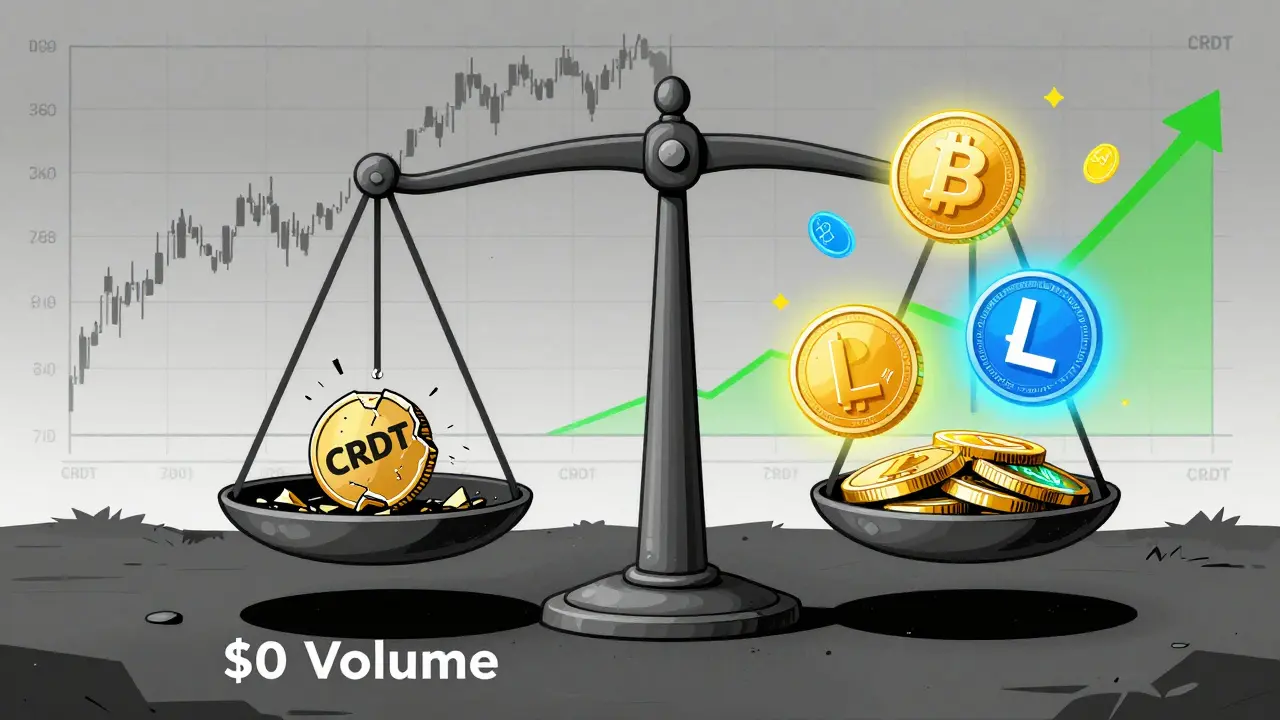
If you try to find CRDT on a charting platform today, you will notice something alarming: the price line is flat, and the volume bars are non-existent. According to data from multiple aggregators like CoinLore and CryptoSlate, the 24-hour trading volume for CRDT is consistently reported as $0. This is not a temporary dip; it is a structural lack of liquidity.
Liquidity is the lifeblood of any cryptocurrency. Without buyers and sellers actively trading the asset, you cannot easily convert your tokens back into fiat currency or other stablecoins. For CRDT, this means that even if you managed to acquire tokens, selling them would be nearly impossible without crashing the price entirely due to the thin order book-or rather, the complete absence of one.
Let’s look at the numbers. The market capitalization hovers around a microscopic $1,200 to $2,400 depending on the slight variations in price feeds across different trackers. Compare this to established payment-focused cryptocurrencies like Ripple (XRP), which boasts a market cap exceeding $28 billion and processes billions in daily volume. CRDT sits in the bottom 0.5% of all tracked cryptocurrencies by activity. Its ranking often fluctuates between #3,000 and #6,000, placing it firmly in the category of "zombie coins"-tokens that still exist on the blockchain but have no active community or economic function.
The all-time high (ATH) tells another part of the story. Sources vary slightly, with some reporting an ATH of $0.15 in September 2020 and others citing $0.40. Regardless of the exact peak, the current price of approximately $0.0002 represents a decline of over 99%. This massive drawdown reflects the total erosion of investor confidence and the failure of the project to deliver on its initial promises.
Red Flags: Why Experts Warn Against CRDT
When analyzing obscure tokens, it helps to look at the metrics that professional analysts use to identify risk. Dr. David Gerard, a well-known critic of speculative crypto assets, has noted in interviews that tokens with zero exchange volume and micro-market caps serve no legitimate purpose and are often either dead projects or deliberate confidence tricks. CRDT fits this description precisely.
Here are three critical red flags associated with CRDT:
- Low Circulating Supply Ratio: Only about 2.93% of the total supply is in circulation. This means that over 97% of the tokens are held by insiders, developers, or locked in vesting contracts. In the crypto world, this creates a massive overhang. If these holders decide to sell, the price would collapse instantly because there are no buyers to absorb the shock. The Blockchain Transparency Institute identifies tokens with less than 5% circulation as high-risk for potential dumps.
- No Exchange Listings: Major platforms like Binance, Coinbase, and Kraken explicitly state they do not list CRDT. Being delisted or never listed from major venues is a strong signal that the project failed to meet basic security, legal, or quality standards required for institutional-grade trading.
- Abandoned Development: A quick check of social media channels reveals no updates since 2021. There is no active GitHub repository showing recent code commits, no new blog posts, and no community engagement on Reddit or Twitter. In the fast-moving world of blockchain, silence for three years usually means the project is dead.
User feedback mirrors these technical concerns. On forums like Reddit, users who attempted to find the promised wallet app report that it is nowhere to be found on official app stores. One user noted, "Their website is just marketing fluff with no technical documentation." This disconnect between the promised product and the actual delivery is a hallmark of abandoned projects.
Comparison with Legitimate Payment Tokens
To put CRDT’s shortcomings into perspective, let’s compare it with tokens that actually function as payment solutions. Projects like Stellar (XLM) and Litecoin (LTC) were built with similar goals: fast, cheap transactions for everyday use.
| Feature | CRDT | Stellar (XLM) | Litecoin (LTC) |
|---|---|---|---|
| Market Cap | ~$2,000 | ~$3 Billion+ | ~$6 Billion+ |
| 24h Volume | $0 | $100 Million+ | $200 Million+ |
| Exchange Listings | None | Major Global Exchanges | Major Global Exchanges |
| Transaction Speed | Dependent on Ethereum (Slow/Expensive) | 3-5 seconds | 2.5 minutes |
| Active Development | Dormant since 2021 | Active Foundation | Active Community |
| Real-World Usage | None Verified | Remittances, Payments | P2P Payments, Merchant Acceptance |
Notice the disparity. Stellar processes thousands of transactions per second with sub-cent fees, supported by a dedicated foundation and a vast network of partners. Litecoin has been running reliably for over a decade, accepted by thousands of merchants worldwide. CRDT, by contrast, relies on the Ethereum network, which can become congested and expensive during peak times, yet offers no unique advantage to justify those costs. More importantly, it lacks the infrastructure to process payments independently.
Can You Buy or Use CRDT Today?
If you are determined to interact with CRDT despite the warnings, here is what you need to know about acquisition and usage.
Buying CRDT: You cannot buy CRDT on centralized exchanges like Coinbase or Binance. Your only theoretical option would be through a decentralized exchange (DEX) like Uniswap, provided there is a liquidity pool. However, given the $0 trading volume reports, it is highly likely that any existing pools are dry or manipulated. Attempting to swap ETH for CRDT on a DEX could result in extreme slippage, meaning you would send a significant amount of Ethereum and receive very few CRDT tokens in return, if any transaction goes through at all.
Using CRDT: The core value proposition of CRDT was its payment card and wallet. As of late 2023 and into 2024, there is no evidence that this system works. Searching for "CRDT Wallet" in the Apple App Store or Google Play Store yields no results from the official developer. Without a functional wallet, you cannot store, manage, or spend the tokens securely. Any third-party wallets claiming to support CRDT may pose security risks, as the project has no active maintenance team to patch vulnerabilities.
Security Warning: Be extremely cautious of any websites or Telegram groups offering to sell CRDT directly or promising high returns. These are likely phishing scams designed to steal your Ethereum or personal information. Always verify contract addresses on Etherscan before interacting with any token.
Future Outlook: Is There Hope for a Revival?
In the rare case of a crypto zombie making a comeback, certain signals usually precede the revival: renewed social media activity, new whitepaper updates, or announcements of partnership deals. For CRDT, none of these signs are present. Delphi Digital’s market structure reports indicate that tokens with sustained zero volume for over 12 months have a 98.7% probability of permanent abandonment.
Furthermore, the regulatory landscape has tightened significantly since 2020. The Financial Action Task Force (FATF) now requires strict compliance measures for virtual asset service providers. A project like CRDT, which claimed to offer banking services, would need robust KYC/AML procedures and licensing to operate legally. There is no indication that the CRDT team has pursued these necessary steps.
From an investment perspective, allocating capital to CRDT offers no upside potential proportional to the risk. The fully diluted valuation (FDV) is negligible, and the lack of liquidity means you cannot exit your position. In the broader context of the $1.2 trillion cryptocurrency market, CRDT represents noise rather than signal.
Alternatives for Content Rewards and Payments
If you are interested in the concepts that CRDT originally pitched-rewarding content creators or using crypto for everyday payments-there are vibrant, active ecosystems that deliver on these promises.
- For Content Creators: Platforms like Mirror.xyz and Steemit (Hive) allow writers and artists to monetize their work directly through blockchain-based tipping and NFTs. These platforms have active communities and transparent reward mechanisms.
- For Everyday Payments: Stablecoins like USDC and USDT are widely accepted for online purchases and peer-to-peer transfers. They offer the speed of crypto without the volatility, backed by reserves of fiat currency.
- For Low-Fee Transactions: Networks like Solana and Polygon provide the infrastructure for fast, cheap payments, supporting numerous dApps that facilitate real-world commerce.
These alternatives offer the utility CRDT promised, but with the backing of active development teams, substantial liquidity, and real-world adoption.
Is CRDT a scam?
While labeling a project a "scam" requires legal determination, CRDT exhibits many characteristics of abandoned or fraudulent schemes. These include zero trading volume, no functional product despite years passing, inactive social media, and a token distribution heavily skewed toward insiders. Experts warn that such tokens carry extreme risk and should be avoided.
Where can I buy CRDT tokens?
You cannot buy CRDT on major centralized exchanges like Binance, Coinbase, or Kraken. Theoretically, it might be available on decentralized exchanges (DEXs) like Uniswap, but due to zero liquidity, executing a trade is practically impossible and highly risky due to potential slippage and hidden fees.
Does the CRDT payment card still work?
No. There is no evidence that the CRDT payment card or wallet application exists or functions. Searches on major app stores yield no results, and user reports confirm the absence of any working software related to the project.
Why is the CRDT price so low?
The price is low because the project has lost all market relevance. With no active development, no users, and no exchange listings, there is no demand for the token. The price reflects the consensus that the project is dormant and holds little to no intrinsic value.
Is it safe to hold CRDT tokens?
Holding CRDT carries significant risk. Since the project appears abandoned, there is no chance of recovery or future utility. Additionally, storing obscure tokens can expose your wallet to potential security vulnerabilities if the underlying smart contract contains unpatched bugs. Most financial advisors recommend avoiding such assets entirely.
Comments (5)

- mark valmart
- June 1, 2026 AT 16:29 PM
just another dead coin, honestly.
save your time and money.

- Hadleigh Edwards
- June 2, 2026 AT 23:56 PM
I have to say that I found this entire analysis to be incredibly thorough and quite illuminating regarding the current state of affairs for what was once touted as a revolutionary banking solution in the crypto space. It is truly fascinating to observe how quickly the landscape shifts from high-flying promises of complete ecosystem integration with merchant payments and content creator rewards down to the stark reality of zero trading volume and a complete absence of any functional product or active development team. The fact that the circulating supply is merely a tiny fraction of the total issuance really highlights the predatory nature of such token distributions where insiders hold the vast majority of assets while retail investors are left holding bags of essentially worthless digital tokens that cannot even be easily liquidated on major exchanges due to the lack of liquidity pools and exchange listings. One can only imagine the frustration felt by those early adopters who believed in the vision of a seamless payment card system integrated with blockchain technology only to find themselves staring at a flatlined chart and an abandoned website that offers nothing but marketing fluff without any technical documentation or working applications available on official app stores. It serves as a potent reminder for all of us in the community to always conduct our own due diligence and look beyond the glossy whitepapers and enthusiastic social media posts to verify the actual on-chain activity, developer commits, and real-world utility before committing any capital to such ventures. The comparison with established players like Stellar and Litecoin really puts things into perspective because those projects have spent years building out robust infrastructure, securing partnerships, and maintaining active communities whereas CRDT seems to have vanished into thin air shortly after its initial launch without ever delivering on its core value proposition. I suppose there is a certain poetic justice in seeing these zombie coins remain on the ledger as a testament to the speculative excesses of the past cycle, but it is also a cautionary tale about the importance of regulatory compliance and sustainable business models in an industry that is increasingly being scrutinized by authorities around the world. Perhaps the most valuable takeaway here is the identification of viable alternatives for those interested in similar use cases, such as platforms that actually reward content creators through transparent mechanisms or stablecoins that provide the stability needed for everyday transactions without the extreme volatility associated with obscure utility tokens. It is encouraging to see that despite the failures of projects like CRDT, the underlying technology continues to evolve and offer genuine solutions to real-world problems when implemented by teams that prioritize execution over hype and maintain consistent engagement with their user base. So while we may shake our heads at the demise of yet another ambitious but ill-fated cryptocurrency project, we should also take heart in the progress being made by legitimate initiatives that are steadily gaining traction and adoption across various sectors of the global economy. Ultimately, the resilience of the blockchain ecosystem lies in its ability to filter out noise and signal, allowing innovative ideas to flourish while discarding those that fail to deliver tangible value to their stakeholders.

- Bill Gunn
- June 3, 2026 AT 20:32 PM
Hey folks! 👋 Just wanted to chime in with a bit of extra context since I’ve been tracking these 'zombie' ERC-20s for a while now. 🕵️♂️
The contract address mentioned (0xDaab...) is definitely live on Etherscan, but if you dig into the transaction history, you’ll mostly see transfers between wallets that look like they’re just shuffling dust around rather than actual trades. 📉
A big red flag people often miss is the 'Pre-mined/Fixed Supply' aspect combined with that tiny circulating percentage. In my experience, when devs hold >95% of the supply and there’s no vesting schedule publicly audited, it’s usually a trapdoor waiting to happen. 💣 They can dump whenever they want, and since there’s no liquidity pool on Uniswap anymore, you literally can’t sell even if you wanted to.
For anyone looking for that 'creator reward' vibe, check out Mirror.xyz or maybe some Hive-based apps. They actually work! ✨ Don’t let the shiny promise of a 'crypto Visa card' blind you to the basic math of liquidity. Stay safe out there! 🛡️🚀

- Joshua Alcover
- June 5, 2026 AT 16:57 PM
The epistemological failure inherent in the CRDT paradigm exemplifies the broader ontological crisis within decentralized financial architectures that lack sovereign backing or tangible asset correlation. To engage with such a construct is to participate in a simulacrum of value, devoid of referential integrity in the material world. The assertion of 'utility' in the absence of exchange-listed liquidity constitutes a logical fallacy of the highest order, rendering the token not merely dormant, but semantically void. One must question the very foundations of trust placed in anonymous entities promising banking solutions without regulatory oversight, thereby exposing the participant to existential risk within a chaotic market structure. This is not merely a bad investment; it is a philosophical error in the attribution of worth to code without consensus. The silence of the developers is not a pause; it is the finality of abandonment, a nihilistic endpoint to the speculative narrative. We must reject these pseudo-innovations that masquerade as technological advancements while serving only to extract wealth from the unwary through complex obfuscation. The true nature of CRDT is revealed not in its whitepaper, but in its null volume-a zero that echoes the emptiness of its promise. To continue to discuss it as anything other than a failed experiment is to ignore the empirical data that dictates its irrelevance. Let this serve as a warning against the seduction of jargon-heavy marketing that lacks substantive implementation. The market has spoken, and its voice is one of absolute rejection. Any further engagement with this asset class is a betrayal of rational economic principles and a surrender to irrational exuberance. We must demand transparency, accountability, and verifiable utility, or we risk the collapse of the entire ideological framework upon which these speculative ventures are built. The CRDT case study is thus a critical juncture in understanding the limits of decentralized autonomy when divorced from real-world anchoring. It stands as a monument to hubris, a digital ruin in the desert of forgotten tokens. Do not mistake existence on a ledger for viability. The distinction is paramount, and the consequences of confusion are severe. One must navigate these waters with extreme caution, armed with rigorous analysis and a skepticism that refuses to be placated by superficial claims of innovation. The reality is stark, unyielding, and indifferent to the hopes of those who sought refuge in its hollow promises.

- Joe Clements
- June 8, 2026 AT 03:28 AM
Thanks for sharing this detailed breakdown. It really helps to understand why certain coins disappear. I know how confusing it can be when you hear about new tech and want to get involved, but it is good to have clear warnings like this. Hopefully, everyone stays safe and finds better options for their investments. It is great to see people looking out for each other in these threads.