
Have you ever tried to move tokens from Ethereum to Solana or Bitcoin and felt like you were playing a dangerous game of hot potato? You bridge the assets, wait for confirmations, hope the network doesn’t crash, and pray you didn’t pick the wrong route. That anxiety is exactly what Rubic was built to solve.
Rubic isn’t your typical centralized exchange where you deposit funds into their custody. Instead, it’s a decentralized finance (DeFi) aggregator that acts as a router for your crypto. Think of it as Skyscanner but for blockchain transactions. It scans dozens of liquidity sources across different networks to find you the best price with the least friction. If you are tired of fragmented liquidity and complex bridging processes, Rubic might be the tool you need. But before you connect your wallet, let’s break down how it works, whether it’s safe, and if it actually saves you money.
What Exactly Is Rubic?
To understand Rubic, you first have to unlearn the idea of a traditional exchange. When you use Binance or Coinbase, you trade against their order book. With Rubic, you are trading directly on-chain, but Rubic handles the complexity behind the scenes.
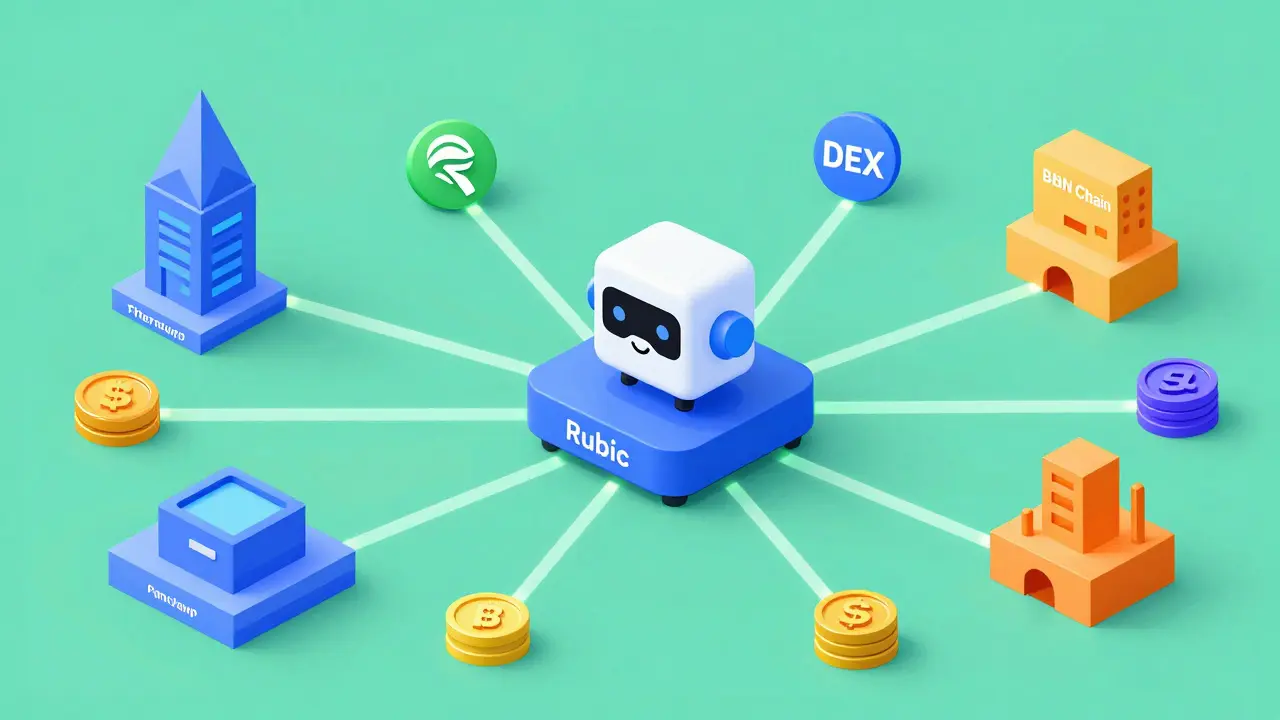
Rubic is a multichain decentralized exchange (DEX) aggregator and cross-chain routing protocol. Its primary job is to execute swaps between tokens on different blockchains without requiring you to manually bridge assets. For example, if you want to swap Bitcoin (BTC) for an Ethereum-based token, Rubic will automatically split the transaction, bridge the BTC to an Ethereum-compatible format, and then swap it on an Ethereum DEX-all in one click.
The platform operates on three core technical pillars:
- External API Providers: These are the data feeds that tell Rubic what prices are available on various exchanges.
- RPC Node: This facilitates communication with the underlying blockchain networks to ensure transactions are broadcast correctly.
- Cross-Chain Manager: This is the brain of the operation. It queries APIs, calculates the most efficient route, and initiates the smart contracts needed to move your assets securely.
This architecture allows Rubic to support major networks including Bitcoin, Ethereum, Arbitrum, BNB Chain, and many others. The goal is simple: make DeFi operations fast, easy, and inexpensive.
How Rubic Works: The Aggregation Advantage
The biggest advantage of using an aggregator like Rubic is liquidity depth. Single-chain DEXs like Uniswap (on Ethereum) or PancakeSwap (on BNB Chain) only see the liquidity within their own ecosystem. If you try to swap a large amount of tokens on Uniswap alone, you might suffer from high slippage-meaning you get fewer tokens than expected because the pool runs out of balance.
Rubic solves this by drawing from multiple prominent DEXs simultaneously. On the EVM (Ethereum Virtual Machine) ecosystem, for instance, Rubic integrates with providers like 1inch, OpenOcean, ODOS, and XY Finance. When you initiate a swap, Rubic’s algorithm splits your order across these platforms to secure the best average price.
Here is why this matters for you:
- Better Prices: By accessing more liquidity, Rubic often finds better rates than any single DEX could offer.
- Reduced Slippage: Large orders are handled more efficiently, minimizing the loss of value during the trade.
- Cross-Chain Simplicity: You don’t need to manage multiple bridges. Rubic handles the inter-network communication.
For users who frequently move assets between chains, this automation saves significant time and reduces the risk of user error-a common cause of lost funds in DeFi.
Security Audit and Safety Concerns
In the world of crypto, "trustless" doesn’t mean "risk-free." Smart contract vulnerabilities are still the leading cause of hacks. So, how secure is Rubic?
Rubic has taken security seriously from the start. Both their multichain contracts and staking contracts have been fully audited by third-party firms. This is a critical distinction. Many newer DeFi projects skip rigorous audits to save costs, leaving users exposed. Rubic’s approach aligns with industry standards for established protocols.
However, there are inherent risks in cross-chain transactions that no audit can completely eliminate:
- Bridge Risks: Cross-chain swaps rely on bridges to move assets between networks. Bridges have historically been targets for hackers. While Rubic uses secure smart contracts to manage this process, you are still relying on the integrity of the underlying bridge infrastructure.
- Smart Contract Complexity: More complex code means more potential points of failure. While audited, no system is 100% immune to zero-day exploits.
- Phishing Attacks: Because Rubic connects directly to your wallet, always ensure you are on the official website (
rubic.exchange). Scammers often create fake sites that look identical to legitimate DeFi platforms.
A key safety feature for privacy-focused users is that Rubic does not require KYC (Know Your Customer) verification. As noted in recent reviews, you can conduct transactions without providing personal identification documents. This enhances accessibility but also means you have less recourse if something goes wrong compared to a regulated centralized exchange.
User Experience and Wallet Integration
If you’ve struggled with clunky DeFi interfaces, Rubic aims to be smoother. The platform features a widget that supports connection with multiple popular wallets, including MetaMask, Phantom, and Coinbase Wallet.
The process is straightforward:
- Connect your wallet.
- Select the token you want to sell and the token you want to receive.
- Rubic automatically detects the networks and suggests the optimal route.
- Confirm the transaction in your wallet.
The learning curve is minimal. Unlike manual bridging, where you must fund specific chains with native gas tokens (like ETH for Ethereum or MATIC for Polygon), Rubic often handles the gas fee optimization internally or guides you through necessary steps clearly. Additionally, the Crypto Tap feature allows direct purchases of certain assets like MATIC or BNB, reducing the barrier to entry for new users who might not yet hold those specific tokens.
One standout feature for developers and projects is the Rubic Relay widget. This allows other websites to integrate Rubic’s trading capabilities directly into their own platforms. If you’ve used a service that offered seamless crypto payments, there’s a chance they’re using Rubic under the hood.
Fees and Costs
DeFi is rarely free. You’ll encounter two main types of fees when using Rubic:
1. Network Gas Fees
These are paid to the blockchain validators, not to Rubic. If you’re swapping on Ethereum, expect higher gas fees, especially during network congestion. Swapping on Layer 2 solutions like Arbitrum or Optimism will be significantly cheaper. Rubic helps optimize routes to minimize unnecessary gas spend, but you cannot control the base network cost.
2. Service Fees
Rubic charges a small service fee for its aggregation and routing services. This fee is typically lower than the slippage you would incur if you traded on a single DEX with limited liquidity. However, for very small trades, the fixed gas costs might outweigh the benefits of aggregation. Always check the estimated output before confirming.
There is also the RBC Token. Holding RBC can sometimes provide fee discounts or access to exclusive features within the ecosystem, though the primary utility is governance and staking rewards. Whether buying RBC is worth it depends on your long-term belief in the project’s growth.
| Feature | Rubic | Uniswap / PancakeSwap |
|---|---|---|
| Cross-Chain Support | Yes (Native) | No (Requires separate bridge) |
| Liquidity Sources | Multiple DEXs Aggregated | Single Pool |
| KYC Required | No | No |
| Best For | Cross-chain swaps, complex routes | Simple single-chain swaps |
| Slippage Control | High (via splitting orders) | Medium (depends on pool size) |

Is Rubic Right for You?
Rubic excels in specific scenarios. If you are a DeFi power user who constantly moves assets between Ethereum, BSC, Polygon, and Solana, Rubic saves you hours of manual bridging and hunting for the best rates. It is particularly useful for executing larger trades where slippage on a single DEX would eat into your profits.
However, it may not be the best choice if:
- You only trade on one chain: If you stick exclusively to Ethereum, using Uniswap directly might be simpler and slightly cheaper since you avoid Rubic’s service layer.
- You are trading obscure tokens: Rubic relies on aggregated liquidity. For highly illiquid or new meme coins, you might find better execution on specialized niche DEXs.
- You prefer centralization: If you want customer support, chargebacks, or fiat on-ramps integrated seamlessly, a centralized exchange like Coinbase is still easier, albeit less private.
The platform’s main hurdle remains adoption. In a crowded market filled with competitors like Thorchain and Synapse Protocol, Rubic needs to continue proving its reliability and speed. Its steady growth in transaction volume-reaching nearly $210 million in early metrics-shows promise, but competition is fierce.
Final Thoughts
Rubic represents a mature step forward in DeFi usability. By abstracting away the complexity of cross-chain interactions, it makes the multi-chain future accessible to everyday users. The lack of KYC requirements appeals to privacy advocates, while the robust security audits provide a baseline of trust.
Just remember: you are interacting with smart contracts. Never share your seed phrase, always verify URLs, and start with small test transactions if you are new to the platform. DeFi offers freedom, but it also demands responsibility. Rubic gives you the tools; you bring the caution.
Is Rubic a centralized or decentralized exchange?
Rubic is a decentralized exchange (DEX) aggregator. It does not hold your funds. Instead, it routes your transactions across various decentralized protocols and bridges to execute swaps non-custodially.
Do I need to complete KYC to use Rubic?
No, Rubic does not require Know Your Customer (KYC) verification. You can connect your wallet and trade anonymously without submitting personal identification documents.
Which wallets are compatible with Rubic?
Rubic supports major Web3 wallets including MetaMask, Phantom, Coinbase Wallet, and Trust Wallet. This ensures compatibility with both EVM-based chains and Solana.
How does Rubic reduce slippage?
Rubic aggregates liquidity from multiple DEXs (like 1inch, OpenOcean, and others). By splitting large orders across several pools, it minimizes price impact and reduces slippage compared to trading on a single exchange.
Is Rubic safe to use in 2026?
Rubic has undergone full smart contract audits, making it relatively secure compared to unaudited projects. However, as with all DeFi platforms, users face risks related to smart contract vulnerabilities and bridge security. Always use the official website and never share your private keys.
Comments (8)

- Mike S
- May 10, 2026 AT 21:18 PM
Oh look, another aggregator trying to sell us the dream of 'easy' DeFi while hiding the fact that you're just trusting a middleman smart contract with your life savings.
I've been in crypto since 2017 and I can tell you right now, Rubic isn't magic. It's just wrapping up bridge risks in pretty UI packaging so normies don't realize they're still exposed to every single exploit vector in the cross-chain ecosystem. You think splitting your order across Uniswap and PancakeSwap makes it safer? Please. If the bridge gets hacked, your funds are gone regardless of how 'optimized' your route was.
And don't get me started on the gas fees. The article claims it optimizes costs, but have you actually tried swapping during peak ETH congestion? You'll pay more in gas than the slippage you saved. It's a classic case of solving a problem most people don't have by creating new ones for those who do. Stick to native DEXs if you want actual control.

- robert Whitehead
- May 12, 2026 AT 05:42 AM
The real issue here is that people like Mike above are too lazy to read the documentation before complaining about tools they clearly don't understand.
Rubic doesn't hold custody. That's the entire point. You are interacting directly with the underlying protocols via their router. If you're worried about bridge hacks, you should be worried about *every* cross-chain transaction you make, not just the ones routed through an aggregator. The alternative is manually bridging yourself, which has historically resulted in far more user error and lost funds due to sending tokens to the wrong address or chain.
Also, claiming it's only for 'normies' is ridiculous. Institutional traders use aggregators all the time because liquidity fragmentation is a real mathematical problem. If you're trading large volumes on a single pool, you're getting wrecked by slippage. Rubic splits orders to mitigate exactly that. It's basic market microstructure 101. Grow up and learn how liquidity works before dismissing established protocols.

- H F
- May 14, 2026 AT 00:44 AM
I have to say, Robert has a point about the slippage aspect! 🌟
I’ve been using Rubic for my smaller cross-chain moves between Arbitrum and BSC and honestly, the UX is miles ahead of doing it manually. I used to spend twenty minutes checking bridges and rates, and now it’s literally one click. Sure, there are risks with any DeFi tool, but the convenience factor is huge for someone like me who isn’t a full-time trader.
That said, I agree with Mike that you shouldn’t dump your entire portfolio into one swap. Start small. Test the waters. But for everyday utility, it’s been a solid experience for me so far!

- Michael Berggren
- May 15, 2026 AT 23:44 PM
Great points everyone! 🙌
I think the key takeaway is that Rubic is a tool, not a solution to all crypto problems. As H F mentioned, the UX improvement is significant. I’ve found that for moving stablecoins across chains, it’s incredibly efficient.
However, I always recommend checking the estimated output carefully. Sometimes the 'best route' includes obscure pools that might have hidden risks. Also, keep an eye on the RBC token utility-it’s often overlooked but holding it can reduce fees over time. Just remember: YMMV (Your Mileage May Vary) in DeFi! 😊

- Kiran CS
- May 17, 2026 AT 13:27 PM
How utterly pedestrian this discussion has become. To suggest that a mere aggregation protocol requires such exhaustive scrutiny is to misunderstand the very nature of decentralized finance.
One must appreciate the elegance of the architecture. The Cross-Chain Manager is not simply a 'router'; it is a sophisticated algorithmic entity that navigates the labyrinthine complexities of multi-chain liquidity with a precision that manual intervention simply cannot match. To dismiss it as 'pretty UI packaging' is the equivalent of calling a symphony 'noise'.
Furthermore, the notion that institutional traders do not utilize such tools is laughable. They require efficiency, and Rubic provides precisely that. For those of us who value our time and intellectual capital, the abstraction of complexity is not a bug; it is the ultimate feature.

- Bijan Das
- May 19, 2026 AT 05:14 AM
Kiran, please stop pretending you’re smarter than everyone else. Nobody cares about your 'symphony' analogy.
Look, I tried Rubic last week. It was fine. Not amazing, not terrible. Just... okay. Why do we need these long essays about it? Just tell us if it works or not. It worked for me when I moved some USDC to Solana. Took like two minutes. Done.
But yeah, don’t trust it with your whole net worth. Crypto is wild west. Always check your wallet connection. And stop acting like you invented cross-chain swaps.

- Ashley Rodriguez
- May 20, 2026 AT 05:00 AM
i really liked reading this post because i was confused about how rubic works compared to regular exchanges like binance. it seems like a lot easier to use if you already have a metamask wallet set up. i tried swapping eth for arb and it was pretty quick. i didn’t notice any huge fees either. maybe i got lucky with the network being quiet but it felt smooth. i hope they keep improving the interface because sometimes the popups are a bit confusing for beginners like me. overall though i think it’s a good option for people who want to stay in defi without dealing with multiple bridges.

- Bridget Coogle
- May 20, 2026 AT 22:29 PM
Ashley, totally hear you on the confusion! DeFi interfaces can be tricky at first.
Just remember to double-check the URL before connecting your wallet. Scammers love cloning these sites. Once you’re on the real site, it’s pretty straightforward. I find that starting with small amounts helps build confidence. No rush! Take your time to explore the features. It’s great that you’re diving into cross-chain swaps-it’s the future of crypto accessibility! 💖