
Imagine executing a trade in 72 microseconds. That is faster than the blink of an eye, and it is the promise behind One Trading, a European cryptocurrency exchange that combines ultra-fast execution with strict EU regulatory compliance. If you are based in Europe and tired of wondering whether your chosen platform will survive the next regulatory crackdown, this might be the venue you have been looking for. But speed and legality do not always equal ease of use or low costs for everyone.
This review breaks down what One Trading actually offers, who it serves, and where it falls short compared to giants like Binance or Coinbase. We are looking at real numbers, specific fee structures, and the practical implications of its dual-license status. Whether you are an institutional trader seeking compliant derivatives exposure or a retail investor curious about high-speed spot trading, here is what you need to know before depositing funds.
The Regulatory Edge: Why Licensing Matters
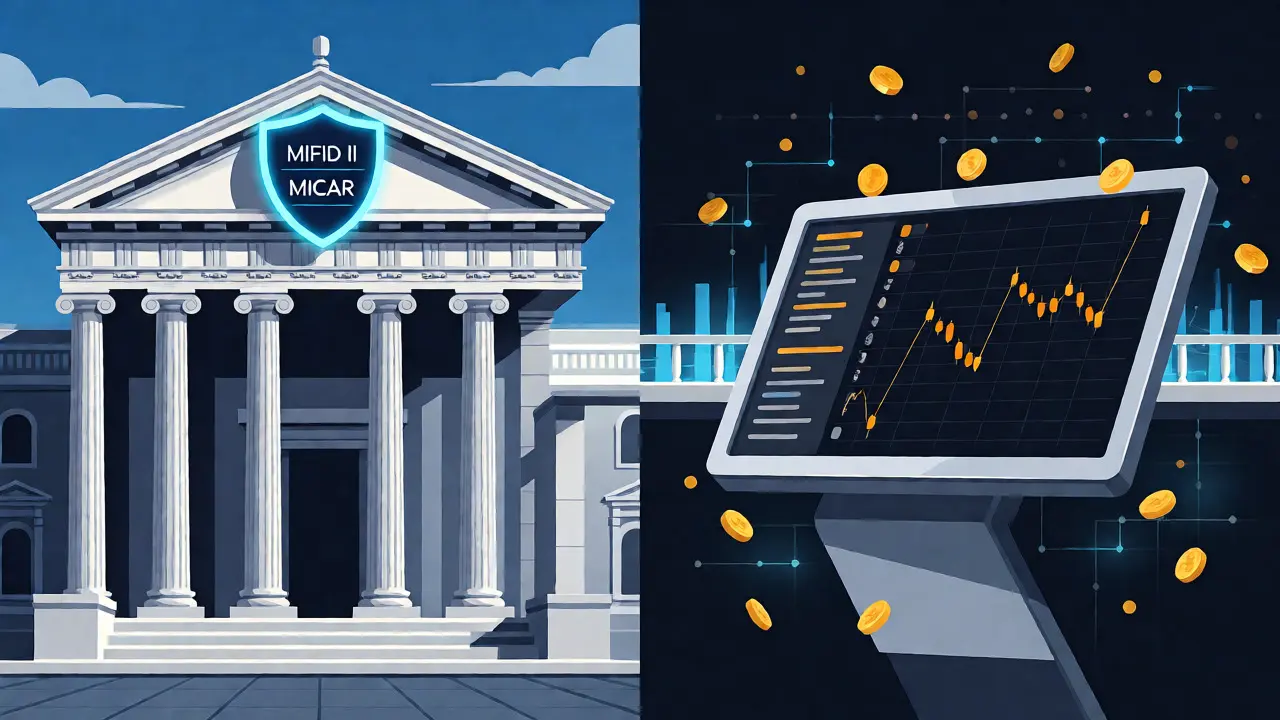
Most crypto exchanges operate in gray areas. They register somewhere obscure and hope regulators do not notice. One Trading takes the opposite approach. The platform operates under two major European frameworks: MiFID II (Markets in Financial Instruments Directive) and MiCAR (Markets in Crypto-Assets Regulation).
What does this mean for you? It means One Trading holds an Organised Trading Facility (OTF) license for derivatives and a Crypto-Asset Service Provider (CASP) license for spot assets. This makes it one of the first fully regulated venues for crypto perpetual futures in the EU. For institutional clients, this is non-negotiable. Banks and hedge funds cannot legally trade on unregulated offshore exchanges due to internal compliance mandates. One Trading solves that problem by providing a paper trail that satisfies auditors.
However, this regulatory rigor comes with friction. You cannot just sign up with an email. The onboarding process requires thorough identity verification and, for derivatives trading, suitability assessments. These are checks mandated by EU law to ensure you understand the risks of leverage. If you want a "no-KYC" experience, this platform is not for you. If you want to sleep well knowing your counterparty is licensed in Amsterdam, this is exactly where you want to be.
Speed and Technology: The 72-Microsecond Claim
One Trading markets itself as "the fastest venue in the world." Their technical specifications claim round-trip execution times of 72 microseconds. To put that in perspective, typical retail exchanges often take milliseconds (thousands of times slower). For high-frequency traders and algorithmic strategies, latency is everything. A delay of even one millisecond can turn a profitable arbitrage opportunity into a loss.
The platform supports comprehensive order types, including market, limit, advanced limit, and stop-limit orders. This depth is essential for professional traders who need precise entry and exit points. Additionally, the integration with TradingView charts provides nine timeframes, seven chart styles, and dozens of technical indicators. While testing revealed minor customization issues, the core functionality remains robust for technical analysis.
For those who prefer simplicity over complexity, there is the "Instant Trade" feature. This interface allows for immediate swaps between crypto-to-fiat and crypto-to-crypto pairs across more than 100 trading pairs. It strips away the order book view, offering a streamlined experience similar to a broker-dealer model rather than a peer-to-peer exchange.
Fees and Costs: The Hidden Spread
Here is where things get tricky. One Trading advertises 0% maker and taker fees for spot cryptocurrency trading. On the surface, this looks unbeatable compared to competitors charging 0.1% or more per transaction. But there is a catch: a 1% spread.
A spread is the difference between the buy price and the sell price. When you buy Bitcoin, you pay slightly above the market rate. When you sell, you receive slightly below. With a 1% spread, you start every trade with a 1% deficit. Unless the asset appreciates by more than 1%, you lose money on the round trip. Compare this to specialized exchanges like Interactive Brokers (0.12%-0.18% spread) or Dukascopy (0.1% spread), and One Trading’s cost structure appears significantly higher for active traders.
There is another barrier to entry: the €5,000 minimum order size for Instant Trade. This effectively locks out casual retail investors who want to test the waters with $100 or $500 trades. This threshold signals that One Trading is targeting well-capitalized individuals and institutions, not the average person buying their first fraction of a Bitcoin.
| Feature | One Trading | Typical Retail Exchange (e.g., Kraken/Binance) |
|---|---|---|
| Maker/Taker Fee (Spot) | 0% | 0.1% - 0.6% |
| Spread Cost | ~1.0% | 0.1% - 0.5% |
| Minimum Order Size | €5,000 (Instant Trade) | $10 - $50 |
| Regulatory Status | MiFID II + MiCAR Licensed | Varies (Often Unregulated) |
For perpetual futures, the platform offers leverage up to 10×. While they claim "ultra-low" fees, exact percentages are not publicly disclosed in all marketing materials, which is a red flag for transparency-focused traders. You will need to check the live fee schedule upon registration to see if the derivatives costs align with your strategy.
Supported Assets and Fiat Currencies
One Trading focuses heavily on the European market. It supports fiat deposits and withdrawals in Euro (EUR), Swiss Franc (CHF), and British Pound (GBP). Payment methods are tailored to these regions: SEPA transfers for EUR, SWIFT for CHF, and Faster Payments Service (FPS) for GBP. This localization is a significant advantage for European users who want to avoid the hassle and fees of currency conversion.
The platform lists over 100 trading pairs. While this is fewer than the thousands available on global giants like Binance, it covers the major assets likely used by institutional and serious retail traders. If you are looking for obscure altcoins or meme coins launched yesterday, you will likely find them elsewhere. One Trading prioritizes liquidity and stability over breadth.
User Experience and Support Quality
Does the platform feel good to use? User testimonials suggest yes. Feedback from the official website highlights intuitive interfaces and fast customer support. One user noted that support resolved an issue within an hour, while another praised the "incredibly fast" platform performance. However, these reviews come from a controlled environment. Independent platforms show limited feedback volume, partly because the user base is smaller and more niche.
A significant drawback highlighted by professional reviewers is the lack of educational resources. Unlike eToro or Coinbase, One Trading does not offer structured courses, webinars, or beginner guides. The learning curve is steep for newcomers. If you are new to crypto, you will need to rely on external resources to learn how to navigate the platform and understand the risks of leverage.
Additionally, there is no demo account. This is a critical omission for traders who want to test strategies without risking capital. You must fund your account to try the interface, which adds pressure when dealing with a €5,000 minimum threshold for certain features.
Security and Custody Solutions
Security is handled through Multi-Party Computation (MPC) technology. Unlike traditional cold storage, which can be slow to access, MPC allows for secure, distributed key management that balances security with accessibility. The platform offers free wallet services and maintains institutional-grade custody standards.
Data privacy is also addressed under GDPR, given its EU base. Users can request data deletion, and information is encrypted in transit. While no system is immune to breaches, the combination of MPC technology and regulatory oversight provides a strong security posture compared to many offshore exchanges that have suffered hacks in recent years.
Who Should Use One Trading?
One Trading is not for everyone. It is a specialized tool designed for a specific demographic.
- Institutional Traders: If you manage funds for a firm that requires MiFID II compliance, this is a top-tier choice. The legal clarity outweighs the higher spreads.
- High-Frequency Traders: The 72-microsecond execution speed is a genuine competitive advantage for algorithms that profit from tiny price discrepancies.
- European Residents: If you hold EUR, CHF, or GBP, the seamless fiat integration saves time and conversion fees.
Conversely, it is likely not suitable for:
- Casual Investors: The €5,000 minimum and 1% spread make small, frequent trades inefficient.
- Beginners: Lack of educational content and demo accounts creates a hostile environment for learning.
- Altcoin Hunters: The limited asset selection may frustrate those looking for early-stage projects.
Frequently Asked Questions
Is One Trading safe and regulated?
Yes, One Trading is highly regulated. It holds both a MiFID II OTF license and a MiCAR CASP license in the European Union. This dual authorization ensures strict adherence to financial standards, making it safer than many unregulated offshore exchanges. The company is incorporated in the Netherlands and uses Multi-Party Computation (MPC) for asset custody.
What are the fees on One Trading?
One Trading charges 0% maker and taker fees for spot trading but applies a ~1% spread. This spread represents the difference between buy and sell prices. There is also a €5,000 minimum order size for the Instant Trade feature. Derivatives fees are variable and should be checked on the platform directly.
Can I use One Trading if I am outside the EU?
Primarily, no. One Trading targets eligible retail and institutional clients across the EU. Its payment rails (SEPA, FPS) and regulatory framework are designed for European residents. Non-EU users may face difficulties with fiat deposits and compliance requirements.
Does One Trading offer a demo account?
No, One Trading does not currently offer a demo account. Traders must fund their accounts to test the platform's features and execution speeds. This can be a disadvantage for beginners who wish to practice without financial risk.
How fast is One Trading?
One Trading claims round-trip execution times of 72 microseconds, positioning it among the fastest venues globally. This speed is achieved through optimized infrastructure and direct market access technologies, benefiting high-frequency and algorithmic traders.