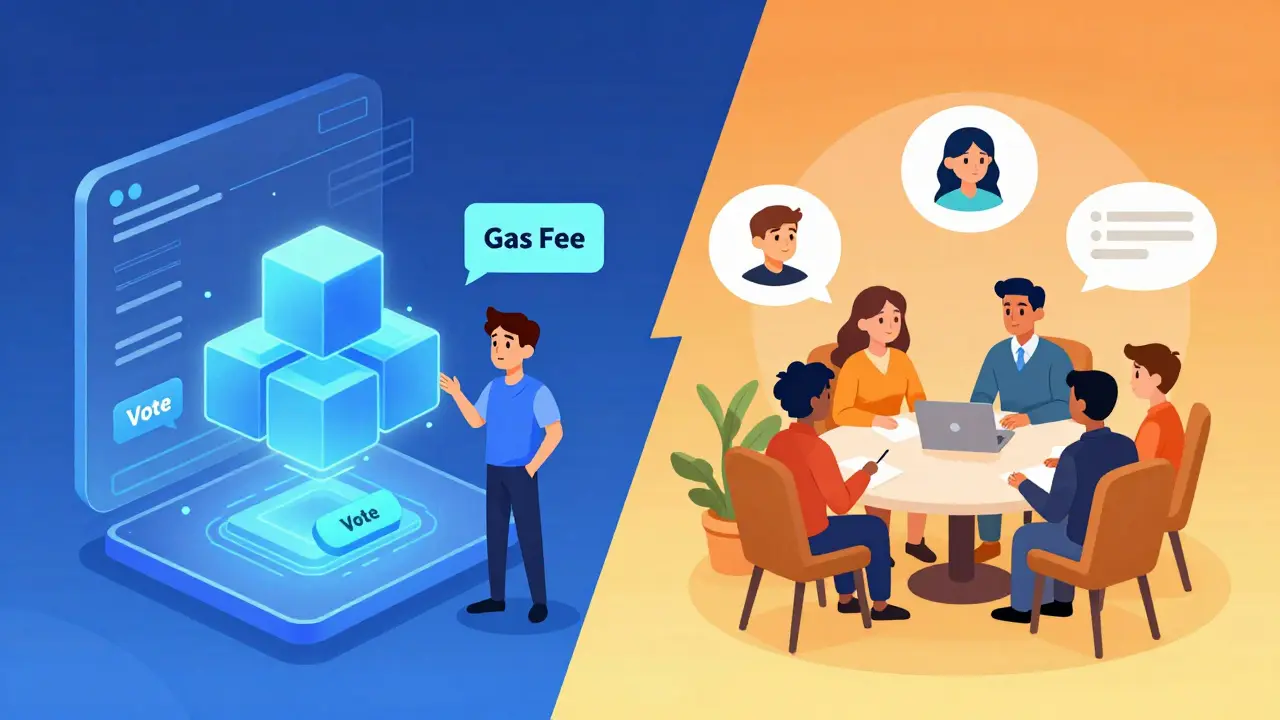

Imagine you are part of a decentralized organization. You hold tokens that give you a say in how the project evolves. A critical upgrade is proposed. Do you click a button to vote directly on the blockchain, paying a fee and locking your choice forever? Or do you join a forum discussion, debate the merits with other members, and let a representative cast the final vote on-chain? This is the core dilemma facing every modern DAO (Decentralized Autonomous Organization) today.
The way a blockchain network or DAO makes decisions defines its soul. It determines who holds power, how fast changes happen, and whether the system remains truly decentralized or slips into quiet centralization. In 2026, we have moved past the early hype of pure decentralization. We now understand that there is no perfect solution. Instead, there is a trade-off between security and efficiency, transparency and privacy, cost and control. Understanding the difference between on-chain governance and decision-making processes recorded directly on the blockchain ledger versus off-chain governance and decision-making processes conducted via external platforms like forums and chat apps is essential for any participant in the crypto ecosystem.
What Is On-Chain Governance?
On-chain governance is the gold standard for cryptographic trust. In this model, every step of the decision-making process happens on the blockchain itself. Proposals are submitted as transactions. Votes are cast by sending tokens or signing messages on-chain. And most importantly, the execution of the winning proposal is automated through smart contracts.
Think of it like a digital constitution that enforces itself. Once a majority votes "yes," the code executes automatically. No human can stop it. No developer can reverse it. This provides a level of immutability and security that traditional organizations cannot match. If a DAO decides to distribute funds to its treasury, the transaction happens instantly upon approval, without needing a bank or a lawyer.
The primary advantage here is trustlessness. You do not need to trust the developers, the founders, or even the majority of voters to act in good faith after the vote. The code ensures that only what was voted for gets executed. This prevents "rug pulls" where leaders promise one thing but do another. Projects like MakerDAO and Compound pioneered this approach, allowing token holders to adjust interest rates and collateral parameters directly through on-chain mechanisms.
However, this perfection comes at a steep price. Every vote requires a blockchain transaction. On networks like Ethereum, this means paying gas fees. If you want to vote on ten different proposals in a week, those fees add up quickly. For small token holders, the cost of voting might exceed the value of their stake, effectively silencing them. This creates a paradox: the system designed to be inclusive ends up favoring the wealthy whales who can afford the transaction costs.
What Is Off-Chain Governance?
Off-chain governance operates outside the blockchain ledger. Discussions happen on Discord, Telegram, or forums like Discourse. Voting might take place on web interfaces that record choices in a central database, or through lightweight signatures that don't require moving tokens on-chain. The final decision is then implemented by developers or a multisig wallet.
This model feels more familiar to anyone who has participated in open-source software development or community boards. It allows for nuanced debate. You can read comments, ask questions, and change your mind before the deadline. There are no gas fees. You can vote on hundreds of proposals for free. This lowers the barrier to entry significantly, encouraging broader participation from retail users who might be intimidated by wallet connections and transaction confirmations.
But here lies the danger: centralization risk. Because the voting data is stored off-chain, it relies on third-party infrastructure. If the forum goes down, or if the voting platform is hacked, the integrity of the decision is compromised. More critically, the link between the vote and the action is manual. Developers must interpret the will of the community and write the code to implement it. This introduces human error and potential bias. A developer could theoretically ignore a clear majority vote, claiming technical difficulties or misinterpretation.
We saw this fragility during the The DAO hack in 2016. Although The DAO had on-chain voting, the community's desire to recover stolen funds led to an off-chain consensus to hard fork Ethereum. This event highlighted that when stakes are high, communities often revert to off-chain social coordination to override on-chain rules. While effective in saving the network, it shattered the myth of absolute on-chain immutability.
Key Differences: Security, Cost, and Speed
To choose the right model, you need to compare them across three critical dimensions: security, cost, and speed. Let’s break down how they perform in real-world scenarios.
| Feature | On-Chain Governance | Off-Chain Governance |
|---|---|---|
| Security | High. Cryptographically secured. Immutable records. | Low to Medium. Relies on central servers. Vulnerable to censorship. |
| Cost | High. Gas fees for every vote and proposal. | Low. Free or negligible cost for participants. |
| Speed | Slow. Limited by block times and network congestion. | Fast. Instant updates on web interfaces. |
| Privacy | None. All votes are public and linked to wallet addresses. | Better. Can use anonymous accounts or private channels. |
| Execution | Automatic. Smart contracts enforce outcomes. | Manual. Requires developers or admins to act. |
Notice the trade-off. On-chain offers security and automatic execution but sacrifices cost and privacy. Off-chain offers speed and accessibility but sacrifices security and autonomy. Neither is inherently better; they serve different purposes. A protocol managing billions in assets needs the security of on-chain execution. A community deciding on the color scheme for its website does not.

The Rise of Hybrid Governance
In 2026, the most successful projects rarely choose one side. They adopt a hybrid governance model. This approach leverages the strengths of both systems while mitigating their weaknesses. The typical workflow looks like this:
- Discussion (Off-Chain): Ideas are proposed on forums. Community members debate, refine, and build consensus. This phase is free, fast, and encourages broad participation.
- Voting (Off-Chain or Light On-Chain): Preliminary votes may occur off-chain to gauge sentiment. Alternatively, projects use signature-based voting (like Snapshot) which is cheap and fast but not fully on-chain.
- Execution (On-Chain): Only the final, approved decisions are submitted on-chain. Smart contracts execute the changes automatically.
This model solves the gas fee problem for routine discussions while maintaining cryptographic security for critical actions. Platforms like Snapshot have become industry standards for this middle ground. They allow token holders to vote using cryptographic signatures without broadcasting transactions to the blockchain. The result is a verifiable record of intent, which is then used to trigger on-chain execution by a trusted executor or a timelock contract.
Consider Uniswap. Its governance process involves extensive off-chain discussion on its forums. Proposals are drafted and refined by community members. Once a proposal gains traction, it moves to an on-chain voting phase. However, even here, the complexity of DeFi protocols means that many parameter adjustments are handled by delegated representatives rather than direct voter input, blending delegation with hybrid execution.
Common Pitfalls to Avoid
Even with a hybrid model, governance can fail. Here are the most common traps that new DAOs fall into:
- Voter Apathy: Most token holders never vote. In purely on-chain systems, low turnout leads to low legitimacy. In off-chain systems, it leads to manipulation by coordinated groups. To combat this, some projects introduce quadratic voting or delegation mechanisms to amplify smaller voices.
- Whale Dominance: Large token holders can sway votes disproportionately. This undermines the democratic ideal. Solutions include vote escrow, where users lock tokens for longer periods to gain more voting power, or reputation-based systems that decouple voting rights from financial stake.
- Complexity Fatigue: If the governance process is too complicated, people disengage. Clear documentation, user-friendly interfaces, and educational resources are crucial. Don’t make users read whitepapers to cast a simple yes/no vote.
- Legal Ambiguity: As regulators in the US and EU tighten rules around securities and decentralized organizations, governance structures face legal scrutiny. Ensure your governance model complies with local laws, especially regarding tax implications of token rewards for participation.
Future Trends: Layer 2 and Zero-Knowledge Proofs
The landscape is evolving rapidly. Two technologies are set to reshape governance in the coming years: Layer 2 scaling solutions and zero-knowledge proofs.
Layer 2 networks like Arbitrum and Optimism drastically reduce gas fees. This makes on-chain voting affordable for everyone. Imagine casting a vote for $0.001 instead of $5. This democratizes access and encourages higher participation rates. Many new DAOs are launching exclusively on Layer 2 chains for this reason.
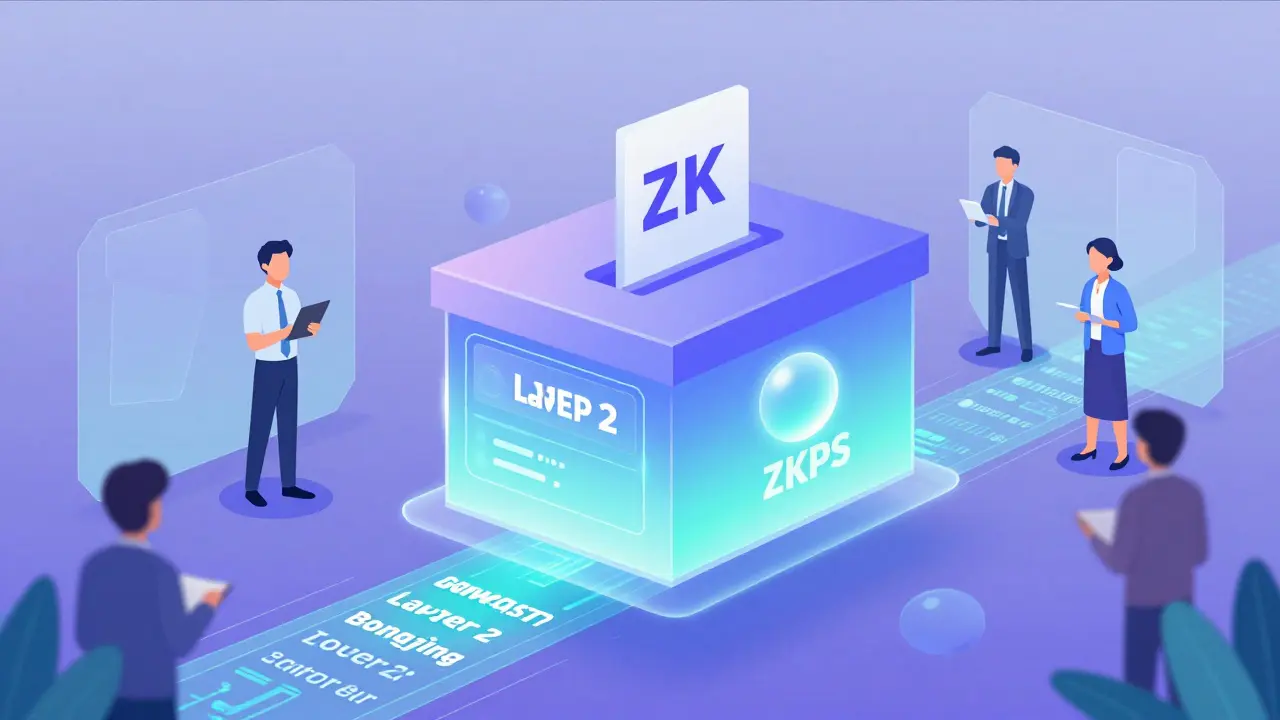
Zero-knowledge proofs (ZKPs) offer a breakthrough in privacy. They allow you to prove that you hold enough tokens to vote without revealing your identity or your specific vote choice until the tally is finalized. This protects voters from retaliation or bribery attempts, which are significant risks in transparent on-chain systems. ZKP-based governance could enable secret ballots in decentralized environments, bringing blockchain closer to traditional democratic ideals.
How to Choose the Right Model for Your Project
If you are building a DAO or joining one, ask yourself these questions:
- What is at stake? If millions of dollars are involved, prioritize on-chain execution for security. If it’s community content, off-chain is fine.
- Who are your users? Are they tech-savvy developers comfortable with wallets? Or are they general consumers? Tailor the interface accordingly.
- How frequent are decisions? Daily operational tweaks benefit from off-chain speed. Quarterly strategic shifts warrant on-chain rigor.
- Do you need privacy? If so, avoid pure on-chain voting. Use off-chain discussions and ZKP tools if available.
There is no one-size-fits-all answer. The best governance systems are adaptable. They start simple and evolve as the community grows. Monitor participation metrics. Listen to feedback. Be willing to pivot from off-chain to on-chain as your treasury grows and security becomes paramount.
Is on-chain governance always more secure than off-chain?
Generally, yes. On-chain governance benefits from the underlying blockchain's security, making votes immutable and tamper-proof. Off-chain governance relies on centralized servers or third-party platforms, which can be hacked, censored, or manipulated. However, on-chain smart contracts can also have bugs, so security depends on rigorous auditing regardless of the model.
Why do most DAOs use a hybrid governance model?
Hybrid models balance cost and security. Off-chain discussions and preliminary voting are free and fast, encouraging broad participation. On-chain execution ensures that final decisions are enforced automatically and securely. This avoids the high gas fees of pure on-chain voting while preventing the centralization risks of pure off-chain systems.
What is Snapshot, and how does it relate to off-chain governance?
Snapshot is a popular off-chain voting platform that uses cryptographic signatures instead of blockchain transactions. It allows token holders to vote for free and instantly, without paying gas fees. The results are verified on-chain later, providing a bridge between efficient off-chain discussion and secure on-chain execution.
Can zero-knowledge proofs improve blockchain governance?
Yes. ZKPs can enable private voting on public blockchains. Voters can prove they have the required tokens to vote without revealing their identity or their vote choice. This protects against voter intimidation and bribery, making on-chain governance more democratic and secure.
Which major projects use on-chain governance?
Major projects like MakerDAO, Compound, and Uniswap utilize on-chain elements for critical decisions. MakerDAO uses on-chain voting to adjust stability fees and collateral types. Compound allows token holders to vote on interest rate models. These projects often combine on-chain execution with off-chain discussion phases.

Comments (6)

- Kim Kay
- July 4, 2026 AT 19:06 PM
hey everyone, just wanted to share some thoughts on this since i've been watching dao structures evolve for a while now.
i think the hybrid model is really the only way forward for most projects honestly. pure on-chain is too expensive for regular folks like me who dont have millions in tokens. but off-chain feels so risky because you never know if the devs will actually do what they say.
im trying to be inclusive here and say that both sides have valid points tho. the gas fees are a huge barrier for sure. maybe layer 2s will fix that soon? i hope so anyway. sorry for any typos im typing fast.

- Michelle Walker
- July 5, 2026 AT 12:37 PM
You're missing the point entirely. On-chain governance isn't about 'feelings' or 'inclusivity'. It's about cryptographic truth. If you can't afford the gas, you don't deserve a vote in a high-stakes protocol. That's not elitism; that's economic reality. Off-chain voting is just theater. It creates an illusion of democracy while centralizing power in the hands of whoever controls the Discord server. Stop pretending Snapshot votes have any real weight when they can be ignored by core devs with zero consequence. The market rewards security, not participation trophies.

- Tawny Holmes
- July 6, 2026 AT 10:08 AM
Actually, Michelle, your take is overly simplistic. While on-chain execution provides immutability, it fails to account for the nuance required in complex governance proposals. A binary yes/no vote on-chain often leads to poorly executed outcomes because voters lack the context provided by off-chain debate. The hybrid model isn't a compromise; it's an optimization. You ignore the fact that most successful DAOs use off-chain signaling to filter noise before committing capital on-chain. Efficiency matters as much as security.

- Jessie Smith
- July 6, 2026 AT 17:31 PM
the whole concept of 'democracy' in daos is a bit of a farce isnt it? we pretend these token holders are citizens but theyre mostly speculators waiting for the next pump.
i find it amusing how people argue over gas fees when the entire structure is built on such fragile social contracts. its like building a castle out of sand and then arguing about the color of the grains. the elites always win whether its on-chain or off-chain because they control the narrative.
maybe we should stop worshipping the code and start looking at the human element which is always messy and imperfect. but thats just my two cents from the sidelines.

- Drew M
- July 7, 2026 AT 02:47 AM
Oh wow, Jessie, you really went there! 😂 But seriously, I think you're onto something with the social contract part. 🤔
I mean, look at all those emojis I'm using, does that make my opinion less valid? Probably not! 😜 The thing is, community vibes matter SO much. If everyone is fighting on Discord, the project dies regardless of the smart contract code. 💀
I love the idea of ZKPs though! Imagine secret ballots! So mysterious! 🕵️♂️✨ It would protect us from the whales bullying us into voting their way. We need more privacy and less public shaming in our governance forums. Let's keep it friendly out there! 🌈🚀

- Deep Rahman
- July 8, 2026 AT 06:37 AM
When we consider the philosophical underpinnings of decentralized autonomous organizations, we must acknowledge that the distinction between on-chain and off-chain governance is somewhat artificial in its practical application because the ultimate authority always resides in the collective consciousness of the participants who choose to engage with the system regardless of the technological medium through which their preferences are expressed.
The question is not merely about technical implementation but about the nature of trust itself and whether we can truly delegate our agency to code without losing the essential human element of deliberation and empathy that allows societies to function cohesively over long periods of time despite inevitable disagreements and conflicts of interest among stakeholders who may have vastly different motivations and levels of expertise regarding the specific issues at hand.