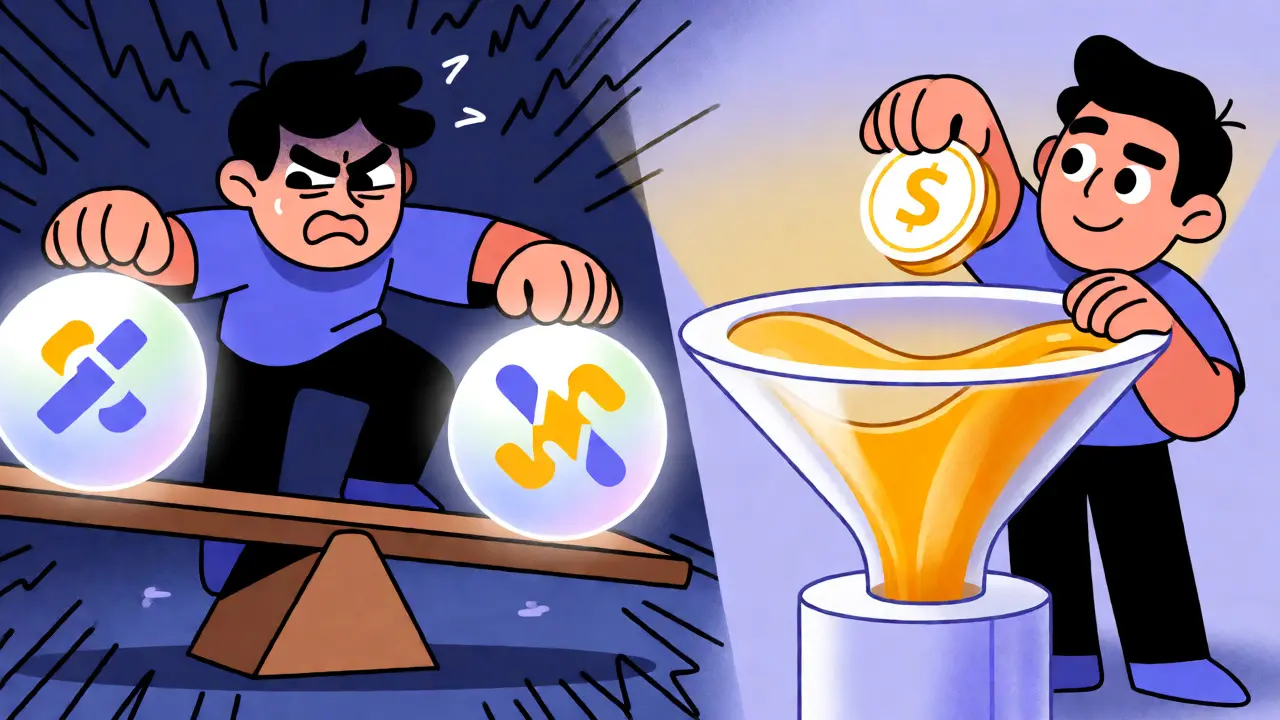

Imagine you want to provide liquidity on a standard decentralized exchange like Uniswap. You don’t just deposit your favorite token; you have to find its partner, split your capital 50/50, and pray the price ratio doesn’t swing too hard against you. That’s impermanent loss waiting to happen. MonoX Protocol is a multi-chain decentralized exchange (DEX) that lets users provide liquidity with a single token instead of paired assets. It solves this exact headache by pairing every deposited asset with a virtual stablecoin called vCASH.
But does this innovation actually work in practice? Or is it just another complex DeFi experiment with low trading volume? As of September 2026, MonoX sits in a tricky spot: technically innovative but struggling for mainstream traction. This review breaks down how its single-token model functions, where it shines compared to traditional AMMs, and why the MONO token’s market performance raises red flags for investors looking for quick flips.
The Core Innovation: Single-Token Liquidity
Traditional Automated Market Makers (AMMs) rely on pairs. If you hold ETH, you must also hold USDC or WBTC to enter a pool. This splits your capital efficiency and exposes you to volatility between two volatile assets. MonoX changes the game by introducing vCASH, a virtual stablecoin mechanism that acts as the counterparty for any single token deposited into the protocol.
Here’s the practical benefit: if you hold a niche altcoin, you can deposit 100% of that coin into a MonoX pool. The protocol virtually pairs it with vCASH. You earn fees from traders swapping your asset against the virtual dollar value. You avoid the hassle of rebalancing two different tokens when prices shift. For projects launching new tokens, this means they don’t need millions in locked collateral to start trading. They can list their token with minimal capital requirements, focusing funds on development rather than liquidity mining incentives.
How Monoswap and Multi-Chain Support Work
The primary interface for trading on MonoX is Monoswap, which is the bootstrap decentralized exchange layer enabling zero-capital token listings and instant swaps. Because the protocol uses virtual pairs, it creates a unified liquidity environment. Your SOL isn’t siloed away from your MATIC; both interact with the same underlying virtual stability layer.
MonoX operates across multiple networks, primarily Ethereum and Polygon. This multi-chain deployment is crucial for accessibility. Ethereum offers deep liquidity but high gas fees, while Polygon provides cheap transactions ideal for smaller trades. However, this dependency brings risks. When Ethereum gas spikes, user experience degrades unless you’re using Layer 2s. The protocol’s smart contract address on supported networks is distinct, requiring careful verification when adding custom tokens to wallets like MetaMask.

MONO Tokenomics and Utility
The native governance and utility token is MONO, which has a maximum supply cap of 100 million tokens, with approximately 7.8 million currently in circulation. MONO serves three main purposes:
- Governance: Holders vote on protocol upgrades and fee structures.
- Fees: A portion of transaction fees goes to MONO holders or treasury reserves.
- Rewards: Liquidity providers often receive MONO emissions alongside trading fees.
The circulating supply represents less than 10% of the max cap. In theory, this scarcity supports price appreciation if demand rises. In reality, low circulating supply combined with low trading volume creates extreme volatility. A small sell-off can crash the price because there aren’t enough buyers to absorb the shock.
Market Performance and Trading Volume Concerns
Here is the uncomfortable truth about MonoX in 2026: it lacks significant market presence. Major aggregators like CoinMarketCap classify it as an "Untracked Listing." This isn’t a glitch; it means trading data is either non-existent or so negligible that it doesn’t meet reporting standards. The MONO token trades around $0.0003, showing little movement over recent months.
| Feature | MonoX Protocol | Traditional AMM (e.g., Uniswap V2) |
|---|---|---|
| Liquidity Requirement | Single Token | 50/50 Token Pair |
| Impermanent Loss Risk | Reduced (via vCASH) | High (dependent on pair volatility) |
| Token Listing Cost | Low/Zero Capital | High Initial Liquidity Needed |
| Trading Volume | Very Low / Untracked | Billions Daily |
| Supported Chains | Ethereum, Polygon | Multi-chain (Ethereum, Arbitrum, etc.) |
The lack of volume is a chicken-and-egg problem. Users don’t trade there because liquidity is thin. Liquidity stays thin because users don’t trade there. Without aggressive marketing or exclusive partnerships with high-profile NFT projects or gaming tokens, breaking out of this cycle is difficult.

Pros and Cons: Is It Worth Using?
If you are a developer launching a new micro-cap token, MonoX offers a genuine advantage. You can list without locking up expensive collateral. This lowers the barrier to entry significantly. For liquidity providers holding diverse assets, the single-token model simplifies portfolio management. You don’t need to constantly rebalance pairs.
However, for active traders, the cons outweigh the pros. Slippage can be high due to low depth. Smart contract risk remains a concern, especially with novel mechanisms like virtual pairs that haven’t been battle-tested at scale like Uniswap or Curve. Regulatory uncertainty in DeFi adds another layer of risk. If regulators crack down on synthetic derivatives or unregistered securities, protocols relying on complex virtual accounting could face hurdles.
Future Outlook and Price Predictions
Analysts remain cautious. Most price predictions for MONO through 2030 lean bearish or flat. Models suggest prices might hover between $0.0001 and $0.0005. Some optimistic scenarios see slight gains if the protocol expands into lending or derivatives markets, leveraging its existing infrastructure. But these are speculative bets. The broader DeFi landscape is consolidating around giants like Uniswap, PancakeSwap, and dYdX. MonoX needs a killer app-perhaps seamless integration with a major gaming ecosystem or NFT marketplace-to justify its existence beyond niche utility.
For now, treat MonoX as a tool for specific use cases rather than a general-purpose exchange. It excels at bootstrapping new tokens and offering simplified liquidity provision for holders of illiquid assets. But do not expect high-frequency trading opportunities or massive yield farming returns comparable to more established platforms.
What makes MonoX different from Uniswap?
The key difference is liquidity provision. Uniswap requires you to deposit two tokens in equal value (e.g., ETH and USDC). MonoX allows you to deposit just one token. The protocol automatically pairs it with a virtual stablecoin (vCASH), reducing impermanent loss risk and simplifying capital allocation.
Is MONO token a good investment?
It carries high risk. With very low trading volume and an "untracked" status on major data sites, MONO is highly volatile. While the technology is innovative, the lack of adoption limits upside potential. It may suit long-term believers in single-token liquidity models, but short-term traders should exercise caution.
Which blockchains does MonoX support?
MonoX Protocol is deployed on Ethereum and Polygon. This allows users to choose between higher security/deeper liquidity on Ethereum or lower transaction fees on Polygon. Cross-chain compatibility helps reduce friction for users accustomed to different network environments.
How do I provide liquidity on MonoX?
Connect a Web3 wallet like MetaMask. Select the token you wish to deposit. Unlike other DEXs, you won’t be asked to add a second token. Confirm the transaction, and your single asset enters the virtual pair pool. You’ll receive LP tokens representing your share of the pool, which accrue trading fees.
What are the risks of using MonoX?
Primary risks include smart contract vulnerabilities, particularly given the unique virtual pair mechanism. There is also liquidity risk; low volume can lead to high slippage during large trades. Finally, regulatory changes affecting DeFi protocols could impact operational viability.