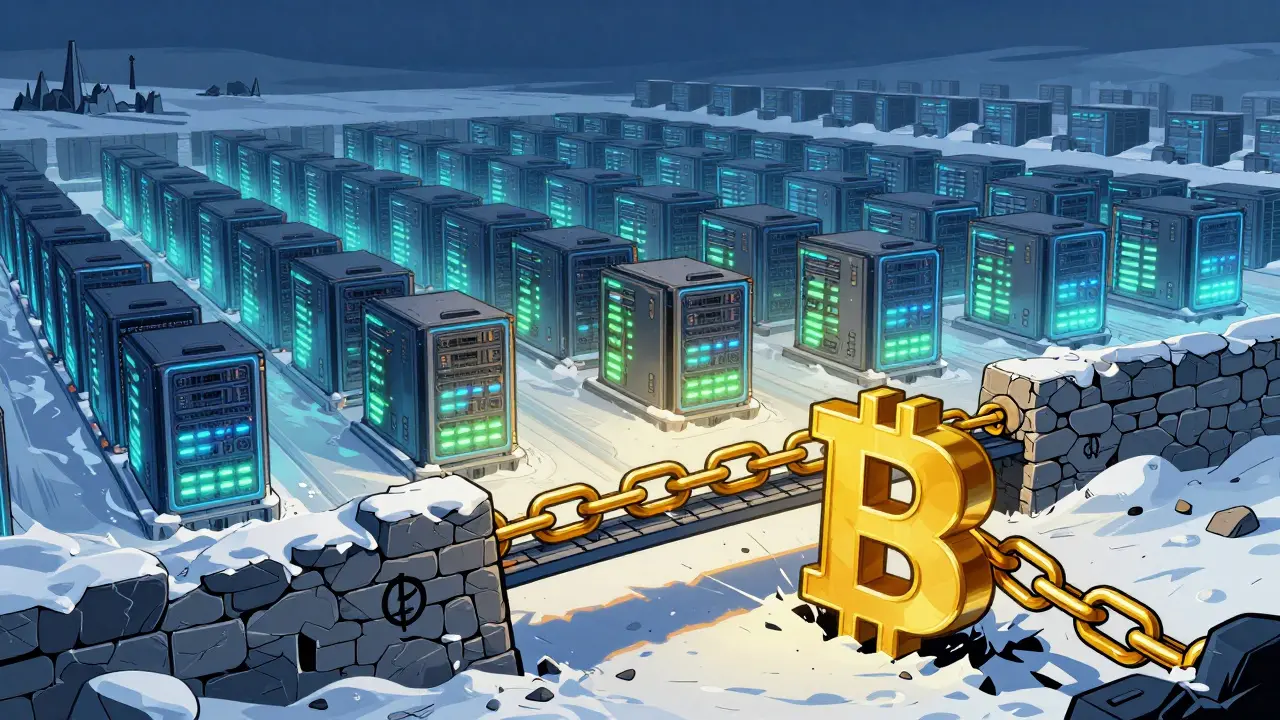

Imagine a world where a country decides the global banking system is no longer a helpful tool, but a weapon used against them. That is exactly the scenario Russia is facing. To fight back, the Kremlin isn't just tweaking its laws; it is building a parallel financial universe. By officially legalizing crypto mining is the process of using high-powered computer hardware to solve complex mathematical puzzles to validate blockchain transactions and earn digital rewards, Russia is attempting to create a financial escape hatch that Western regulators simply cannot plug.
The Strategic Shift to a Shadow Economy
For years, Russia treated digital assets with suspicion. But since the 2022 invasion of Ukraine, the tone has shifted from "stay away" to "build it." The goal is simple: create a system that doesn't rely on the US dollar or the SWIFT messaging network. This isn't just about a few people buying Bitcoin on their phones; it is a state-sponsored effort to build a "shadow crypto economy."
According to data from Chainalysis is a leading blockchain data platform that provides investigative and compliance tools to government agencies and private companies, this ecosystem involves a complex web of sanctioned exchanges, money laundering services, and military procurement networks. By legalizing mining, Russia ensures it has a steady supply of digital assets to provide liquidity for cross-border trade, effectively turning electricity and hardware into a tool for economic survival.
The Rise of the A7A5 Stablecoin
If Bitcoin is the gold of the crypto world, stablecoins are the cash. Russia realized that Bitcoin's volatility makes it a nightmare for pricing tanks or grain. Their solution? The A7A5 stablecoin is a ruble-backed cryptocurrency launched in February 2025 to facilitate systematic commercial transactions outside Western oversight. Launched by Moldovan oligarch Ilan Shor and backed by the state-owned Promsvyazbank, this token was designed specifically for business use.
The numbers are staggering. From its launch through July 2025, A7A5 processed over $51.17 billion in transactions. In its first four months alone, it moved roughly $9.3 billion. Because the token is backed by rubles and operates through a network of friendly intermediaries, it is far harder for the US Treasury to track than a USD-backed coin like USDT. It allows Russian companies to pay for imports and exports without ever touching a Western bank account.
| Feature | A7A5 Stablecoin | USD-Backed Stablecoins (e.g., USDC) |
|---|---|---|
| Backing Asset | Russian Ruble | US Dollar / Treasury Bills |
| Primary Intent | Sanctions Evasion / State Trade | Liquidity / Trading / Payments |
| Regulatory Oversight | Minimal / Russian-Aligned | High / US & Global Regulators |
| Primary User Base | Sanctioned Russian Entities | Global Retail & Institutional Investors |
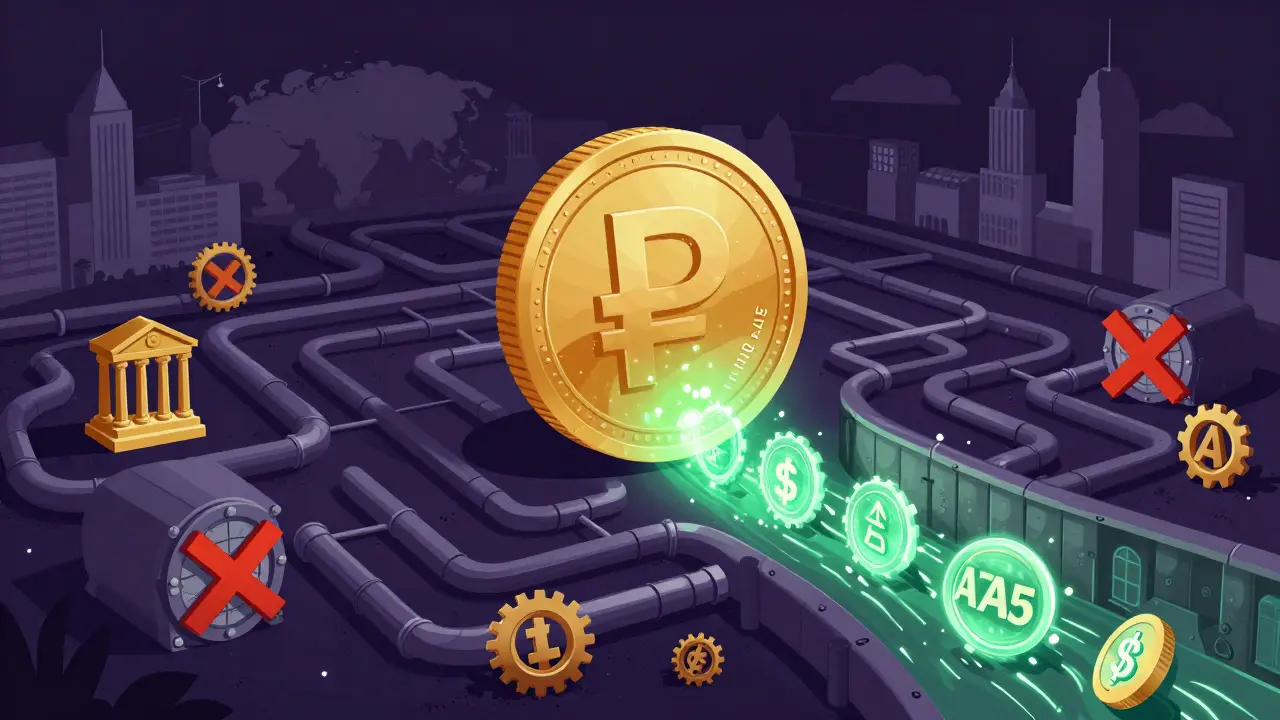
The Infrastructure of Evasion: Exchanges and Shells
A currency is useless without a place to trade it. To support A7A5 and other assets, Russia relies on a network of "insular" exchanges. Garantex is a cryptocurrency exchange with deep ties to Russia that was sanctioned by the US in 2022 for facilitating illicit finance served as a primary hub. When the US cracked down on Garantex, the players didn't quit; they just evolved. Former employees created Grinex in 2024, a new entity specifically designed to bypass the very sanctions that killed their predecessor.
This cat-and-mouse game extends to neighboring countries. Kyrgyzstan has become a vital node in this network, with firms like Old Vector managing the technical side of the A7A5 launch. By routing transactions through Central Asian banks, Russia adds layers of obfuscation, making it difficult for investigators to prove that a payment for "industrial equipment" is actually a payment for military components.
The Western Counter-Attack
Western intelligence agencies aren't just watching; they are hitting back. On August 20, 2025, the OFAC is the Office of Foreign Assets Control, a US government agency responsible for administering and enforcing economic and trade sanctions made history by designating a virtual currency mining company for the first time. This was a clear signal: the US will target the hardware and the electricity, not just the digital wallets.
The UK's OFSI joined in, sanctioning the individuals and Luxembourg-based firms that provided the plumbing for the A7A5 network. These coordinated strikes target the "human network"-the oligarchs and bankers like Konstantin Malofeyev who organize these schemes. By cutting off the bridge between the crypto world and the traditional banking world, the West hopes to make the shadow economy too expensive to maintain.

Does Crypto Actually Work for Sanctions Evasion?
Here is the reality: crypto is a helpful tool, but it isn't a magic wand. The Bitcoin Policy Institute is a research organization focused on the strategic and economic implications of Bitcoin adoption argues that Bitcoin is far too small to replace the dollar or euro for large-scale trade. Before the war, Russia's annual exports were around $400 billion. That's nearly 50% of Bitcoin's entire market cap. If Russia tried to move that much volume into Bitcoin, the price would swing wildly, making it an unstable currency for state trade.
Furthermore, the very thing that makes crypto attractive-the blockchain-is also its biggest weakness. Because most blockchains are public ledgers, every transaction leaves a digital fingerprint. While Russia can use mixers and privacy coins, a determined investigator with the right tools can eventually trace the flow of funds. The transparency of the blockchain means that once a wallet is flagged, every asset inside it becomes toxic.
Looking Ahead: The Future of Digital Warfare
Russia's move to legalize mining is a long-term bet on a fragmented global economy. They are no longer trying to "join" the global system; they are trying to build one that ignores it. We are seeing the emergence of a digital iron curtain, where one side uses the dollar and the other uses state-backed tokens and mined assets.
For now, the battle is over the "off-ramps"-the places where crypto is turned back into real-world goods and services. As long as the world's most important commodities are still priced in dollars, Russia's crypto-economy will remain a supportive tool rather than a total replacement. But as more nations explore similar paths, the global financial map is being rewritten in real-time.
Why did Russia legalize crypto mining specifically for sanctions?
By legalizing mining, Russia can generate its own digital assets independently of Western financial systems. This provides the state with a source of liquidity and a way to create new payment rails that do not rely on the US dollar or SWIFT, making it easier to trade with partners who are also avoiding Western sanctions.
What is the A7A5 stablecoin and how does it work?
A7A5 is a ruble-backed stablecoin launched in early 2025. Unlike Bitcoin, its value is pegged to the Russian ruble, making it more stable for commercial transactions. It is used by Russian entities to move large sums of money across borders through a network of non-Western exchanges and banks, bypassing traditional oversight.
Can the US actually stop these crypto transactions?
It is difficult but not impossible. The US Treasury (OFAC) targets the "on-ramps" and "off-ramps," such as exchanges like Grinex or Garantex. By sanctioning the companies that convert crypto to cash, they make the assets harder to use in the real world. Additionally, blockchain analytics allow investigators to track fund flows and identify sanctioned wallets.
Is Bitcoin a viable replacement for the US Dollar in Russia?
Not really. The Bitcoin Policy Institute notes that Bitcoin's total market capitalization is too small to handle the volume of Russia's national exports. The high volatility of Bitcoin also makes it risky for long-term government contracts or commodity trading compared to stablecoins or traditional currencies.
Which countries are using similar crypto strategies?
Russia is not alone. North Korea and Venezuela have also used cryptocurrencies to evade international sanctions, often using mining or state-backed digital tokens to fund their governments and procure banned goods.
Comments (10)

- daniella davis
- April 13, 2026 AT 08:47 AM
Omg please... everyone thinks they're so shocked by this but it's literally just basic finance for anyone who actually knows how the world works. The idea that the US can just flick a switch and stop the flow of value is a total fairy tale. Trust me, these "insular" exchanges are just the tip of the iceberg and most people here are just too blind to see that the traditional banking system is already a joke. It's just so embarrassing that some people still think a piece of paper from the Treasury carries any real weight in a decentralized era. Like, seriously, read a book on game theory before pretending to be surprised that a superpower would find a loophole in a system they created. It is honestly hilarious how delusional the general public is about how money actually moves across borders when the stakes are this high. Just keep believing in your little regulations while the real players move billions in the blink of an eye. I cannot even deal with the naivety in some of these thoughts. It is practically a comedy at this point.

- Alan Seiden
- April 14, 2026 AT 22:29 PM
Absolute rubbish. The British government should be doing far more than just sanctioning a few Luxembourg firms. It is a complete disgrace that we allow these digital loopholes to exist while our national security is compromised by state-sponsored cyber-crime. This isn't "innovation," it is blatant criminality and the West is far too timid in its response.

- Samson Selleck
- April 16, 2026 AT 16:14 PM
The structural asymmetry here is fascinating. By leveraging a ruble-backed stablecoin, the Kremlin is essentially attempting to mitigate the volatility of the BTC pair while maintaining a non-custodial bridge for liquidity. It's a textbook example of regulatory arbitrage. The efficacy of OFAC's intervention is likely marginal given the obfuscation layers provided by Central Asian intermediaries, which effectively creates a high-latency filter for any forensic chain analysis. The systemic risk isn't the crypto itself, but the erosion of the petrodollar hegemony via these synthetic offsets.

- EDOZIEM MICHAEL
- April 17, 2026 AT 16:48 PM
money is just a story we all agree to believe in anyway so why not change the story

- Heather Warren
- April 19, 2026 AT 11:17 AM
I think it's really helpful to look at the A7A5 table for a clear comparison. It shows exactly why the ruble backing is so key for their specific goals. Maybe we can all learn something about how different systems adapt to pressure!

- Kieran Smith
- April 20, 2026 AT 22:55 PM
wow thats wild... i wonder if other countrys will start doin the same thing soon. seems like a smart way to keep things movin when the banks shut down

- Lela Singh
- April 21, 2026 AT 08:11 AM
Total game changer! The sheer audacity of building a shadow economy is absolutely electrifying. This is a masterclass in financial agility!

- Artavius Edmond
- April 22, 2026 AT 11:57 AM
I'm just vibing with the idea that maybe the world is moving toward a more multipolar system. It's a bit chaotic, but it's interesting to see everyone trying to find a middle ground or a new way to coexist without the old rules.

- Chidinma Sandra okafor
- April 23, 2026 AT 00:16 AM
Oh look at the West trying to play police again. So cute that they think a few sanctions on some random company will stop a whole nation. Maybe if they spent less time pretending to be the world's moral compass and more time actually understanding how power works, they wouldn't be so surprised.

- jennelle williams
- April 23, 2026 AT 08:06 AM
it all feels so heavy. we are just trying to find a way to stay connected in a broken world.