
You are holding your first Bitcoin and wondering where to trade it. Do you go with the big, familiar name that looks like a bank, or do you dive into the complex world of smart contracts? This choice defines your entire experience in crypto. It dictates how safe your money is, how fast you can move it, and how much control you actually have over your assets. In 2026, this isn't just a technical debate; it's a practical decision about your financial freedom versus convenience.
The landscape has shifted significantly since the early days of Bitcoin. Centralized exchanges (CEXs) still dominate the market, but decentralized exchanges (DEXs) have matured from experimental side-projects into serious alternatives. Understanding the difference between these two models is no longer optional for anyone serious about digital assets. Let’s break down exactly how they work, where they fail, and which one fits your specific needs.
Key Takeaways
- Centralized exchanges offer ease of use and fiat currency access but require you to trust a third party with your funds.
- Decentralized exchanges provide full self-custody and censorship resistance but demand higher technical skill and carry smart contract risks.
- Liquidity remains significantly deeper on CEXs, making them better for large trades and tight spreads.
- DEXs are superior for privacy and avoiding KYC requirements, though they often lack direct fiat on-ramps.
- Hybrid models are emerging, combining CEX liquidity with DEX custody features for the best of both worlds.
How Centralized Exchanges Work
Centralized Exchanges are platforms operated by a company that acts as an intermediary between buyers and sellers, holding user funds in custodial wallets. Think of them like traditional stock brokers. When you sign up for a platform like Coinbase or Kraken, you don't actually hold your coins in a personal wallet. Instead, you deposit them into an account managed by the exchange. The exchange maintains a ledger of who owns what, similar to how a bank tracks your checking account balance.
This model relies on proprietary order matching engines that run off-chain. These systems are incredibly fast, processing tens of thousands of transactions per second with minimal latency. For most users, this speed is invisible; you click "buy," and the trade executes instantly. Because the exchange handles the heavy lifting of security and infrastructure, the user interface is designed to be simple. You verify your identity through Know Your Customer (KYC) checks, link a bank account, and start trading within minutes. This low barrier to entry is why CEXs captured 87.4% of the market share in recent years.
However, this convenience comes at a cost. You are trusting a single entity not to go bankrupt, get hacked, or freeze your account. If the exchange goes under, recovering your funds can be a legal nightmare. The collapse of FTX in 2022 is the prime example, where billions in user funds were locked away due to corporate mismanagement. While major players now publish proof-of-reserves audits, the fundamental risk of counterparty failure remains.
How Decentralized Exchanges Work
Decentralized Exchanges are peer-to-peer trading protocols that execute trades via smart contracts on a blockchain, allowing users to trade directly from their non-custodial wallets without intermediaries. There is no company behind a DEX like Uniswap or PancakeSwap. Instead, there is code. Specifically, Automated Market Maker (AMM) algorithms determine prices based on liquidity pools rather than traditional order books.
When you use a DEX, you connect your own wallet, such as MetaMask, directly to the protocol. You never leave your assets in someone else's hands. To buy Ethereum, you swap your USDC tokens directly against ETH using the liquidity provided by other users who deposited assets into the pool. This process eliminates the need for KYC, customer support tickets, or account passwords. You are the sole custodian of your keys.
The trade-off here is complexity. Navigating a DEX requires understanding gas fees, slippage tolerance, and network congestion. If you set your slippage too low, your transaction might fail. If you set it too high, you might get a bad price. Furthermore, because trades happen on-chain, they are subject to blockchain confirmation times. While Layer-2 solutions like Arbitrum and Optimism have reduced these delays to seconds, they are still slower than the instant execution of a CEX. Additionally, most DEXs only allow crypto-to-crypto swaps, meaning you need to already own cryptocurrency before you can start trading.

Head-to-Head Comparison
To make the decision easier, let's look at the core differences across several critical dimensions. Each model has distinct strengths that appeal to different types of traders.
| Feature | Centralized Exchange (CEX) | Decentralized Exchange (DEX) |
|---|---|---|
| Custody | Custodial (Exchange holds funds) | Non-Custodial (User holds funds) |
| Onboarding | KYC required, ~15-20 mins | No KYC, requires wallet setup |
| Fiat Access | Direct bank integration available | Limited, mostly crypto-to-crypto |
| Liquidity | Very High (Deep order books) | Moderate (Liquidity pools) |
| Transaction Speed | Instant (Off-chain matching) | Seconds to Minutes (On-chain confirmation) |
| Security Risk | Hacks, Bankruptcy, Freezes | Smart Contract Bugs, Phishing |
| Privacy | Low (Data tracked by company) | High (Pseudonymous on-chain activity) |
| Regulatory Status | Heavily Regulated/Licensed | Gray Area/Evolving Regulations |
Security: Who Holds the Keys?
Security is the biggest point of contention. With a CEX, your primary risk is the platform itself. Historically, CEXs have suffered from massive hacks and insolvencies. A report by CipherTrace noted that major CEX hacks totaled nearly $5 billion between 2011 and 2024. However, modern top-tier CEXs mitigate this by keeping 95-98% of assets in cold storage and implementing multi-signature wallets. The remaining risk is operational: what happens if the CEO runs off with the money or the company files for bankruptcy?
With a DEX, the risk shifts to the code. Smart contracts are immutable, which means if there is a bug, it stays there until patched. The Wormhole bridge exploit in 2022, which lost $320 million, highlighted this vulnerability. However, DEXs eliminate the risk of corporate fraud. No one can freeze your account or decide who gets paid during a bankruptcy. For many long-term holders, the peace of mind from self-custody outweighs the fear of smart contract bugs, especially as audits become more rigorous. Today, 78% of top DEXs undergo third-party audits, a significant improvement from the early days.
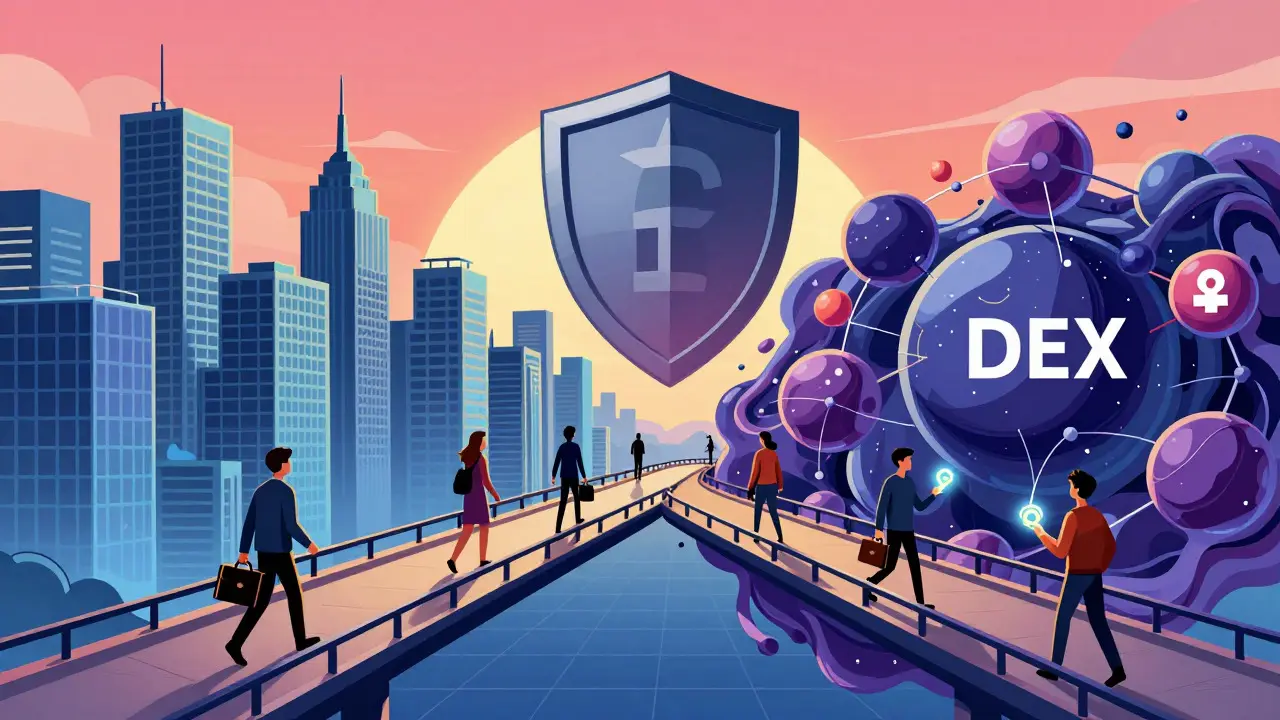
User Experience and Learning Curve
If you value simplicity, CEXs win by a landslide. They look like any other finance app. You log in, see your portfolio, and click buttons. Documentation is abundant, and customer support is available via chat or email. For beginners, this familiarity reduces anxiety. You don't need to worry about losing your seed phrase because the exchange remembers your password for you.
DEXs, on the other hand, have a steep learning curve. Surveys indicate that 62% of new Web3 users require three or more attempts to successfully complete their first DEX swap. Common pitfalls include running out of gas tokens (like ETH for Ethereum networks), setting incorrect slippage parameters, or connecting to a malicious website. Once you master these basics, however, the experience becomes empowering. You aren't waiting for customer support to unlock a frozen account; you have total control. But for the average user, the friction is real. It takes roughly 15-20 hours to become competent with DEX navigation compared to 2-3 hours for basic CEX proficiency.
Liquidity and Trading Costs
Liquidity refers to how easily you can buy or sell an asset without affecting its price. CEXs generally have deeper liquidity because they aggregate orders from millions of users globally. Binance, for instance, processes tens of billions in daily volume. This depth means tighter spreads-you pay less difference between the bid and ask price. For large institutional trades, this is crucial.
DEXs rely on liquidity providers who deposit assets into pools. While major pairs like ETH/USDC on Uniswap have decent liquidity, smaller or newer tokens often suffer from thin pools. This leads to higher slippage, where the price moves against you as your trade executes. Regarding costs, CEXs charge explicit trading fees, typically ranging from 0.1% to 0.6%. DEXs charge a small fee to the liquidity pool (often 0.3%) plus the network gas fee. On mainnet Ethereum, gas fees can be high, but on Layer-2 networks like Arbitrum, they drop to fractions of a cent. So, while DEXs seem cheaper per trade, the gas cost adds a variable layer that CEXs don't have.
Regulation and Future Outlook
Regulation is tightening around both models, but in different ways. CEXs face strict compliance requirements, including licensing in various jurisdictions. The implementation of MiCA in Europe forced many unregulated CEXs to exit the market. This adds stability but also bureaucracy. DEXs operate in a gray area. Since there is no central entity to regulate, regulators often target the token issuers or developers instead. The SEC's lawsuit against Uniswap Labs in 2024 signaled that even permissionless protocols might face scrutiny if deemed securities exchanges.
Looking ahead, the lines are blurring. Hybrid models are emerging where CEXs integrate DEX liquidity. Platforms like Coinbase are building their own Layer-2 chains (Base) that host DEXs, allowing users to access DeFi benefits while staying within a familiar CEX interface. Gartner predicts a bifurcated market by 2027, where CEXs serve retail users seeking convenience, while DEXs handle institutional DeFi interactions. For now, the best approach depends on your goals. If you want easy access to buy Bitcoin with a credit card, stick with a CEX. If you want to hold your assets securely and participate in DeFi, learn to use a DEX. Many experienced traders use both: CEXs for buying and selling, and DEXs for holding and advanced trading.
Are DEXs safer than CEXs?
It depends on the type of risk. DEXs are safer from corporate bankruptcy and account freezes because you hold your own keys. However, they carry smart contract risk, where a bug in the code could drain funds. CEXs are safer from technical errors but risky from management failure and hacks. Most experts recommend diversifying: keep long-term holdings in self-custody (via DEX or hardware wallet) and use CEXs for active trading.
Can I buy crypto with a bank card on a DEX?
Generally, no. Most DEXs only accept crypto payments. To use a DEX, you must first buy crypto on a CEX or P2P platform, transfer it to your wallet, and then swap it on the DEX. Some DEXs have integrated fiat on-ramps, but these often route through third-party services that may require KYC anyway.
Which exchange is better for beginners?
Centralized exchanges are better for beginners due to their intuitive interfaces, customer support, and ability to buy directly with fiat currency. DEXs require knowledge of wallets, gas fees, and network selection, which can be overwhelming for newcomers. Start with a reputable CEX to gain experience, then explore DEXs once comfortable.
Do DEXs charge higher fees than CEXs?
Not necessarily. DEXs charge a protocol fee (usually 0.3%) plus gas fees. On cheap networks like Solana or Arbitrum, total costs can be lower than CEX trading fees. On Ethereum Mainnet, high gas fees can make DEX trades expensive. CEXs have predictable, fixed trading fees but no gas costs for the user.
What is slippage in a DEX?
Slippage is the difference between the expected price of a trade and the actual price executed. In DEXs, prices change as liquidity pools shift. If you trade a large amount, you might move the price significantly. Setting a high slippage tolerance ensures your trade goes through but might result in a worse price. Setting it too low might cause the transaction to fail.

Comments (5)

- Niall O'Rourke
- August 17, 2026 AT 00:00 AM
everyone is so obsessed with the word decentralization it has become a meaningless buzzword used by people who dont actually understand what they are reading. you think holding your own keys makes you free but really you are just becoming a single point of failure for your own incompetence. the real elites know that convenience is the only thing that matters in the end because nobody wants to deal with gas fees and seed phrases when they could just click a button. the whole narrative about self custody is just a way for tech bros to feel superior to the rest of us who value our time more than abstract ideals. we should stop pretending that complexity is a virtue and admit that centralized systems work better for the average person who just wants to buy some coins without thinking about it. the market will always correct itself towards the path of least resistance and that is why cexs will always win out in the long run no matter what the purists say

- Patrick Pat
- August 18, 2026 AT 00:38 AM
oh great another take on the eternal debate like we havent read this exact same argument five hundred times already. the problem with these articles is they always present it as a binary choice when in reality most people just use both depending on the situation. i mean sure dexe are cool if you want to play with smart contracts but trying to explain slippage tolerance to your mom is a nightmare. also the part about hybrid models is interesting but lets be honest how many of those are actually viable right now versus just marketing fluff from companies trying to keep their users locked in. the regulatory angle is the real headache here because miCA is going to squeeze everyone out eventually so pick your poison carefully. at least the table was clear though which is more than i can say for most crypto writing these days

- Claudio Perrone
- August 18, 2026 AT 11:04 AM
this post is basically saying that freedom is overrated and thats a huge lie. i mean think about it they want you to trust a company with all your money while they secretly track every move you make its not just about the hack risk its about the surveillance state creeping into your wallet. the fact that they even mention kyc as a positive feature shows how far we have fallen from the original vision of bitcoin being anonymous and borderless. sure the learning curve is steep but thats the price of admission for actual ownership and anyone who cant handle it probably shouldnt be in crypto anyway. the smart contract bugs are temporary glitches but corporate fraud is a permanent condition of the industry so choose your risks wisely friends. we are living in a simulation where the house always wins unless you step outside the board completely

- Aaron Morrissey
- August 19, 2026 AT 21:04 PM
It is truly fascinating to observe how the dichotomy between centralized and decentralized exchanges continues to define the contemporary discourse surrounding digital asset management, yet one must acknowledge that the nuance often gets lost in the fervor of ideological camps. The article rightly highlights the maturity of DEXs, but I would argue that the true innovation lies in the convergence of these two paradigms, creating a symbiotic ecosystem where liquidity meets sovereignty. Consider the implications of Layer-2 solutions reducing friction; this is not merely a technical upgrade but a fundamental shift in user experience that bridges the gap between accessibility and control. We must not view this as a zero-sum game where one model triumphs over the other, but rather as a complementary relationship that serves different segments of the market with varying degrees of sophistication and risk tolerance. The regulatory landscape, particularly with MiCA, acts as a catalyst for this evolution, forcing players to adapt or perish, thereby accelerating the integration of DeFi features into mainstream platforms. It is my considered opinion that the future belongs to those who can navigate this complex terrain with both an open mind and a pragmatic approach, leveraging the strengths of each system to maximize utility and security. The notion that one must choose a side is a false dichotomy that hinders progress and understanding in this rapidly evolving field. Let us embrace the complexity and recognize that the best tools for the job are those that empower the individual to make informed decisions based on their unique circumstances and goals. This is not just about trading assets; it is about redefining the very nature of financial interaction in the digital age.

- Patrick Quairoli
- August 21, 2026 AT 11:34 AM
you guys are all missing the point again and again the big players are planning to kill dexes before they get too powerful its obvious once they figure out how to tax every swap directly on chain the whole concept of decentralization becomes moot. look at how they pushed the sec lawsuit against uniswap it wasnt about securities it was about controlling the flow of capital and keeping the middlemen in business. the proof of reserves audits are just a smokescreen to make you feel safe while they prepare for the next round of bailouts using your deposits as collateral. trust no one check the code yourself because the developers are working with the government agencies behind the scenes to build backdoors into every protocol. the only real safety is holding cash under your mattress or moving everything to a cold storage device that is never connected to the internet ever. anything else is just gambling on the benevolence of corporations that have proven time and again that they will betray you the moment it suits them financially. wake up sheeple the matrix is closing in fast