
You might have seen the ticker SHELL pop up on your exchange feed and wondered what it actually does. Is it a new coin for paying bills? A governance token for a bank? Not quite. MyShell (SHELL) is the native currency of an artificial intelligence ecosystem, not just another blockchain project trying to solve payments. Think of it as the fuel for a marketplace where people build, share, and own AI agents. If you are confused because there was also an older DeFi project called Shell Protocol using the same name, you are not alone. This guide cuts through the noise to explain exactly what MyShell is, how its token works, and why it matters in the current AI-crypto landscape.
Not Just Another Coin: The MyShell Mission
Most cryptocurrencies try to be everything to everyone-money, store of value, smart contract platform. MyShell takes a different route. It focuses specifically on the consumer side of artificial intelligence. The platform connects four key groups: creators who build AI agents, consumers who use them, patrons who fund promising projects, and developers who contribute open-source models. MyShell is a decentralized AI consumer layer that enables users to build, share, and own AI agents while using the SHELL token for payments and incentives. Unlike traditional chatbots locked inside corporate walls, MyShell aims to let users truly own their digital assistants.
The core idea is simple: if you create a useful AI agent, you should get paid for every interaction it has. If you provide a model that powers these agents, you should share in the revenue. SHELL is the mechanism that makes this economy work. It isn't designed to replace Ethereum or Solana; instead, it lives on top of them, handling the specific economic interactions of the AI-agent world. This distinction is crucial because it means SHELL's value is tied directly to the usage of the platform, not just speculative trading volume.
How SHELL Works Inside the Ecosystem
So, what can you actually do with SHELL? It’s not just a ticket to ride. The token serves several practical functions within the MyShell network. First, it acts as the primary payment method. Users spend SHELL to access premium features, subscribe to specific AI agents, or buy services from creators. Second, it rewards participation. Creators earn SHELL when their agents are used. Model contributors earn a share when their open-source models power applications. Patrons receive incentives for supporting early-stage agents.
| User Role | Action | SHELL Utility |
|---|---|---|
| Consumer | Using AI Agents | Pays for subscriptions, premium features, and one-off services. |
| Creator | Building & Listing Agents | Earns revenue from user interactions and advertising fees. |
| Developer | Contributing Models | Receives royalties when their models are integrated into apps. |
| Patron | Supporting Projects | Stakes or spends SHELL to gain badges and future rewards. |
Beyond payments, SHELL plays a role in governance and promotion. Holders can participate in voting on platform upgrades, though the extent of this power is still evolving. More immediately, users can use SHELL to advertise their AI agents, boosting visibility in the marketplace. This creates a circular economy: money flows in from users, goes out to creators and developers, and circulates back through advertising and governance actions.
Tokenomics: Supply, Distribution, and Risks
If you are looking at the price chart, you need to understand the supply mechanics first. The total maximum supply of SHELL is capped at 1,000,000,000 tokens. However, don't assume all those tokens are floating around. As of late 2026, significant portions remain locked due to vesting schedules for private investors and team members. This is critical for traders to note. When large blocks of tokens unlock, they hit the market, potentially creating selling pressure.
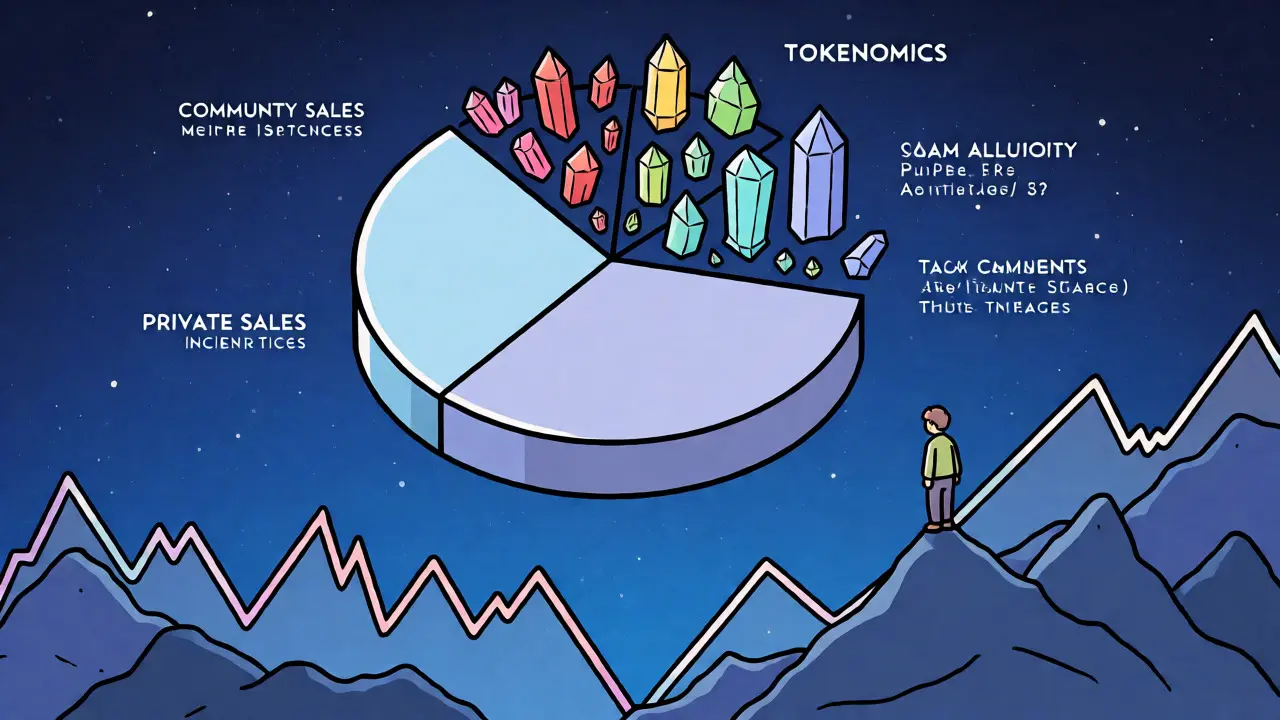
Here is a rough breakdown of how the pie was sliced during the launch phase:
- Community Incentives (~30%): Reserved for rewards, airdrops, and ecosystem growth.
- Private Sales (~29%): Sold to early backers, subject to a one-year cliff and three-year unlocking period.
- Team & Foundation (~17%): Allocated to the core development team and foundation reserves.
- Airdrops & Marketing (~5-8%): Distributed via Binance HODLer campaigns and other promotional events.
Be careful with data providers. You will see conflicting numbers for circulating supply. Some report ~270 million, others ~457 million. This discrepancy usually stems from how different platforms calculate "circulating" versus "total unlocked." Always check the official contract address before buying. On both Ethereum and BNB Smart Chain, the correct address is 0xf2c88757f8d03634671208935974b60a2a28bdb3. If you see a different address, you are likely looking at a fake token or the old Shell Protocol asset.

Technology Stack: AI Meets Blockchain
MyShell isn't building its own Layer-1 blockchain from scratch. It leverages existing networks like Ethereum and BNB Smart Chain for settlement. The magic happens at the application layer. The platform integrates approximately 100 open-source AI models, allowing developers to mix and match capabilities without starting from zero. This lowers the barrier to entry for creators who want to build sophisticated agents but lack massive compute resources.
A standout feature is the Shell Launchpad. This tool allows creators to tokenize their AI agents. You define the agent's name, ticker, and initial supply. Users buy into the agent using SHELL. Once the bonding curve limit is reached, the agent automatically deploys to a decentralized exchange. This turns a piece of software into a tradable asset, blending the worlds of SaaS and crypto speculation.
MyShell vs. Shell Protocol: Don't Mix Them Up
This is the most common pitfall for newcomers. There are two distinct projects with the ticker SHELL. Confusing them can lead to bad investments.
| Feature | MyShell (SHELL) | Shell Protocol (SHELL) |
|---|---|---|
| Primary Focus | AI Agent Marketplace & Creator Economy | DeFi Governance & Automated Market Makers |
| Launch Date | February 2025 | Earlier (Legacy Project) |
| Networks | Ethereum, BNB Smart Chain | Ethereum (Primarily) |
| Utility | Payments for AI services, creator rewards | Governance for liquidity pools |
| Status | Active, listed on major exchanges | Less active, legacy status |
When you search for "SHELL," ensure you are looking at MyShell. The old Shell Protocol had a much smaller allocation structure and served a completely different purpose in the DeFi space. MyShell is the current, actively traded asset associated with the AI boom.
Market Performance and Volatility
As of October 2026, SHELL trades in the range of $0.021 to $0.022. This is a significant drop from its listing price of $0.28 in February 2025. Such depreciation is common for new tokens facing lock-up expirations and broader market corrections. The market capitalization hovers between $6 million and $10 million, depending on which data provider you trust. This places it in the micro-cap category, meaning high volatility is expected.
Binance labeled SHELL with a "Seed Tag," warning users about higher risk compared to established assets. This tag signals that the token is still in its early stages, with lower liquidity and less historical data. For investors, this means potential upside if the AI-agent narrative grows, but also substantial downside risk if adoption stalls.
Getting Started: How to Buy and Use SHELL
Ready to dive in? Here is the safest path to acquiring and using SHELL:
- Verify the Contract: Copy the address
0xf2c88757f8d03634671208935974b60a2a28bdb3into your wallet explorer to confirm it matches the network you are using (Ethereum or BSC). - Choose Your Network: Decide whether you want to pay lower gas fees on BNB Smart Chain or prioritize Ethereum security. Most activity seems to favor BSC for cost efficiency.
- Acquire Tokens: Buy SHELL on supported exchanges like Binance or Bybit. Alternatively, swap for it on decentralized exchanges like PancakeSwap or Uniswap.
- Fund Your Wallet: Ensure you have enough ETH or BNB to cover transaction fees. You cannot pay gas fees with SHELL itself.
- Interact with the Platform: Connect your wallet to the MyShell website. Explore the agent marketplace, try out free agents, and consider purchasing a Creator Pass if you plan to build your own tools.
Risks and Realities
No investment is without risk, and SHELL has specific ones. First, competition is fierce. Centralized AI platforms like OpenAI or Anthropic offer powerful tools without requiring crypto wallets. MyShell must prove that decentralization adds real value-such as true ownership and lower fees-to attract mainstream users.
Second, technical risks exist. Smart contracts can have bugs. Bridges between chains can fail. Third, regulatory uncertainty remains. While the MiCA whitepaper clarifies its stance in Europe, other jurisdictions may treat utility tokens differently. Finally, the reliance on vesting unlocks means that even if demand rises, selling pressure from insiders could suppress price gains for years.
Is MyShell (SHELL) the same as Shell Protocol?
No. They are two unrelated projects that happen to share the ticker symbol. MyShell is an AI-agent platform launched in 2025, while Shell Protocol is an older DeFi project. Always verify the contract address to ensure you are buying the correct asset.
What is the total supply of SHELL tokens?
The maximum total supply is capped at 1,000,000,000 tokens. However, the circulating supply varies by source due to ongoing vesting schedules for private investors and team members. As of late 2026, estimates range between 270 million and 457 million circulating tokens.
Can I mine SHELL?
No, SHELL is not mined like Bitcoin. It is an ERC-20 and BEP-20 token. You acquire it by purchasing it on exchanges, earning it through platform activities (like creating agents), or receiving it via airdrops and staking rewards.
Which blockchains support SHELL?
SHELL is available on both Ethereum (ERC-20) and BNB Smart Chain (BEP-20). The contract address is identical on both networks: 0xf2c88757f8d03634671208935974b60a2a28bdb3.
Why did SHELL's price drop after launch?
Like many new tokens, SHELL experienced post-listing depreciation due to profit-taking by early investors, general crypto market trends, and the gradual release of locked tokens (vesting), which increases supply on the market.