
Have you seen the hype around the Binopoly airdrop? If you are scrolling through crypto Twitter or Telegram groups right now, you have probably heard whispers about free BINO tokens. But here is the hard truth: information about this specific airdrop is incredibly thin. Unlike major projects that release detailed whitepapers and clear eligibility criteria, Binopoly operates in the shadows of limited data.
This guide cuts through the noise. We will look at what we actually know about the BINO token, how you might be able to get it, and more importantly, how to spot the scams trying to steal your wallet funds. Since today is June 1, 2026, the landscape has shifted, and many early promises have either vanished or turned into complex exchange challenges. Let’s break down exactly where things stand.
What Is Binopoly (BINO)?
To understand the airdrop, you first need to understand the asset. Binopoly is a cryptocurrency token that trades under the ticker symbol BINO. It is not one of the household names like Bitcoin or Ethereum. In fact, finding reliable data on it is difficult. On major tracking platforms, you might see placeholder values for its price or market cap. This usually means one of two things: either the trading volume is extremely low, or the data feeds are broken because the project has stalled.
There is also a major point of confusion you need to watch out for. There is another project called BinoFi that also uses the ticker BINO. BinoFi is a different entity entirely, often associated with presales and hybrid exchange models. Do not mix them up. When people talk about the Binopoly airdrop, they are referring to the token with the contract address starting with 0xa2df...05eb592. Always verify the contract address before sending any transactions.
The Reality of the BINO Airdrop
So, is there an actual airdrop? The short answer is: maybe, but it’s not straightforward. There is no official, public "snapshot" date announced by the Binopoly development team that tells you, "If you held X amount on Date Y, you get Z tokens." That kind of clarity is missing.
Instead, the primary avenue for receiving free BINO tokens appears to be through exchange partnerships, specifically with Bitget. Bitget has mentioned in their promotional materials that users can receive free Binopoly tokens by participating in ongoing challenges and promotions. This is a common model in 2026. Projects don’t just give away tokens randomly anymore; they tie distributions to user activity.
Here is what that typically looks like:
- Trading Challenges: You might need to trade a certain volume of other assets on Bitget to qualify for reward points.
- Referral Programs: Inviting new users to the platform often yields bonus tokens.
- Liquidity Provision: Adding liquidity to specific pools might grant you access to future distributions.
The problem? The details are vague. There is no public ledger showing how many tokens were allocated for these rewards, nor is there a clear timeline for when they will be distributed. This lack of transparency is a red flag you should take seriously.
How to Participate Safely
If you decide to chase the Binopoly airdrop, you need to play it smart. Because official documentation is scarce, you are operating in a gray area. Here is a step-by-step approach to maximize your chances while minimizing risk.
- Create a Bitget Account: Since Bitget is the only platform explicitly mentioning BINO rewards, this is your starting point. Complete your KYC (Know Your Customer) verification. Unverified accounts rarely receive substantial airdrops.
- Monitor the "Rewards Hub": Log in regularly and check the promotions section. Look for banners or tasks labeled with "BINO" or "Binopoly." These tasks change frequently.
- Engage in Low-Risk Activity: Instead of buying large amounts of BINO (which might be illiquid), participate in general platform activities. Trade stablecoins or major pairs if required by the challenge terms.
- Use a Separate Wallet: If the airdrop requires connecting a Web3 wallet, never use your main vault. Create a fresh, empty wallet for interacting with unknown contracts.
Remember, the goal is to qualify without spending money you aren't willing to lose. Do not buy BINO tokens on decentralized exchanges (DEXs) expecting immediate profit from an airdrop. The price action for BINO has been described as inactive, meaning you could buy in and find no buyers when you want to sell.
Red Flags: How to Spot Binopoly Scams
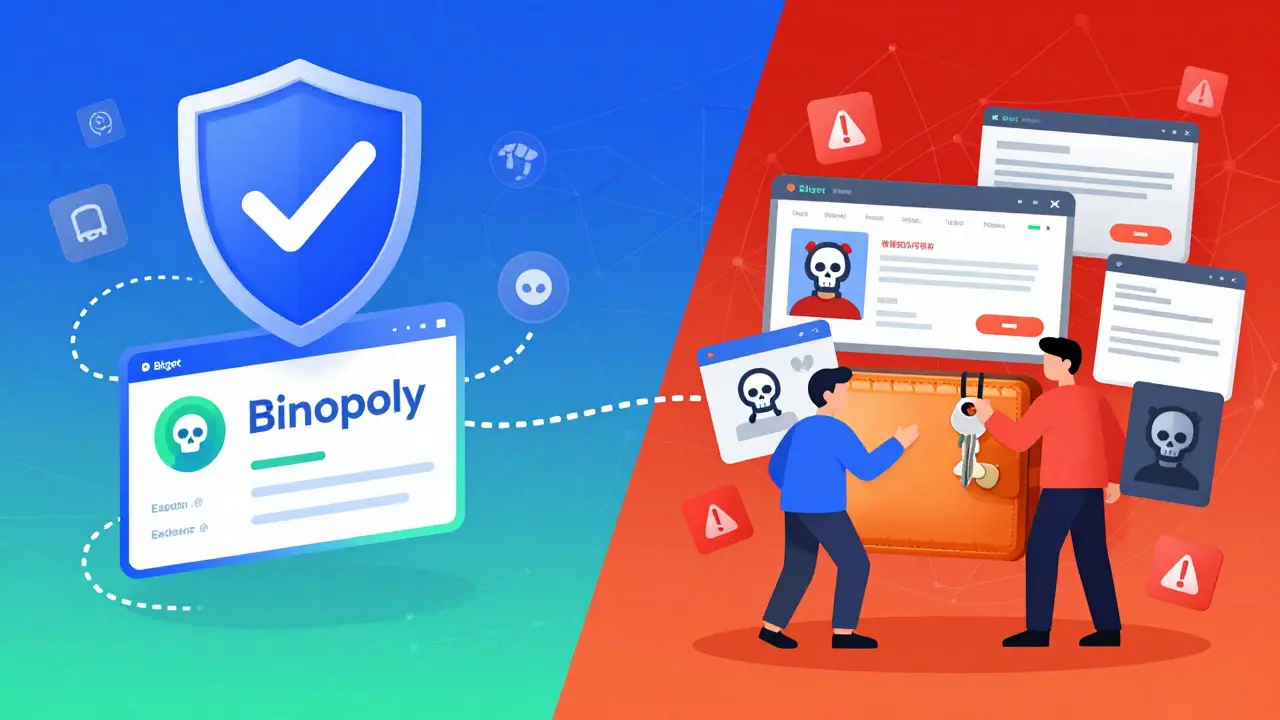
This is the most critical section. Because legitimate information about Binopoly is hard to find, scammers fill the void. They create fake websites, Discord servers, and Telegram bots claiming to offer "early access" to the airdrop. Here is how to protect yourself.
| Scam Type | What They Say | Reality Check |
|---|---|---|
| Fake Claim Sites | "Enter your wallet address here to claim 1000 BINO tokens instantly!" | Legitimate airdrops are usually auto-credited to your exchange account or require a signature transaction, not a simple form submission. |
| Impersonator DMs | Direct messages from "Binopoly Support" offering help. | Official teams do not DM users first. Block and report immediately. |
| Gas Fee Scams | "Pay a small ETH/SOL fee to unlock your airdrop." | Airdrops are free. If you have to pay to receive them, it’s a scam. |
| Mixed-Up Tickers | Promoting BinoFi (the presale project) as the original Binopoly. | Check the contract address. BinoFi and Binopoly are different projects. |
Always double-check URLs. Scammers register domains like `binopoly-airdrop-official.com` which look real but are phishing sites. Stick to the official links provided within reputable exchanges like Bitget or Binance.
Market Context: Why Is Data So Scarce?
You might wonder why a project would launch an airdrop without proper marketing. In 2026, the crypto market has matured. Investors are skeptical of vaporware-projects that promise much but deliver little. The absence of BINO from major "Top Upcoming Airdrops" lists on platforms like CoinGecko suggests that the project lacks significant community traction or developer activity.
Compare this to successful airdrops from recent years. Projects like Nillion Network or Initia distributed tens of millions of dollars worth of tokens. They did so with clear communication, regular updates, and transparent allocation charts. Binopoly does not have this track record. The price prediction models for BINO often show $0.00 value, which isn't necessarily a prediction of failure, but rather an indicator that there is insufficient data to calculate a fair market value.
This scarcity of data is a feature, not a bug, for scammers. It allows them to operate without immediate correction from a vocal community. For you, the investor, it means extra caution is required.
Alternatives to Consider
If the uncertainty around Binopoly makes you nervous, you are not alone. Many crypto enthusiasts are looking for more transparent opportunities. While I cannot recommend specific investments, I can suggest looking for projects that meet these criteria:
- Public Roadmap: The team publishes regular updates on GitHub or their blog.
- Verified Contract: The token contract is verified on block explorers like Etherscan or Solscan.
- Clear Allocation: The percentage of tokens reserved for airdrops is publicly stated.
In 2026, established Layer 1 and Layer 2 networks often offer staking rewards or governance incentives that are safer than speculative airdrops. Platforms like Binance Launchpool also provide a structured way to earn new tokens by locking existing assets, reducing the risk of interacting with unverified smart contracts.
Final Thoughts on the BINO Opportunity
The Binopoly airdrop is a high-risk, low-clarity opportunity. There is no guaranteed payout, and the path to qualification is obscured by a lack of official communication. Your best bet is to monitor Bitget’s challenge sections passively. Do not invest money hoping for a return from the airdrop itself. Treat any potential BINO tokens as a lottery ticket-if you win, great. If not, you haven’t lost capital.
Stay vigilant. Verify every link. And remember, in the world of crypto, if something sounds too good to be true and comes with zero documentation, it probably is.
Is the Binopoly (BINO) airdrop still active in 2026?
There is no official confirmation of a broad public airdrop. However, Bitget occasionally offers BINO tokens as rewards for completing specific trading challenges or promotional tasks. You must check the current promotions page on Bitget to see if any active campaigns exist.
How do I distinguish between Binopoly and BinoFi?
Both use the ticker BINO, but they are different projects. Binopoly is associated with the contract address starting with 0xa2df...05eb592. BinoFi is a separate project often linked to presales and hybrid exchange models. Always verify the full contract address before transacting.
Can I buy BINO tokens directly on Binance?
No, Binopoly is not listed on the centralized Binance Exchange. To acquire BINO, you would typically need to use Binance’s Web3 Wallet feature to interact with decentralized exchanges (DEXs), or purchase it on other supported platforms like Bitget.
Why is there so little price data for BINO?
The lack of price data suggests very low trading volume or inactive markets. Major data aggregators may display placeholder values (-- or $0.00) because there are insufficient trades to calculate a reliable market price. This indicates high liquidity risk.
Is it safe to connect my wallet to claim a Binopoly airdrop?
Only if you are using a dedicated, empty wallet and interacting through a trusted platform like Bitget. Never connect your main holding wallet to unknown dApps or click links from unofficial sources. Scammers frequently target airdrop hunters with malicious smart contracts.

Comments (7)

- stalin brian
- June 3, 2026 AT 07:34 AM
im a bit confused bout the whole binopoly vs binofi thing. like are they totally different projects or just rebranding? i dont wanna lose my savings on some fake token.

- Rosie Morris
- June 4, 2026 AT 21:54 PM
oh gosh, this is so scary to think about. i feel for anyone who might get scammed because its really hard to keep up with all these changes. please be careful everyone out there.
i read that you should never share your seed phrase but what if someone sends a dm from support? does that mean its always fake? i just want to make sure im doing the right thing and not getting hacked by accident.

- kamal ifrani
- June 5, 2026 AT 05:32 AM
absolute garbage post. you people are sheep following a dead project. binopoly has no volume, no team, and zero utility. why are we even discussing this trash? it’s obvious vaporware designed to bleed retail investors dry while the devs sit back and laugh at your ignorance. stop enabling these scams by giving them attention. it’s pathetic how easily you can be manipulated by shiny tokens and empty promises. wake up before you lose everything you have worked for. this isn’t investing, it’s gambling with loaded dice against predators who know exactly what they’re doing. do yourself a favor and stay away from anything with a $0.00 market cap unless you enjoy watching your money vanish into thin air.

- Sam Dashti
- June 6, 2026 AT 21:30 PM
look, kamal is being a bit harsh here but he has a point about the risk. however, ignoring the opportunity entirely is also risky in crypto. sometimes the big wins come from the obscure plays.
the key is to treat it like a lottery ticket as the article says. if you put in ten bucks and get nothing, life goes on. if you hit the jackpot, sweet. but don't bet the farm. i've seen too many folks blow up their accounts chasing airdrops that never materialized. it's a game of patience and verification. check those contract addresses twice, triple even. one slip up and boom, gone forever. stay sharp, stay skeptical, but don't let fear paralyze you completely either.

- Craig Swanson
- June 6, 2026 AT 22:38 PM
I need to step in here because I see a lot of confusion and unnecessary panic. Let me break this down for you clearly so you don't make costly mistakes. First, verify the contract address. Always. Second, use a burner wallet. Never connect your main vault to unknown dApps. This is non-negotiable. If you are not willing to lose the funds in that wallet, do not connect it. Security is paramount in this space. Do not trust DMs, do not trust links from Telegram bots, and do not trust sites asking for upfront fees. Legitimate airdrops do not ask for gas fees to claim. They are free. Period. Protect yourself by educating yourself and acting with caution. You have the power to stay safe if you follow these basic rules.

- Joe Clements
- June 7, 2026 AT 10:49 AM
Hey guys, just wanted to add that Bitget challenges are pretty straightforward if you know where to look. I did a similar one last month for another token. Just trade stablecoins to meet the volume requirement. No need to buy risky shitcoins. Keep it simple and low risk. Good luck to everyone participating!

- saradee dee
- June 8, 2026 AT 09:39 AM
Wow, this is such a dramatic situation! I am honestly shocked that there is so little information available. It feels like walking through a minefield without a map. I hope everyone stays safe and doesn't fall for any tricks. The uncertainty is overwhelming but I guess we have to be brave and careful at the same time. Let's hope for the best outcome for those who decide to participate.