Adaptive Mining Difficulty: How Crypto Networks Adjust to Keep Mining Fair
When you mine cryptocurrency, you’re competing against thousands of others to solve a math problem. But what if suddenly everyone gets faster hardware? Or what if miners drop off? That’s where adaptive mining difficulty, a system that automatically changes how hard it is to mine new blocks based on network speed. It’s the silent governor that keeps Bitcoin and other proof-of-work coins running smoothly. Without it, blocks would come too fast or too slow, breaking the rhythm of the whole network.
This system isn’t magic—it’s math. Most blockchains, like Bitcoin, check how long it took to mine the last 2,016 blocks. If it took less than two weeks, difficulty goes up. If it took longer, it goes down. Simple. But the impact is huge. When a new mining farm pops up in Kazakhstan, the network notices. When miners in Texas shut down during a heatwave, the network adjusts. It doesn’t care who’s mining—it just cares about timing. That’s why Bitcoin stays at roughly one block every ten minutes, even as mining power jumps from gigahashes to exahashes.
But adaptive mining difficulty isn’t perfect. In 2022, when Russia cracked down on miners, Bitcoin’s difficulty dropped for the first time in years. Some smaller coins, like Ethereum Classic, saw even bigger swings—difficulty plunged after a major miner left, then spiked again when new hardware arrived. These swings aren’t bugs—they’re features. They’re designed to survive chaos. That’s why coins with strong difficulty adjustment can outlast hype cycles and pump-and-dump schemes. The network doesn’t need to trust anyone. It just needs to adapt.
That same principle shows up in other parts of crypto. Take proof of work, the consensus mechanism that relies on computational power to secure the blockchain. It only works if the cost to attack it is higher than the reward. Adaptive difficulty makes sure that cost stays high. It’s why you can’t just buy a few GPUs and take over Bitcoin. And it’s why crypto mining, the process of validating transactions and adding them to the blockchain using specialized hardware remains a global, decentralized game—not a centralized monopoly.
Look at the posts below. You’ll see how difficulty changes affect real coins—like Bitcoin’s halving cycles, or how smaller chains collapse when mining becomes too easy. You’ll find stories of miners who lost money because they didn’t understand difficulty adjustments. You’ll see how exchanges and wallets track these shifts to warn users. This isn’t theory. It’s survival. And if you’re trading, mining, or just holding crypto, you need to know how the network keeps itself alive—without asking anyone for permission.
Future of Adaptive Mining Difficulty in Blockchain Networks
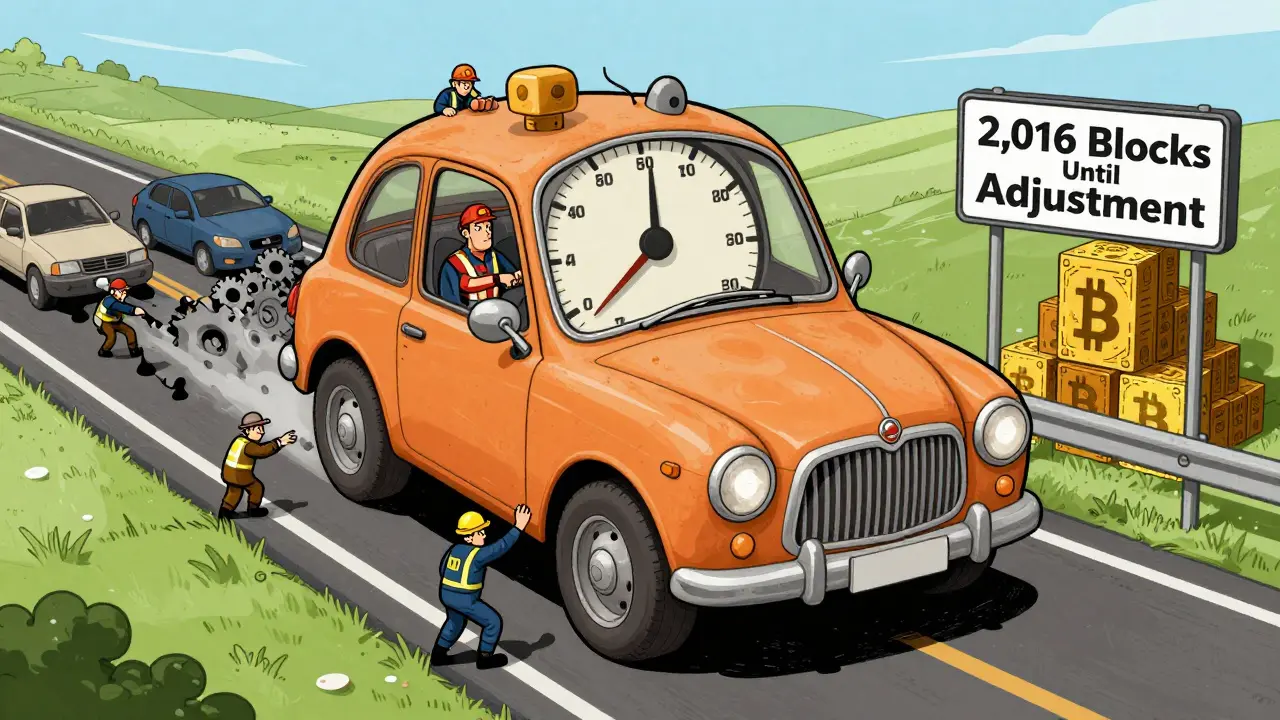

Adaptive mining difficulty is transforming blockchain networks by replacing slow, two-week adjustments with real-time tuning. It improves security, cuts energy waste, and stabilizes block times - but adoption faces resistance from miners and conservative networks like Bitcoin.