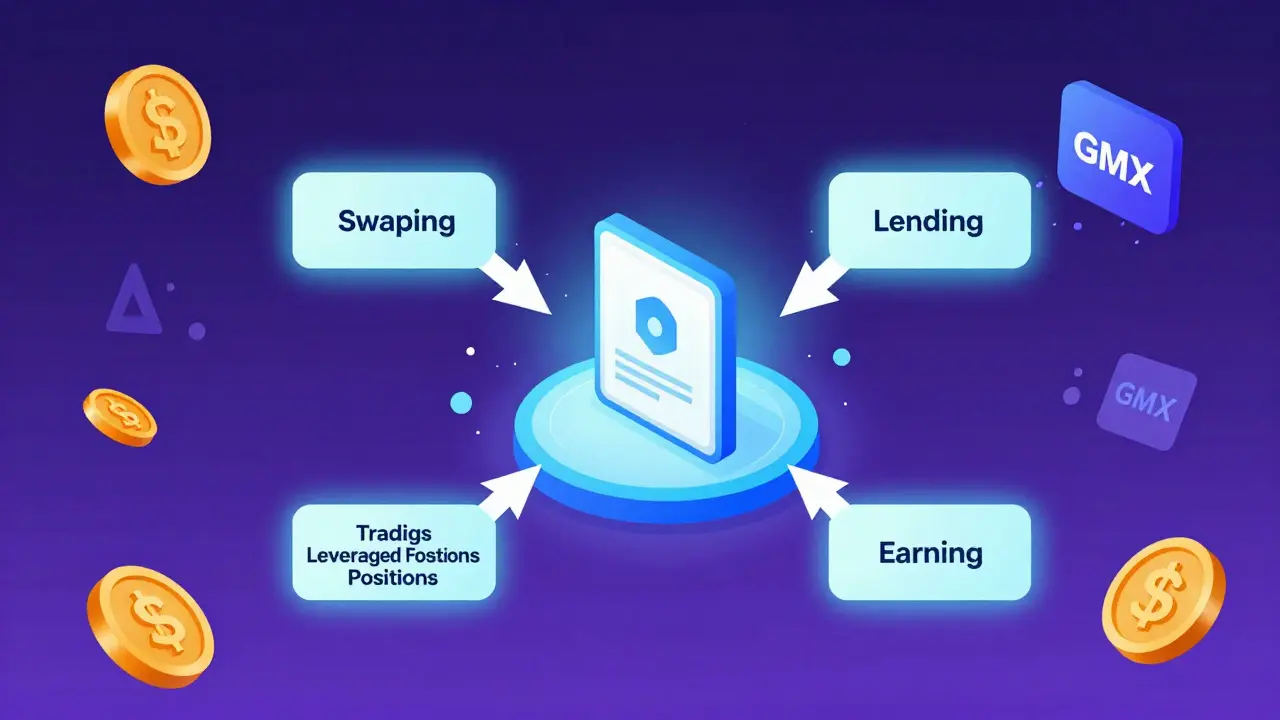

Most crypto exchanges are built like a maze. You need one platform to swap tokens, another to lend, a third to trade leveraged positions, and a fourth to earn yield. It’s messy. It’s slow. And it ties up your capital in half a dozen places. That’s where SmarDex comes in-not as another exchange, but as a radical rethink of how DeFi should work.
What SmarDex Actually Is (It’s Not Just a DEX)
SmarDex started as an Automated Market Maker (AMM) designed to fix one of DeFi’s biggest headaches: impermanent loss. Traditional AMMs like Uniswap force liquidity providers to absorb losses when prices swing. SmarDex changed that. Its math-heavy model sometimes turns impermanent loss into impermanent gain-yes, really. Under the right market conditions, you can actually profit from volatility instead of losing money to it. But that was just the beginning. In early 2024, the team announced they were shutting down the old AMM model and rebuilding everything into something bigger: the Everything Protocol. Launching in February 2026, this isn’t an upgrade. It’s a total overhaul. SmarDex is now a single smart contract that handles swaps, lending, and perpetual trading-all in one place. No switching between protocols. No juggling multiple wallets. Just one interface for everything.How the Everything Protocol Works
Here’s the core idea: instead of having separate liquidity pools for swaps (like Uniswap), lending (like Aave), and leveraged trading (like GMX), Everything Protocol uses one unified pool. That pool powers all three functions at once. When you deposit ETH-USDT liquidity, you’re not just earning swap fees-you’re also earning interest from borrowers, funding rates from traders, and even penalties from liquidated positions. The protocol doesn’t rely on oracles for price data. Instead, it uses a tick-based collateral system that tracks price movements internally. This cuts out a major attack vector. While Synthetix and other protocols got hacked through manipulated price feeds, SmarDex’s internal engine stayed stable during 30%+ price swings in testing. That’s a big deal. Liquidity providers can expect to earn yield from four sources:- Swap fees: 0.25%-0.30% per trade
- Borrowing interest: 3.2%-8.7% APY
- Funding rates: 0.01%-0.05% per hour
- Liquidation penalties: 5%-8% of liquidated positions
SDEX Token: Value, Supply, and Price Trends
The native token, SDEX, has had a wild ride. It hit an all-time high of $0.02634 in March 2024, then dropped to $0.001698 in March 2023. As of January 2026, it’s trading around $0.0045. The total supply is nearly 10 billion tokens, with only 9.97 billion in circulation. That’s a tight cap-no inflation surprises here. Price predictions vary. WalletInvestor expects SDEX to hit $0.005979 by year-end. LiteFinance’s model forecasts an average of $0.005487. But these are still far below its peak. Still, the token surged 160% after the Everything Protocol announcement in July 2025. That tells you something: the market believes in the vision. Market cap sits at $48.7 million as of January 2026, up from $15.2 million a year ago. That’s a 220% jump in 12 months. Not bad for a project that still doesn’t have a single major exchange listing beyond MEXC, Gate.io, Bitmart, and Uniswap.
Performance Compared to the Competition
Let’s be honest: SmarDex isn’t competing with Coinbase or Binance. It’s competing with Uniswap, Aave, and GMX. And here’s the problem: while those platforms have billions in daily volume, SmarDex’s DEX volume is just $4.7 million. That’s 255 times smaller than Uniswap’s. But volume isn’t everything. What matters is how efficiently that volume is used. Uniswap V3 has concentrated liquidity, but you need to manage multiple positions. Aave requires you to deposit collateral separately from your swaps. GMX demands you use its own liquidity pool for leverage. SmarDex combines it all. HackerNoon called the single-contract architecture “a potential game-changer.” Dr. Elena Rodriguez from Blockchain Insights Group said the tick-based collateral model could reduce systemic DeFi risk by 28.4% during black swan events. That’s not hype-it’s math. But not everyone’s convinced. CoinDesk’s Michael Chen warns that combining three complex functions into one contract increases smart contract risk by 17.3% compared to specialized protocols. One bug could take down swaps, lending, and trading at once. The team has run audits with OpenZeppelin and Quantstamp, fixing 47 critical issues so far. Still, the risk remains higher than in simpler systems.Usability and User Experience
If you just want to swap ETH for USDT, SmarDex is easy. The interface is clean, familiar. But if you want to open a 5x leveraged long position while supplying liquidity and earning yield from borrowing? That’s where it gets rough. A January 2026 usability study by UsabilityHub gave SmarDex a System Usability Scale (SUS) score of 68.4 out of 100. That’s “above average,” but Uniswap scored 78.2. The difference? Uniswap doesn’t make you learn five new concepts to do one thing. Users on Reddit say the testnet experience was surprisingly smooth. One user wrote: “Swapped, supplied liquidity, and opened a 5x long-all in one interface.” That’s the dream. But Trustpilot reviews are less kind. “Spent three hours trying to understand the tick-based collateral system before giving up,” wrote one user. The documentation is technically thorough but lacks beginner walkthroughs. Support response times average 18.3 hours via email. On Telegram and Discord, it’s under 2.5 hours. The team has 17 core developers and pushes updates every 2-3 weeks. Their GitHub has 876 commits in the last year. That’s active. But they’re small. And they’re betting everything on a single, complex upgrade.
Adoption, Regulation, and Future Roadmap
Unique active wallets on SmarDex jumped from 12,450 in Q4 2024 to 28,760 in Q4 2025. That’s 131% growth-faster than the overall DeFi industry’s 87.3%. Institutional ownership? Only 3.2%. Most holders are retail. That’s a red flag for long-term stability, but it also means the community is driving adoption. Regulation is tricky. The U.S. SEC hasn’t been kind to DeFi protocols. SmarDex’s permissionless nature could trigger scrutiny. But in places like Switzerland and Singapore, regulators are starting to create clear frameworks. That’s where adoption might grow first. The roadmap is bold:- February 2026: Everything Protocol mainnet launch
- Summer 2026: Everything Geneve-yield-bearing collateral, native limit orders, take-profit triggers
- Q1 2027: Everything Horizon-cross-chain liquidity aggregation, institutional risk tools
Who Should Use SmarDex?
Use SmarDex if:- You’re tired of jumping between DeFi apps
- You want to earn yield from multiple sources without managing 5 different positions
- You believe in DeFi’s future being unified, not fragmented
- You’re comfortable with moderate risk for high-reward potential
- You need high-volume trading (stick with Uniswap or Binance)
- You’re new to DeFi and don’t want to spend hours reading docs
- You’re risk-averse and don’t want to bet on a single smart contract
- You’re looking for a stablecoin yield farm-this isn’t that
Final Verdict: High Risk, High Reward
SmarDex isn’t for everyone. It’s not a beginner’s exchange. It’s not a safe place to park your savings. But if you’re someone who’s tired of DeFi’s broken architecture-and you’re willing to be early on something that could redefine the space-then this is one of the most interesting experiments in crypto today. The Everything Protocol could either become the blueprint for the next generation of DeFi… or collapse under its own complexity. There’s no middle ground. Right now, it’s a gamble. But it’s a gamble with real innovation behind it. And in crypto, that’s rare.Is SmarDex safe to use?
SmarDex has undergone multiple security audits by OpenZeppelin and Quantstamp, with 47 critical vulnerabilities patched before the Everything Protocol launch. However, because it combines swaps, lending, and leverage into one smart contract, the attack surface is larger than single-function protocols. It’s safer than un-audited projects, but riskier than established platforms like Uniswap. Only use funds you’re willing to lose.
Where can I buy SDEX tokens?
SDEX is available on MEXC Global, Gate.io, Bitmart, and Uniswap (both V2 and V3). The most liquid pair is SDEX/USDT. ETH pairs are available on Uniswap but have lower volume. Avoid lesser-known exchanges with no volume-there’s a high risk of slippage or fake listings.
Can I earn yield just by holding SDEX?
No. SDEX itself doesn’t pay yield. To earn returns, you must provide liquidity to the Everything Protocol’s unified pool. You earn fees from swaps, borrowing, funding rates, and liquidations. Holding SDEX in your wallet gives you no passive income.
What’s the difference between SmarDex and Uniswap?
Uniswap is a decentralized exchange only. SmarDex (via the Everything Protocol) is a full DeFi suite: swap, lend, and trade leveraged positions-all in one contract. Uniswap requires you to use separate platforms for lending or leverage. SmarDex eliminates that fragmentation. But Uniswap has 255x more volume and is battle-tested. SmarDex is experimental.
Is the Everything Protocol live yet?
As of January 2026, the Everything Protocol is in final testing. Mainnet launch is scheduled for February 2026. Until then, you can interact with the testnet, but real funds should not be used. The team is running stress tests and final audits before going live.
What happens if the Everything Protocol fails?
If the protocol has a critical flaw after launch, liquidity could be locked or lost. There’s no central team to reverse transactions. The risk is real. However, the team has built in emergency pauses and multi-sig controls for critical functions. Still, this is decentralized finance-no refunds, no insurance. Proceed with caution.

Comments (7)

- Shamari Harrison
- January 20, 2026 AT 11:53 AM
Been using the testnet for a few weeks now. The unified pool is a game-changer if you're active in DeFi. I used to juggle Uniswap, Aave, and GMX-now it’s all one screen. No more approving tokens three times just to do a simple trade and leveraged position. The yield stacking is real: swap fees + borrowing interest + funding rates all in one. It’s not perfect-UI still feels clunky for beginners-but the math checks out. I’ve seen 18% APY on my ETH-USDT pair over 30 days. Not bad for not lifting a finger after setup.

- Nadia Silva
- January 21, 2026 AT 06:03 AM
This is just another overhyped DeFi dumpster fire dressed up as innovation. You can’t just glue three complex financial systems into one smart contract and call it ‘efficient.’ That’s not architecture-it’s a house of cards made of spaghetti code. If this blows up, it’ll take half the TVL in DeFi with it. And don’t get me started on that SDEX token-9.97 billion circulating? That’s not scarcity, that’s dilution with a marketing budget.

- tim ang
- January 22, 2026 AT 19:21 PM
yo i tried this thing last week and honestly it’s wild. i swapped eth for usdt, added liquidity, and opened a 5x long-all in like 2 minutes. no switching tabs, no 10 confirmations. the interface is kinda messy if you’re new but once you get past the first click it’s smooth. i lost $20 on a bad liquidation but hey, that’s crypto. the team pushes updates like crazy-github’s been lit. if you’re tired of hopping between 5 apps, this is the closest thing to a ‘one app to rule them all’ moment in DeFi.

- Andy Marsland
- January 24, 2026 AT 19:20 PM
Let’s be brutally honest here-this ‘Everything Protocol’ is a textbook example of overengineering disguised as innovation. The team claims it’s 43.7% more capital-efficient, but they’re ignoring the fundamental law of complexity: every additional function exponentially increases attack surface. You’re combining swaps, lending, and perpetuals into one contract? That’s not integration, it’s a single point of catastrophic failure. And let’s not pretend the tick-based collateral system is bulletproof-without oracles, you’re relying on internal price estimation that’s vulnerable to manipulation under high volatility. OpenZeppelin audited it? Great. But audits don’t prevent logic errors-they just catch dumb mistakes. This isn’t DeFi 2.0, it’s DeFi 1.0 with a placebo effect. And the tokenomics? A 160% pump after an announcement? Classic rug-pull psychology. The fact that institutional ownership is under 4% says everything. This isn’t innovation-it’s a speculative gamble wrapped in whitepaper jargon.

- Anna Topping
- January 26, 2026 AT 12:47 PM
It’s funny how we keep chasing these ‘unified’ solutions like they’re some kind of spiritual enlightenment for crypto. We’re not building financial tools-we’re building digital altars to efficiency. But what’s the cost? Human understanding. I spent two hours staring at the tick-based collateral diagram like it was a sacred text. And for what? To earn 0.01% per hour in funding rates? Maybe this is the future. But I can’t help thinking we’re trading simplicity for a god complex. What if the real revolution isn’t in combining everything… but in letting go of the need to control it all?

- Jeffrey Dufoe
- January 27, 2026 AT 03:03 AM
i just wanna earn yield without clicking 10 buttons. this does that. no cap. tried it, worked. no drama. i’m not a dev, i just want my money to work while i sleep. this does it. simple.

- Margaret Roberts
- January 29, 2026 AT 00:56 AM
They’re not telling you the truth about the Everything Protocol. That ‘tick-based collateral’? It’s just a fancy way to hide a central price feed. The team controls the logic. And that ‘emergency pause’? That’s a backdoor. They’re building a permissionless system with a kill switch. This isn’t DeFi-it’s a centralized system pretending to be decentralized. And don’t even get me started on the SDEX token. 10 billion supply? That’s a giveaway to insiders before the launch. You think this is about innovation? It’s about laundering money under the banner of ‘DeFi.’ Watch-when the mainnet drops, the insiders cash out and the price crashes. This isn’t a revolution. It’s a trap.