
Imagine you are trying to send a letter. In the traditional world, you drop it in a mailbox, and the postal service-a central authority-sorts, transports, and delivers it. If the post office burns down or decides to censor your mail, communication stops. Now imagine a world where every person on the street holds a copy of every letter ever sent, and they all agree on what is written without needing a postmaster. This is the fundamental shift from client-server models to peer-to-peer (P2P) networks, and it is the backbone of why blockchain technology exists.
Most of the internet we use daily relies on a centralized structure. When you check your email or browse social media, your device (the client) asks a powerful remote computer (the server) for data. But blockchain rejects this hierarchy. It adopts P2P architecture not just as a technical preference, but as a philosophical necessity for trustlessness and censorship resistance. Understanding this architectural choice explains why Bitcoin cannot be shut down, why Ethereum remains resilient, and how decentralized finance operates without banks.
The Client-Server Model: The Centralized Standard
To understand why blockchain chose a different path, we first need to look at the status quo. The Client-Server Architecture is a computing model where clients request services and servers provide them, relying on a centralized point of control. Think of a restaurant. You (the client) sit at a table and order food. The kitchen (the server) prepares it and sends it back via waiters. The kitchen has all the resources, the recipes, and the authority. You have none of that; you just consume the output.
In digital terms, when you visit a website like Amazon or Netflix, your browser is the client. It is lightweight and does little heavy lifting. The massive data centers owned by Amazon or Netflix are the servers. They store the movies, process the payments, and manage the user accounts. This model offers several clear advantages:
- Centralized Control: Updates are easy. If Netflix wants to change its interface, it updates the server code once, and everyone sees the change instantly.
- Data Integrity: There is one source of truth. Your bank balance is stored in their database, so there is no confusion about whether you have $100 or $1000.
- Scalability for Resources: If traffic spikes, the company can simply add more powerful servers to handle the load.
However, this convenience comes with a critical flaw: the single point of failure. If the server goes down, the service dies. If the server owner decides to ban you, you lose access. If hackers breach the central database, all user data is compromised at once. For financial systems and identity records, this centralization creates a target-rich environment for attacks and corruption.
P2P Architecture: The Decentralized Alternative
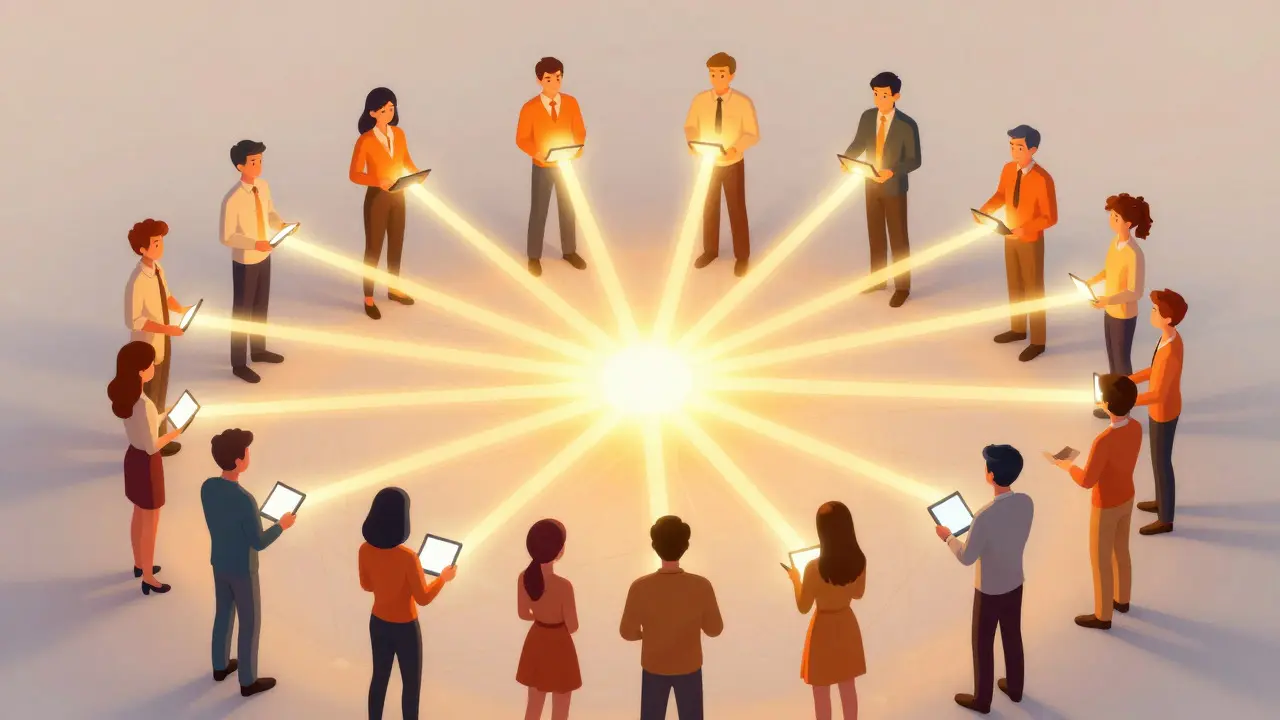
Peer-to-Peer (P2P) Network is a distributed architecture where each node acts as both a client and a server, sharing resources directly without central coordination. In a P2P network, there is no kitchen. Instead, imagine a potluck dinner where every guest brings a dish, eats others' dishes, and helps clean up. Every participant is equal. Every node has the same permissions and responsibilities.
Historically, P2P networks were used for file sharing. BitTorrent is the classic example. When you download a large file, you aren't pulling it from one supercomputer. You are pulling small pieces from dozens of other users who already have parts of the file. As you download, you simultaneously upload pieces to others. This distributes the bandwidth load across the entire network.
The key characteristics of P2P architecture include:
- Decentralization: No single entity controls the network. Authority is distributed among all participants.
- Redundancy: Data is replicated across many nodes. If one node fails, the data survives on thousands of others.
- Cost Efficiency: Infrastructure costs are shared. Instead of one company paying for massive data centers, every user contributes a small amount of storage and processing power.
While traditional P2P networks struggled with stability and security as they grew larger, blockchain technology solved these issues by adding cryptographic verification and economic incentives. This transformation turned a chaotic file-sharing protocol into a robust global financial infrastructure.
Why Blockchain Requires P2P: Eliminating Trust Issues
The core promise of blockchain is "trustless" operation. This doesn't mean you don't trust anyone; it means you don't need to trust a specific intermediary. You trust the math and the network consensus. A client-server model inherently requires trust in the server operator. You must believe Visa is recording transactions correctly. You must believe Google isn't manipulating search results. Blockchain removes this requirement by using P2P architecture.
In a blockchain P2P network, every full node maintains a complete copy of the ledger. When a new transaction occurs, it is broadcast to the entire network. Nodes validate the transaction against predefined rules (consensus mechanisms). Only if the majority agrees is the transaction added to a block. This process ensures that no single party can alter history or censor transactions without controlling more than half of the network's computational power or stake.
This design provides three critical benefits for blockchain applications:
- Censorship Resistance: Since data is everywhere, no government or corporation can easily shut down the network. To stop Bitcoin, you would need to shut down thousands of independent computers across dozens of countries simultaneously.
- Transparency: Anyone can run a node and verify every transaction. There are no hidden ledgers or secret accounting books.
- Resilience: The network continues to function even if significant portions of nodes go offline due to disasters, attacks, or voluntary withdrawal.
Comparing Architectures: A Technical Breakdown
To visualize the differences, let's compare how these architectures handle key operational aspects. The following table highlights the structural divergences between client-server and P2P models, specifically in the context of distributed systems.
| Feature | Client-Server Model | P2P Model (Blockchain) |
|---|---|---|
| Data Storage | Centralized databases on few servers | Distributed across all participating nodes |
| Control & Authority | Central administrator manages access and updates | Consensus algorithms determine validity; no admin |
| Single Point of Failure | Yes; server outage kills the service | No; network survives individual node failures |
| Scalability | Vertical scaling (bigger servers) or horizontal (more servers) | Horizontal scaling via node addition, but throughput limited by consensus |
| Cost Structure | High upfront and maintenance costs for server owners | Low entry cost; costs distributed among users |
| Privacy | Provider knows all user activity | Pseudonymous; addresses obscure real-world identity |
Notice the trade-off in scalability. Client-server models can scale vertically by buying faster processors. P2P networks scale horizontally by adding more nodes, but because every node must agree on every transaction, the speed of the network is often slower than a centralized database. This is why blockchain transactions take longer than credit card swipes. However, for applications where trust and immutability are more valuable than raw speed, P2P is the superior choice.
How Consensus Makes P2P Viable for Finance
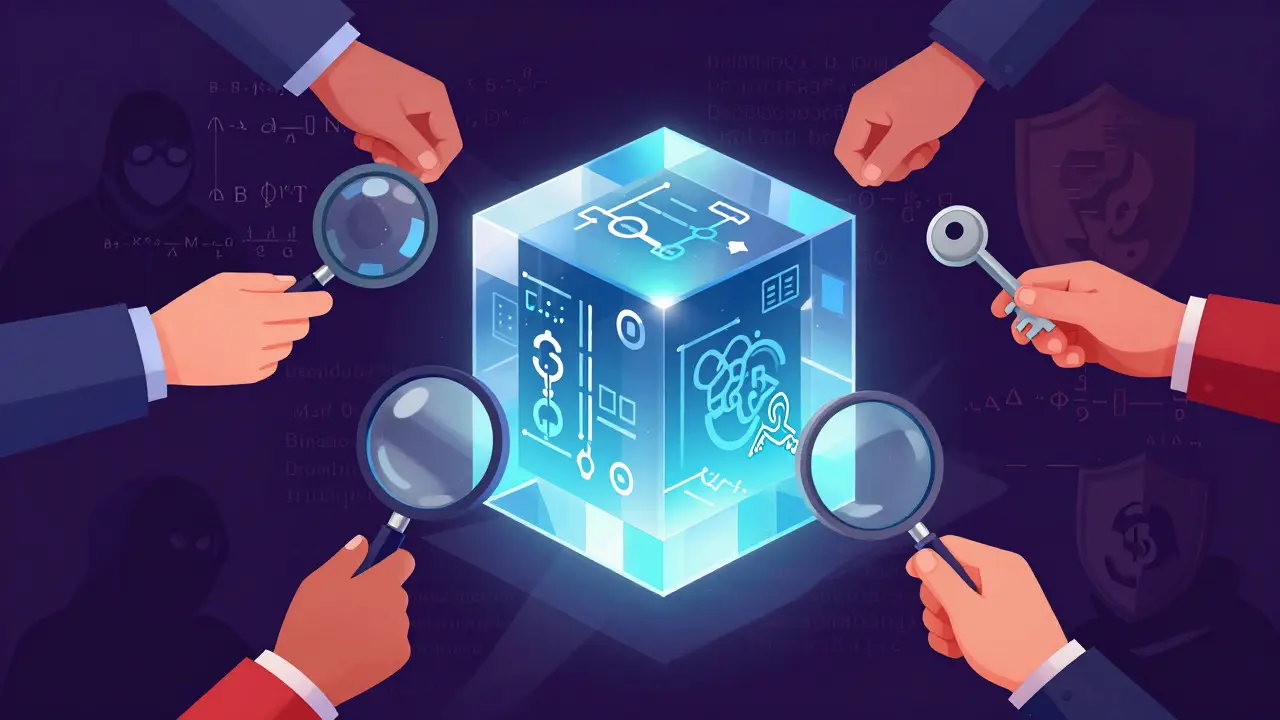
A major challenge with early P2P networks was coordination. How do peers agree on which version of a file is correct? In blockchain, this problem is solved through Consensus Mechanisms are protocols that allow distributed nodes to agree on the state of the ledger without a central authority.
Bitcoin uses Proof of Work (PoW), where miners compete to solve complex mathematical puzzles. The winner gets to add the next block and is rewarded with cryptocurrency. This makes attacking the network economically irrational because it requires massive energy expenditure. Ethereum has transitioned to Proof of Stake (PoS), where validators lock up coins as collateral. If they act maliciously, they lose their stake. These mechanisms transform the P2P network from a loose collection of peers into a coordinated, secure system.
Without consensus, P2P would just be another file-sharing protocol. With consensus, it becomes a global computer capable of executing smart contracts and managing digital assets securely. This combination allows blockchain to offer the resilience of P2P with the reliability required for financial transactions.
Real-World Implications and Future Trends
The adoption of P2P architecture in blockchain has profound implications for industries beyond finance. In supply chain management, P2P networks allow multiple companies to share a single source of truth without revealing proprietary secrets to a central third party. In healthcare, patient records can be stored on a P2P blockchain, giving patients control over who accesses their data while ensuring hospitals have verified information.
Current developments focus on overcoming the inherent latency of P2P networks. Layer-2 solutions like the Lightning Network for Bitcoin allow millions of microtransactions to occur off-chain, with only the final settlement recorded on the main P2P blockchain. Sharding, implemented in Ethereum 2.0, splits the blockchain into smaller pieces (shards) that can be processed in parallel by different groups of nodes, significantly increasing throughput while maintaining decentralization.
As Internet of Things (IoT) devices proliferate, P2P blockchain networks may enable machine-to-machine economies. Sensors could pay each other for data or services using micropayments on a decentralized network, eliminating the need for central billing platforms. This evolution suggests that P2P architecture will become increasingly central to the infrastructure of the digital economy, offering a robust alternative to fragile centralized systems.
Is P2P always better than client-server?
Not necessarily. For most everyday applications like streaming video or social media, client-server models are more efficient, easier to manage, and provide better performance. P2P is superior when decentralization, censorship resistance, and trustlessness are critical requirements, such as in cryptocurrencies and decentralized finance.
Can a blockchain network be hacked?
While individual nodes or wallets can be compromised, hacking the entire blockchain network is extremely difficult. It would require controlling more than 50% of the network's computational power (in PoW) or stake (in PoS), known as a 51% attack. For major networks like Bitcoin and Ethereum, this is currently economically unfeasible.
What is the role of a node in a P2P blockchain network?
A node is any computer connected to the network that stores a copy of the blockchain and validates transactions. Full nodes ensure the integrity of the network by rejecting invalid blocks, while light nodes rely on full nodes for data but still participate in the network's security through consensus participation.
Why is blockchain slower than traditional banking?
Traditional banking uses centralized databases that can process thousands of transactions per second. Blockchain requires all nodes to reach consensus on each transaction, which takes time. Additionally, blocks are created at fixed intervals (e.g., every 10 minutes for Bitcoin) to ensure stability and prevent forks, limiting throughput compared to centralized systems.
Does P2P architecture guarantee anonymity?
P2P provides pseudonymity, not true anonymity. Transactions are linked to public addresses rather than names, but all transaction history is visible on the public ledger. Advanced analysis techniques can sometimes link addresses to real-world identities. True anonymity requires additional privacy-enhancing technologies like zero-knowledge proofs or mixing services.