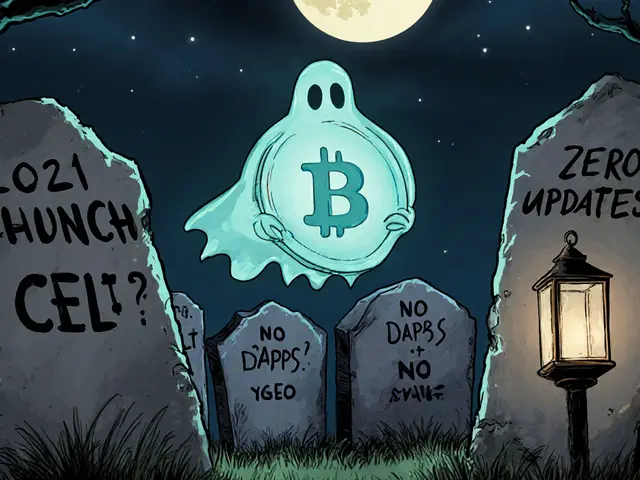

Remember the rush of early 2022? The Lunar Crystal NFT airdrop by Lunar was one of those fleeting moments where everyone scrambled for free digital assets on Binance Smart Chain. If you were hunting for passive income or just collecting shiny tokens, you likely saw the announcement. But here is the cold truth: today, that project is mostly a ghost story. It serves as a perfect case study in how quickly hype evaporates when substance doesn't follow.
The Promise vs. The Reality
Lunar positioned itself as a DeFi ecosystem aiming to "revolutionize how we interface with crypto." Sounds ambitious, right? They promised passive earnings distribution to token holders, which was the buzzword du jour in Q1 2022. The Lunar Crystal NFT wasn't just art; it was pitched as a key to community engagement. Participants were told they would receive "at least 1 NFT" simply by completing social tasks. It felt easy. Too easy?
Most people didn't ask hard questions then. Why? Because the bull market made us all optimistic. We clicked links, connected wallets, and hoped for the best. Now, looking back from September 2026, we can see what actually happened. The technical details were sparse. No whitepaper deep dive. No GitHub repository linked in major announcements. Just a website promising "magical experiences" built on Azure and .NET, which is weirdly traditional for a blockchain project claiming decentralization.
How the Airdrop Actually Worked
If you tried to participate back in March 2022, the process was straightforward but vague. You needed a BSC-compatible wallet like MetaMask or Trust Wallet. Then, you had to link through CoinMarketCap. This integration was supposed to be a trust signal. After all, who doesn't trust CMC? But unlike other projects that laid out clear steps-like following Twitter, liking Facebook pages, or chatting with Telegram bots-Lunar's instructions were thin.
- Wallet Connection: Required a standard BSC wallet setup.
- Social Verification: Basic account linking, though specifics varied by user report.
- Claim Mechanism: Unclear. Many users reported waiting indefinitely for their NFTs to appear.
The lack of clarity caused friction. In contrast, competitors like Baby Ape Beast (BAB) offered specific traits and VIP tiers. BAB even promised 3D NFTs for long-term holders. Lunar? It just said "here is a crystal." And for many, that crystal never showed up in their wallet.
| Feature | Lunar Crystal (LNR) | Baby Ape Beast (BAB) | Typical Ethereum Project |
|---|---|---|---|
| Blockchain | Binance Smart Chain | Binance Smart Chain | Ethereum Mainnet |
| Participation Cost | Low Gas Fees | Low Gas Fees | High Gas Fees ($50-$200+) |
| Transparency | Low (No Whitepaper Link) | Medium (Clear Roadmap) | High (Audited Contracts) |
| Utility Claim | Passive Earnings | Community Access/Minting | Varied (Gaming, DAO, etc.) |
| Current Status (2026) | Inactive/Abandoned | Niche Community | Established Market |
Why Did It Fade Away?
You might wonder why Lunar disappeared so completely. It wasn't just bad luck. The project lacked critical infrastructure. There were no audits from security firms like CertiK or OpenZeppelin. For context, contemporaries like Scroll and Linea received detailed tech scores above 89%. Lunar? Silence. No expert reviews. No community forums buzzing with debate. Just a quiet fade into obscurity.
This silence speaks volumes. When a project has real traction, people talk about it. They complain about bugs. They brag about gains. With Lunar, there was virtually zero user feedback documentation. No Reddit threads. No Twitter sentiment analysis. This suggests either extremely low participation or a total failure to deliver on promises. If you claimed an NFT, did you ever use it? Probably not. It sat in your wallet, a digital souvenir of a trend that passed.
The Broader Lesson for Crypto Investors
What does the Lunar Crystal story teach us now, in 2026? First, check the code. If a project claims to be decentralized but runs on centralized tech stacks without open-source verification, be skeptical. Second, look for community activity. A dead Discord or empty Telegram group is a red flag. Third, beware of "passive earnings" promises without a clear revenue model. How does Lunar pay you if it doesn't make money?
The market has matured since 2022. Today, investors demand proof of work. They want audits, active development, and transparent tokenomics. The era of "click this link, get free token" is over for serious players. While new airdrops still exist, they are far more rigorous. Projects like Abstract Chain require significant holdings and complex point systems. Lunar's simplicity was its downfall because it signaled a lack of depth.
Is There Any Value Left?
So, should you go digging through old wallets for a Lunar Crystal NFT? Honestly, probably not. The secondary market liquidity for these assets is near zero. No major exchanges list them. No collectors are bidding on them. The domain lunar.io still exists, but it pivoted away from NFTs entirely. Their current focus is on general Web3 experiences, with no mention of LNR or the Crystal collection.
If you hold the token, it’s essentially a historical artifact. It reminds us of the speculative frenzy of the early 2020s. It’s cool to show friends, "Hey, I was there," but don't expect a return on investment. The opportunity cost of holding illiquid, abandoned assets is high. Better to move capital to projects with active roadmaps and verified teams.
What was the Lunar Crystal NFT?
It was a promotional non-fungible token distributed by the Lunar DeFi project in early 2022. Users received it for free by completing social media tasks and connecting via CoinMarketCap. It was intended to grant access to passive earnings within the Lunar ecosystem, though this utility rarely materialized for most holders.
Is the LNR token still valuable?
Currently, the LNR token holds negligible value. Trading volume is minimal to non-existent on major exchanges. Most holders consider it a sunk cost or a collectible rather than a financial asset. Always check live market data before making any decisions, but expectations should be very low.
Why did the Lunar project fail?
The project suffered from a lack of transparency, missing technical audits, and unclear utility for its tokens. Additionally, the broader crypto market downturn after Q1 2022 wiped out many speculative projects that lacked sustainable business models. The absence of community engagement and developer updates sealed its fate.
Can I still claim the Lunar Crystal NFT?
No. The airdrop campaign concluded in early 2022. The official channels for claiming have been inactive for years. If you missed the window, you cannot retroactively claim the NFT. Current efforts by the Lunar team focus on different product lines unrelated to this specific collection.
Was the Lunar airdrop a scam?
It is difficult to label it a malicious scam without evidence of rug pulls or stolen funds. However, it fits the profile of a "zombie project"-one that launched with hype but failed to deliver on promises due to poor execution or lack of funding. It wasted users' time and attention, which is a cost in itself.