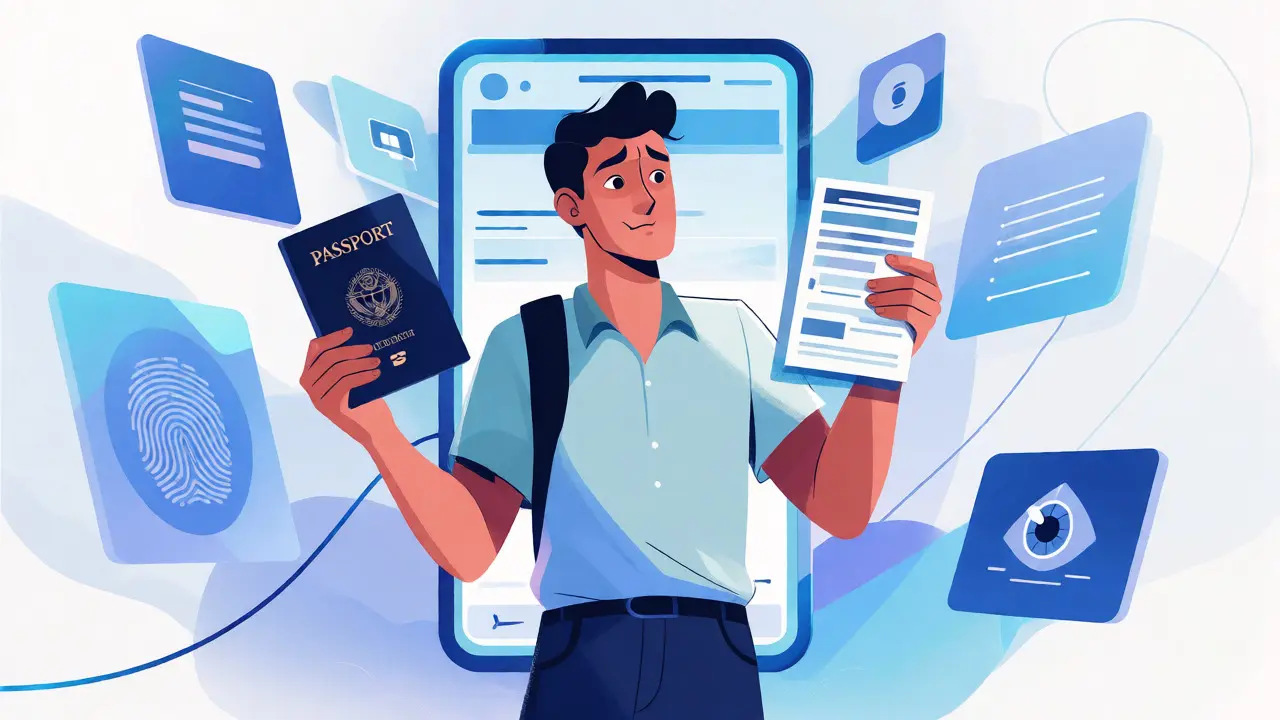

You hand over your passport, a selfie, and maybe a utility bill to open a bank account or sign up for a crypto exchange. It feels routine. But behind that quick upload sits a massive, fragile web of sensitive data known as Know Your Customer (KYC) data. If this information leaks, it’s not just an inconvenience; it’s a potential identity theft nightmare. With the global KYC compliance market projected to hit $3.02 billion by 2027, the stakes have never been higher.
Why does this matter right now? Because the old way of storing your digital identity is breaking. Centralized databases are honeypots for hackers. The Financial Stability Board reported that inadequate KYC security contributed to 43% of the $2.7 billion in anti-money laundering fines issued globally in 2022 alone. You need to understand how to keep your data safe, whether you’re a consumer uploading documents or a business handling them. Let’s look at what actually protects your identity and where the cracks are forming.
The Evolution of Identity Verification
KYC didn’t start with blockchain. It began with the Bank Secrecy Act of 1970 in the US, but it exploded after the USA PATRIOT Act of 2001. Today, it’s the cornerstone of Anti-Money Laundering (AML) frameworks in 189 jurisdictions. The goal is simple: stop bad actors from washing dirty money through clean systems. But the method has shifted from manual checks to high-speed automated verification.
Traditional banks used to take weeks to verify you. Manual document checks were slow and error-prone. Now, AI-powered platforms like Onfido and Trulioo can verify you in under five minutes. They use biometric matching with accuracy rates exceeding 98.5%, according to NIST tests. This speed is great for user experience, but it creates a new problem: volume. When millions of people are verified instantly, the amount of Personally Identifiable Information (PII) being processed skyrockets. More data means more surface area for attacks.
Technical Shields: Encryption and Standards
So, how is your data actually protected once you hit "submit"? It comes down to encryption standards. Reputable financial institutions must use AES-256 encryption for data stored on their servers (data at rest) and TLS 1.2 or higher for data moving between your device and their server (data in transit). These aren't optional suggestions; they are mandated by standards like PCI DSS version 4.0.
But encryption is just the lock on the door. The key management is where things get tricky. Many breaches happen not because the encryption was weak, but because the keys were mishandled or accessed by unauthorized employees. A 2024 survey found that 58% of compliance officers cited employee errors during manual verification as their top security issue. That’s why modern systems are moving toward risk-based authentication. Instead of asking everyone for three factors of identification, smart systems analyze transaction risk. Low-risk logins might only need one factor, while high-value transfers trigger multi-factor challenges. This reduces friction for users while tightening security where it counts.
The Privacy Paradox: GDPR and CCPA
Here is the conflict most people don’t see coming. Regulations demand we collect more data for security, but privacy laws like GDPR (General Data Protection Regulation) and CCPA restrict how long we can keep it. GDPR fines can reach 4% of a company’s global annual turnover. For a giant like Deutsche Bank, which faced a $225 million fine in early 2024 for poor KYC controls, that’s real money.
Companies are now forced to practice data minimization. They should only collect what they strictly need. Yet, many legacy systems hoard data "just in case." This creates bloated databases that are harder to secure. If a hacker gets into a centralized database holding ten years of unused customer records, they’ve got a goldmine. The solution isn’t just better firewalls; it’s smarter data lifecycle management. Deleting old, unnecessary records reduces the blast radius of any potential breach.

Blockchain and Decentralized Identity
This is where blockchain enters the conversation. Traditional KYC relies on centralized silos. Each bank holds its own copy of your data. If you switch banks, you often re-upload everything. Blockchain offers a different path: Self-Sovereign Identity (SSI) systems. In this model, you hold your own credentials in a digital wallet. When a service needs to verify you, you share a cryptographic proof rather than the raw data.
Imagine proving you’re over 18 without revealing your exact birth date or address. That’s the power of zero-knowledge proofs (ZKPs). A study by MIT’s Digital Currency Initiative found that ZKP implementations could reduce data exposure by 89%. However, adoption is slow. Only about 41% of financial institutions are piloting these systems, largely due to interoperability issues. There are 195 jurisdictions with varying rules, making a single global standard difficult to achieve. Still, 92% of top cryptocurrency exchanges already use blockchain-based KYC solutions, showing that the tech-forward sectors are leading the charge.
Vendor Risks and Third-Party Leaks
Most fintech companies don’t build their own verification engines. They plug in third-party APIs from providers like LexisNexis or Jumio. This convenience introduces supply chain risk. If your vendor gets hacked, your customers’ data leaks too. A Reddit thread on FinTech implementation nightmares highlighted that 63% of professionals fear third-party vendor leaks the most. One European bank lost 12,000 customer records because a compromised identity verification API failed.
When choosing a provider, look beyond marketing claims. Check their ISO 27001 certification status and ask about their incident response plans. Documentation quality matters too. Reviews show that platforms with clear, updated developer docs, like Onfido, tend to integrate more securely than those with outdated guides. If the integration is messy, the security posture usually suffers.
| Feature | Traditional Banking KYC | Modern RegTech / Blockchain KYC |
|---|---|---|
| Onboarding Time | 2-4 weeks (manual review) | < 5 minutes (automated/AI) |
| Fraud Detection Accuracy | 75-80% | Up to 99.8% (Deep Learning) |
| Data Storage Model | Centralized Silos | Decentralized / User-Controlled Wallets |
| Abandonment Rate | 30-40% | < 5% |
| Primary Risk Vector | Manual Error / Insider Threat | API Vulnerabilities / Smart Contract Bugs |

Best Practices for Users and Businesses
If you are a consumer, you can’t control the backend, but you can protect yourself. Use unique passwords for financial accounts. Enable two-factor authentication (2FA) everywhere. Be wary of services that ask for excessive documentation upfront. If a platform asks for your social security number when it only needs your name and email, question it.
For businesses, the playbook is clearer. Automate where possible to reduce human error. Implement strict access controls so only authorized personnel can view raw PII. Regularly audit your third-party vendors. And crucially, adopt privacy-by-design principles. Don’t bolt security on at the end; bake it into the architecture from day one. Institutions that treat KYC as a trust-building tool rather than a checkbox see lower churn rates. Customers notice when their data is handled with care.
The Future: Harmonization and Automation
We are heading toward a more unified global framework. The EU’s 6th Anti-Money Laundering Directive and the US Corporate Transparency Act are pushing for stricter beneficial ownership reporting. This increases compliance costs by roughly 22% year-over-year, but it also standardizes expectations. We might see a "digital euro" identity framework by 2025, which could streamline cross-border verification across Europe.
Ultimately, the future of KYC data security lies in balancing transparency with privacy. Technologies like ZKPs and decentralized identifiers will likely become mainstream as computational costs drop. Until then, vigilance is key. Whether you’re managing a bank’s compliance department or just opening a trading account, remember: your identity is your most valuable asset. Treat it that way.
What happens if my KYC data is breached?
If your KYC data is breached, you face increased risk of identity theft and fraud. Financial institutions are legally required to notify affected users, often within 72 hours under regulations like GDPR. You should immediately monitor your credit reports, change passwords for all linked accounts, and consider placing a fraud alert on your file. In severe cases, you may be eligible for compensation or credit monitoring services provided by the institution.
Is blockchain KYC safer than traditional methods?
Blockchain KYC can be safer because it reduces reliance on centralized databases, which are prime targets for hackers. By using cryptographic proofs and allowing users to control their own data via wallets, it minimizes the storage of raw personally identifiable information. However, it is not immune to risks; vulnerabilities can exist in the smart contracts or the off-chain storage layers. Safety depends on the specific implementation and the security of the underlying infrastructure.
How long do companies keep KYC data?
Retention periods vary by jurisdiction and regulation. Generally, financial institutions must keep KYC records for at least five years after the end of the business relationship, as recommended by FATF guidelines. Some regions require longer retention. However, privacy laws like GDPR encourage data minimization, meaning companies should delete data sooner if it is no longer necessary for legal or regulatory purposes.
Can I refuse to provide KYC information?
You can refuse, but the consequence is usually that you cannot open or maintain an account with regulated financial institutions. KYC is a legal requirement for banks, brokerages, and crypto exchanges to comply with anti-money laundering laws. Without successful verification, these entities are prohibited from providing services to you, regardless of your personal preference.
What is a Zero-Knowledge Proof in KYC?
A Zero-Knowledge Proof (ZKP) is a cryptographic method that allows one party to prove to another that a statement is true without revealing any information beyond the validity of the statement itself. In KYC, this means you can prove you are over 18 or a resident of a certain country without sharing your actual birth date or home address. This significantly reduces the amount of sensitive data exposed during verification.