
You see the notification. Maybe it’s a tweet from an influencer or a pop-up on a crypto news site. It promises free tokens, passive income, and a listing on CoinMarketCap. The project is Golden Doge (GDOGE), a meme token that claims to pay you just for holding it. But before you rush to claim your share, we need to look at what is actually happening behind the scenes.
I’ve spent time digging into the data behind this specific airdrop and the token's current status. The short answer? Proceed with extreme caution. While the mechanism sounds appealing on paper, the reality of the market activity tells a very different story. Let’s break down exactly how this works, where the money comes from, and why most experts are steering clear.
The Golden Vault Mechanism Explained
To understand if this airdrop is worth your time, you first have to understand how the token pays out. Golden Doge operates on the Binance Smart Chain (BSC), which means transactions are fast and cheap compared to Ethereum. The core feature is something called the "Golden Vault."
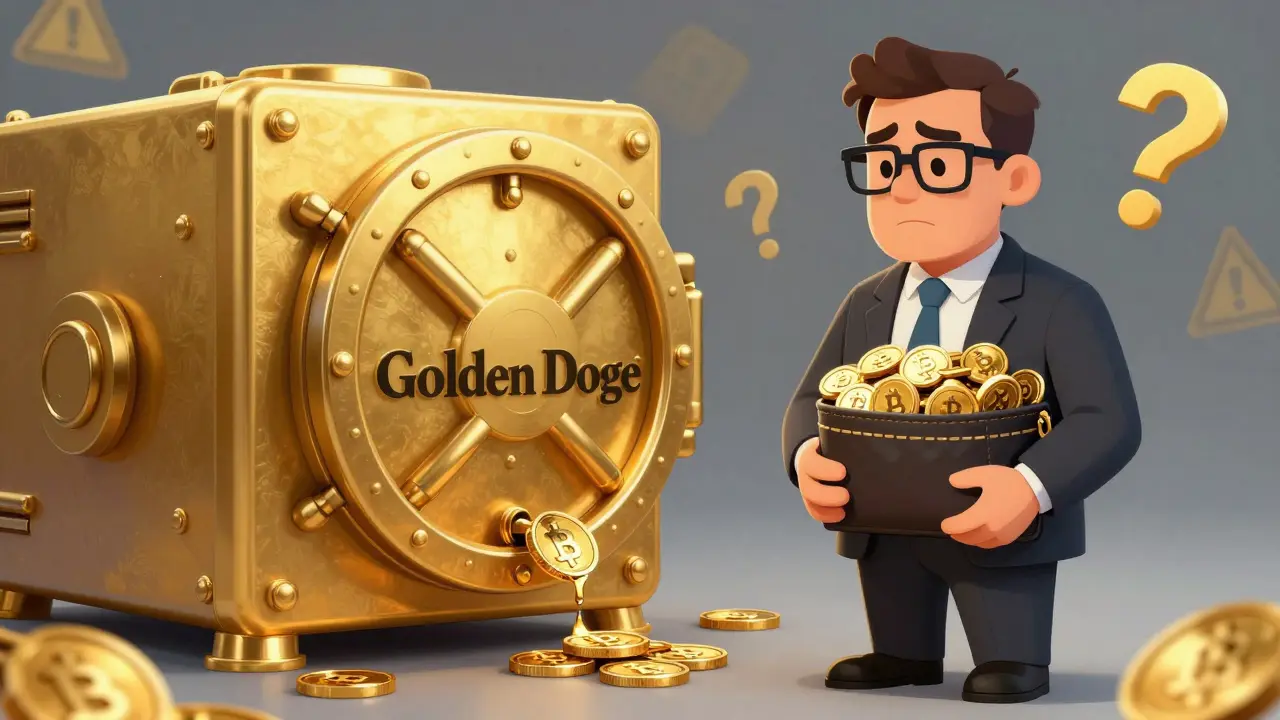
Here is how it works in theory: every time someone buys or sells GDOGE, a 10% tax is applied. That’s 5% on the buy and 5% on the sell. Instead of going to the developers' pockets, these fees are sent to a smart contract-the Golden Vault. This vault then redistributes those funds, in the form of BNB (the native currency of BSC), to all wallet holders who own GDOGE.
If you hold 1% of the total supply, you get 1% of the daily rewards. You can claim these rewards once every 24 hours. On the surface, this looks like a passive income stream. You buy tokens, wait, and watch your BNB balance grow. But there is a massive catch: the rewards depend entirely on trading volume. If no one is buying or selling, the vault stays empty.
| Attribute | Value / Detail |
|---|---|
| Total Supply | 100 Quadrillion (100P) GDOGE |
| Airdrop Allocation | 5 Quadrillion (5% of total supply) |
| Transaction Tax | 10% (5% Buy, 5% Sell) |
| Reward Currency | BNB (claimed every 24 hours) |
| Network | Binance Smart Chain (BEP-20) |
The Reality of the Airdrop Distribution
The initial distribution plan allocated 5 quadrillion tokens specifically for community airdrops. That is a huge number. But remember, the total supply is 100 quadrillion. Inflation is a major issue here. When a token has such a massive supply, each individual token becomes incredibly cheap.
Let’s put that in perspective. Even if the price were $0.000000000001 per token, the market cap would be $100 million. Currently, GDOGE trades at a fraction of that-around $0.000000000000000003. This means that even if you received millions of tokens in an airdrop, their monetary value is likely negligible unless the trading volume explodes.
Most users find themselves in a difficult spot. They hold billions of tokens, but because the price is so low and the volume is so thin, they cannot sell them without crashing the price further. This is known as a "liquidity trap." You might have tokens, but you don't have cash.
CoinMarketCap Listing: What It Really Means
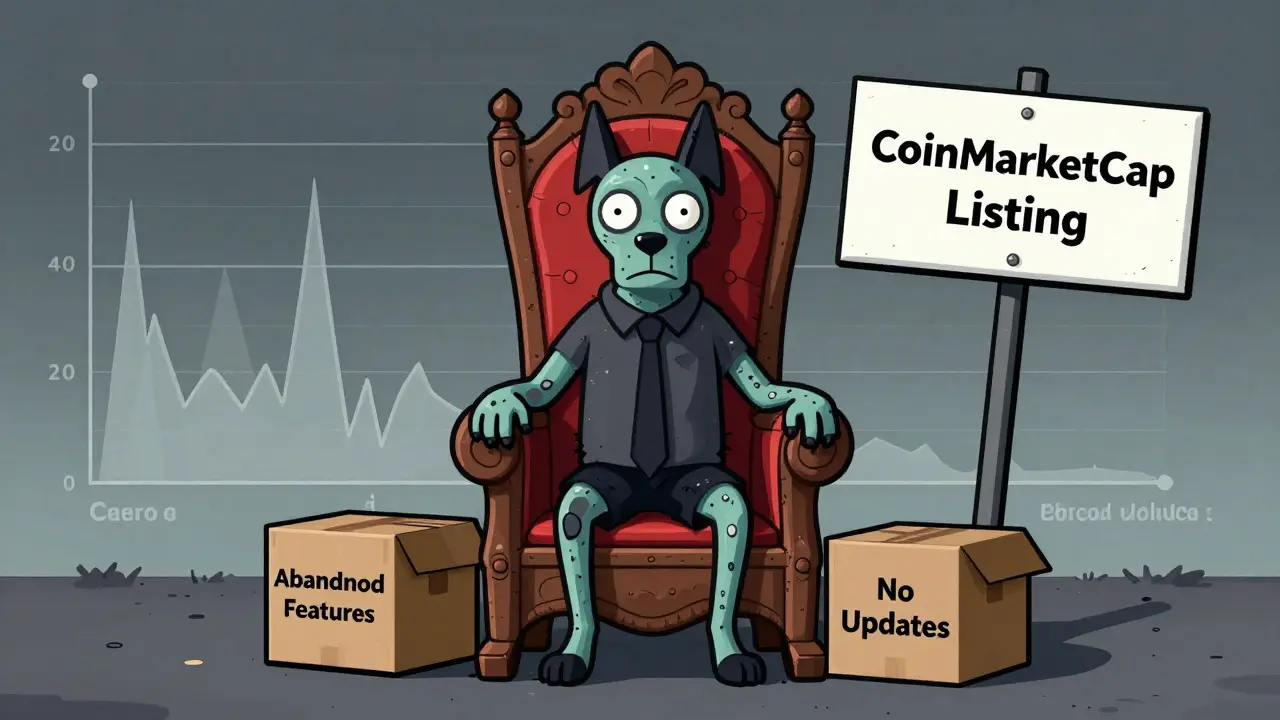
Seeing a logo next to "CoinMarketCap" often gives projects a false sense of legitimacy. Users assume that if it’s listed on CMC, it must be safe. However, CoinMarketCap lists thousands of tokens, including many that are inactive or abandoned.
GDOGE was listed based on meeting minimum technical requirements. According to internal documentation and transparency reports, it falls under a lower tier classification. This means it has passed basic checks for being a valid BEP-20 token, but it does not imply endorsement of its quality, utility, or long-term viability. Many "zombie tokens"-projects with no active development-remain listed simply because they still exist on the blockchain.
As of late 2025, GDOGE shows extremely low market activity. Its 24-hour trading volume has dropped to single digits (around $8.28). Compare this to major meme coins like Dogecoin or Shiba Inu, which trade in billions daily. Without volume, the Golden Vault generates almost nothing.
Why Trading Volume Matters More Than Promises
This is the most critical part of the analysis. The reward system is circular. To earn BNB, people need to trade GDOGE. To trade GDOGE, people need to believe the price will go up. But with a 10% tax on every transaction, traders lose money instantly when they buy. This discourages active trading.
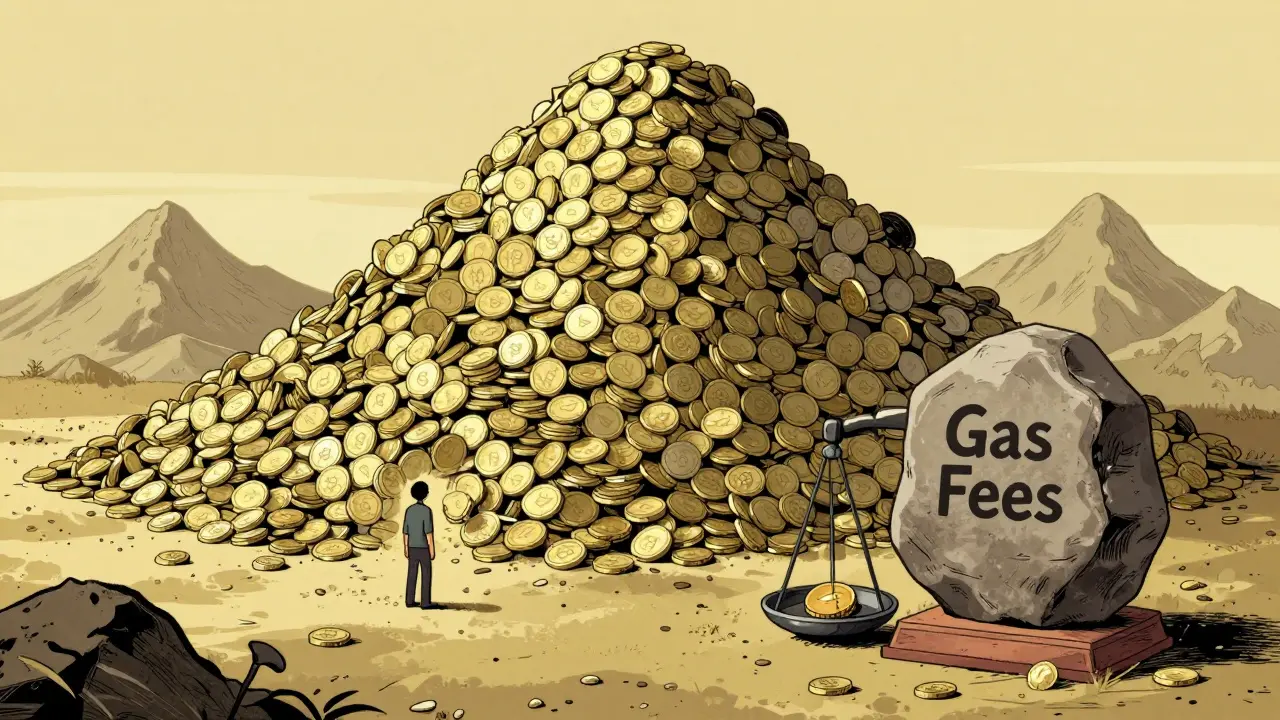
Low trading volume means low fees collected by the vault. Low fees mean tiny rewards for holders. I calculated this recently: if you hold 1 million GDOGE tokens (which is only 0.000001% of the supply), your daily reward is approximately $0.000003 in BNB. That is less than a fraction of a cent. You would spend more on gas fees to interact with the contract than you would ever earn.
Experts like Dr. Michael Saylor have warned against tokens with quadrillion-scale supplies and no fundamental utility. He noted that these often exhibit pump-and-dump characteristics. The Crypto Research Report rated GDOGE a 1.2 out of 10, citing mathematical flaws in its tokenomics that prevent meaningful price appreciation.
Red Flags and Community Sentiment
If you look at user experiences on platforms like Reddit and Trustpilot, the sentiment is overwhelmingly negative. Common complaints include:
- Empty Vaults: Users report claiming rewards only to receive amounts too small to cover withdrawal fees.
- Abandoned Development: The official Twitter account hasn’t posted meaningful updates since early 2024. Planned features like NFT games and lotteries were never built.
- Bot Activity: Telegram channels are filled with automated bots rather than real community discussions.
- Liquidity Issues: Sellers struggle to offload large amounts without slippage destroying the value.
Regulatory bodies are also watching closely. The U.S. SEC has flagged tokens with redistribution mechanisms and excessive supplies as potential unregistered securities. This adds another layer of risk for anyone holding GDOGE.
Is There Any Path to Recovery?
In the crypto world, narratives change quickly. Meme coins can surge based on hype alone. However, for GDOGE to recover, it needs a catalyst. It needs new utility, a burn mechanism to reduce the massive supply, or a partnership that brings real liquidity. Currently, none of these exist.
Industry analysts predict that over 99% of low-activity tokens with supplies exceeding 1 quadrillion will exit the market within 12 months. GDOGE fits this profile perfectly. While it remains technically active on PancakeSwap, it lacks the ecosystem support needed to sustain itself.
Practical Steps If You Already Hold GDOGE
If you already participated in the airdrop and hold GDOGE, here is what you should consider doing next:
- Check Your Wallet Balance: Use a block explorer like BscScan to verify your actual holdings and the contract address.
- Calculate Gas Costs: Before trying to sell, estimate the BNB cost for the transaction. If the fee is higher than the token's value, it may be better to let it sit or donate it.
- Monitor Volume: Watch CoinGecko or CoinMarketCap for any sudden spikes in volume. If volume stays below $100/day, the rewards will remain negligible.
- Stay Skeptical: Ignore messages promising "secret burns" or "new partnerships" unless they are verified on-chain.
Remember, in crypto, not losing money is often more important than making it. High taxes and low liquidity are structural disadvantages that are hard to overcome.
Is the Golden Doge airdrop still active?
The initial airdrop allocation of 5 quadrillion tokens was distributed during the launch phase. Current distributions are not publicly documented as ongoing active campaigns. Most remaining tokens are held by early participants or stuck in illiquid wallets.
How do I claim my Golden Vault rewards?
You must connect a compatible wallet (like MetaMask) to the official Golden Doge dashboard on Binance Smart Chain. Click "Claim" to receive accumulated BNB. Note that you can only claim once every 24 hours, and the amount is often microscopic due to low trading volume.
Why is GDOGE listed on CoinMarketCap but not Coinbase?
Why is GDOGE listed on CoinMarketCap but not Coinbase?
CoinMarketCap lists tokens that meet basic technical criteria for existence on a blockchain. Coinbase requires rigorous security audits, legal compliance, and significant liquidity before listing. GDOGE fails to meet the stricter standards required by centralized exchanges like Coinbase.
What is the contract address for Golden Doge?
The verified contract address on Binance Smart Chain is 0xA53E0b9dD9Bd8cB6E6b6ffa9. Always double-check this address on BscScan before interacting with any website to avoid phishing scams.
Is Golden Doge a scam?
While it may not be a traditional "rug pull" where developers drain liquidity immediately, it exhibits characteristics of a zombie project. The economic model makes profit nearly impossible for average users, and development has stalled. Experts classify it as high-risk and speculative.

Comments (6)

- Felix Eduardo Velasquez
- May 2, 2026 AT 23:46 PM
The math here is brutally simple and often ignored by people chasing free money. When you have a 10% tax on every transaction, you are effectively creating a friction-heavy environment that discourages the very activity needed to fund the rewards. It is a self-fulfilling prophecy of stagnation. The Golden Vault does not create value; it merely redistributes existing value from traders to holders, but since the volume is near zero, there is no value to redistribute. I have seen this pattern repeatedly in BSC meme coins with quadrillion supplies. They rely on the illusion of liquidity rather than actual market depth. The CoinMarketCap listing is a technicality, not an endorsement of viability. Most users fail to realize that holding these tokens is often more expensive than selling them due to gas fees exceeding the token's nominal worth. It is a classic example of economic design flaws masquerading as innovation.

- Emily A
- May 4, 2026 AT 09:51 AM
One must be exceedingly precise when evaluating such projects, for the terminology used by promoters is deliberately misleading. To claim that a token with negligible trading volume offers "passive income" is factually incorrect and financially irresponsible. The mechanism described relies entirely on external speculation to generate internal revenue, which is a fundamental contradiction in sustainable economics. Furthermore, the assertion that CoinMarketCap listing equates to safety is demonstrably false, as their criteria are purely technical regarding blockchain existence, not financial health. Users who fall for this narrative are ignoring basic principles of supply and demand. The inflationary nature of a 100 quadrillion supply ensures that individual token value remains perpetually suppressed unless artificial buying pressure is maintained, which is unsustainable. One should not confuse availability with legitimacy.

- Gabby Puche
- May 4, 2026 AT 21:53 PM
I totally get why people get excited about the idea of free BNB just for holding a token 🌟 But honestly, looking at the numbers, it feels like a trap waiting to happen. The gas fees alone would probably eat up any tiny reward you might see coming in. It’s so sad when projects promise the moon but deliver dust. You really have to watch out for those liquidity traps mentioned in the post. They sound harmless until you try to sell and realize your tokens are basically stuck. Stay safe everyone and don’t let the hype cloud your judgment! 💫

- Lynne Teperman
- May 6, 2026 AT 08:18 AM
the silence from the dev team speaks volumes really. no updates since early 2024 is a long time in crypto. feels like a ghost town now. the bots in telegram are just noise trying to keep the illusion alive. better to walk away than waste time on empty vaults.

- Rachel S
- May 7, 2026 AT 01:12 AM
It is truly disheartening to witness how easily individuals are lured into these sophisticated yet hollow schemes. The dramatic disparity between the promised utility and the actual performance is staggering. One can almost feel the desperation in the marketing materials, promising wealth through mere possession of digital assets that hold virtually no intrinsic value. The lack of development progress is not merely a setback; it is a definitive indicator of abandonment. We must remain vigilant against such deceptive practices that prey on the hopes of inexperienced investors. The regulatory warnings are clear, yet many choose to ignore them in pursuit of fleeting gains. This situation serves as a stark reminder of the perils inherent in unregulated markets.

- Jan Conrad
- May 7, 2026 AT 05:50 AM
I’ve been tracking similar BEP-20 tokens with high tax structures, and the correlation between low volume and project death is nearly absolute. The 10% tax acts as a barrier to entry for serious traders, leaving only retail investors who lack the capital to move the needle. Without institutional interest or significant whale activity, the price discovery mechanism fails completely. It raises the question of whether any redemption is possible without a hard fork or burn event, which seems unlikely given the current sentiment. The data suggests that holding is statistically inferior to exiting immediately, despite the sunk cost fallacy keeping many participants engaged.