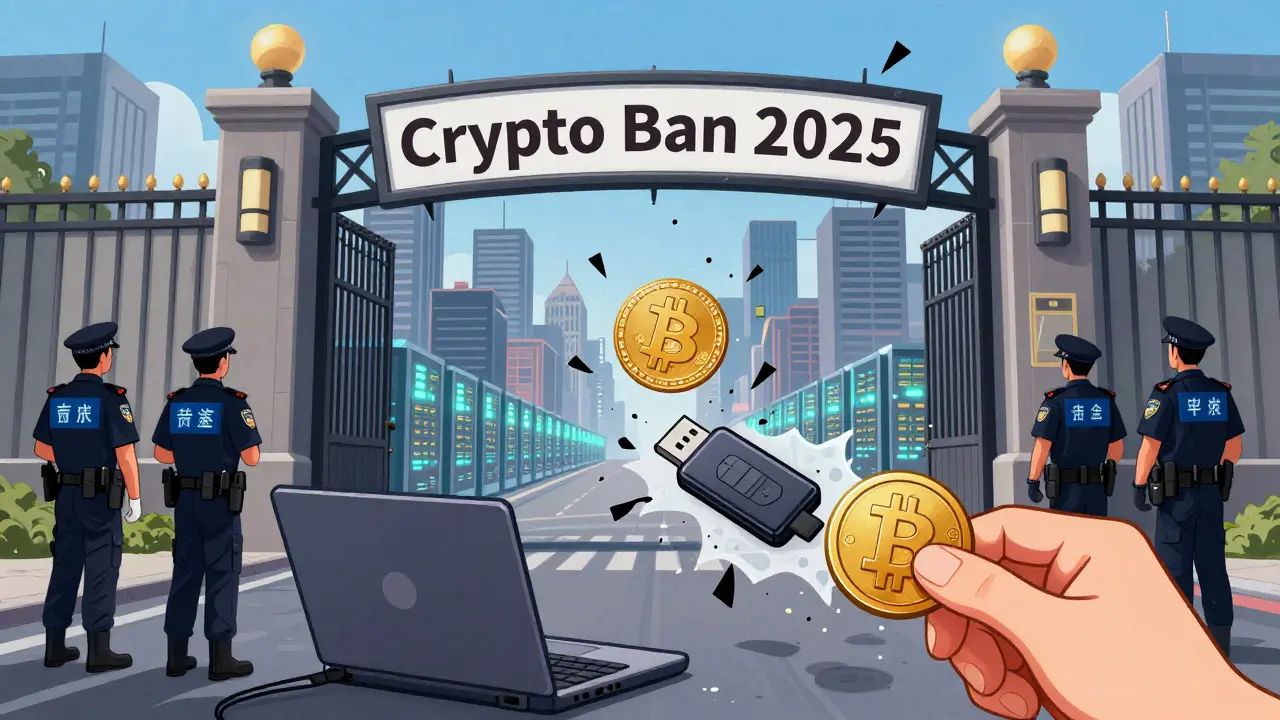

On June 1, 2025, China made history by becoming the first major economy to fully ban all cryptocurrency activity. Not just trading. Not just mining. Not just exchanges. Cryptocurrency itself - owned, held, or used by any individual or business inside China - became illegal. This wasn’t a surprise. It was the final step in a 16-year campaign to erase private digital money from the country’s financial system.
How China Turned From Crypto Hub to Crypto Zero
In 2013, China was one of the biggest Bitcoin markets in the world. Miners ran massive data centers in Inner Mongolia and Sichuan. Traders swapped Bitcoin for yuan on platforms like BTCChina. By 2017, China accounted for over 70% of global Bitcoin mining. But that was the peak. The crackdown started quietly. In June 2009, the government banned using virtual currencies to buy real goods. In December 2013, banks were told not to touch Bitcoin. By April 2014, trading accounts were shut down. In September 2017, Initial Coin Offerings (ICOs) were outlawed, and exchanges like Huobi and OKEx were forced to shut down operations inside China. They didn’t disappear - they just moved overseas. The real turning point came in June 2021. The government ordered all crypto mining to stop. Power plants were cut off. Data centers were shut down. Thousands of mining rigs were packed up and shipped to Kazakhstan, the U.S., and Russia. The move was justified as an environmental issue - crypto mining used too much electricity. But the real goal was clearer: remove any infrastructure that could support decentralized money. By September 2021, even holding Bitcoin or Ethereum was technically illegal. But enforcement was patchy. People still used VPNs to access foreign exchanges like Binance or Coinbase. They kept wallets on their phones. They traded peer-to-peer. The government knew it had to go further.The June 2025 Ban: What Exactly Is Illegal?
The June 1, 2025, order from the People’s Bank of China (PBOC) left no room for loopholes. It banned:- Any trading of cryptocurrencies - domestic or foreign
- Operating mining equipment - even if it’s just one rig in a basement
- Buying, selling, or holding Bitcoin, Ethereum, or any other digital asset
- Using VPNs to access foreign crypto platforms
- Accepting crypto as payment for goods or services
- Providing services that support crypto - like wallet apps or blockchain analytics tools
How Seizures Work: From Wallets to Bank Accounts
Seizure isn’t just a threat - it’s routine. Chinese authorities have built a system to find, freeze, and take crypto assets. Here’s how it works:- Financial monitoring: Banks and payment processors (like Alipay and WeChat Pay) flag any transaction linked to known crypto addresses. Even small transfers to foreign wallets trigger alerts.
- Internet traffic tracking: The Great Firewall now scans for connections to crypto exchanges, mining pools, and wallet services. If your device connects to a crypto site - even once - it gets flagged.
- Device seizures: Police can legally seize laptops, phones, and external hard drives. If they find crypto keys, private keys, or wallet files, they take everything. In 2024, a man in Guangzhou was arrested after police found 12 Bitcoin on his old laptop.
- Bank account freezes: If you bought crypto with yuan, your bank account gets frozen until you prove you didn’t use it for crypto. No proof? The money is seized.
- Penalties: Fines range from 50,000 to 500,000 yuan ($7,000-$70,000). Repeat offenders face jail time.
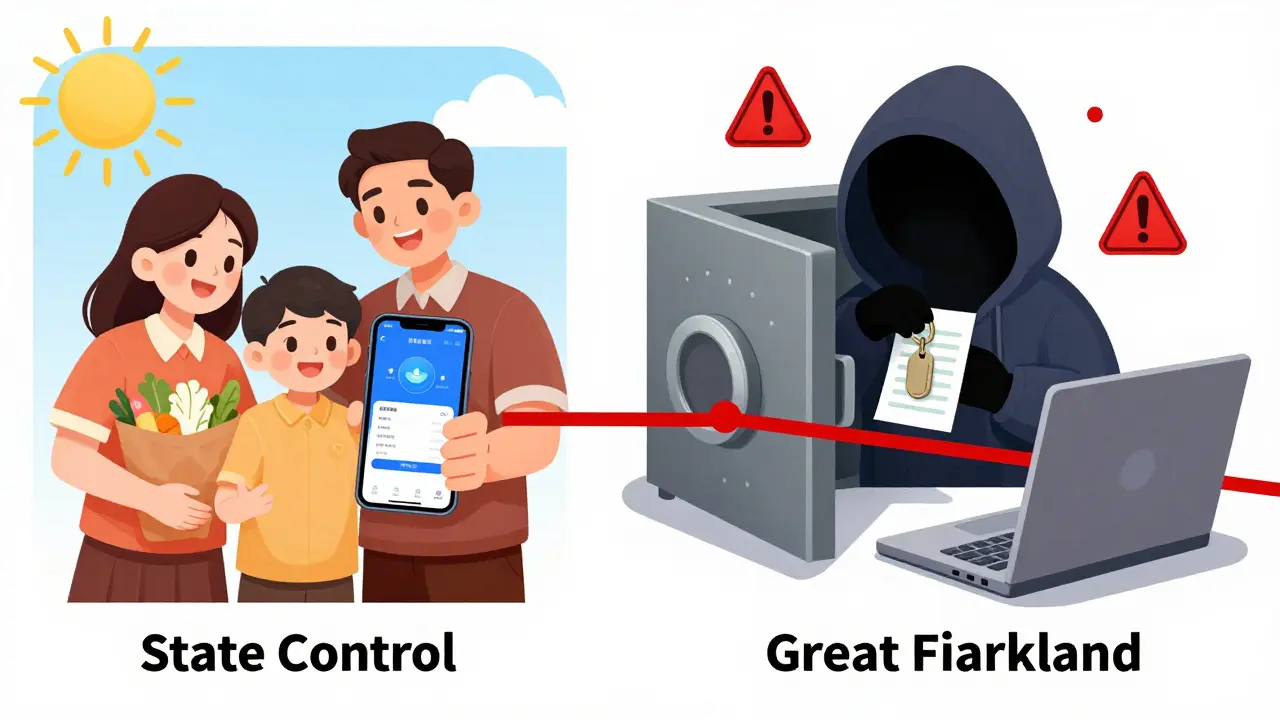
Why Did China Do This? It’s Not Just About Money
Most countries regulate crypto to protect investors or stop crime. China didn’t. It wanted to eliminate competition. The real goal? Push everyone onto the digital yuan - China’s own state-controlled digital currency. The digital yuan isn’t decentralized. It’s not anonymous. Every transaction is tracked by the government. Every dollar you spend is recorded. That’s exactly what China wants. By banning Bitcoin and Ethereum, China removed any alternative. No one can say, “I don’t trust the government’s money - I’ll use crypto instead.” There is no instead. The digital yuan is the only option. This also helps China maintain capital controls. Before the ban, people could move money out of China by buying crypto and sending it overseas. Now, that’s impossible. The government controls every digital dollar.What Happens to People Who Still Use Crypto?
Some still try. A few use offline wallets - paper keys stored in safes. Others use peer-to-peer apps that don’t require internet access. But these are rare. The risk is too high. In 2025, a 24-year-old student in Shanghai was arrested after he used a QR code to receive 2 Ethereum from a friend. He didn’t sell it. He didn’t trade it. He just held it. He got fined 200,000 yuan and had his phone confiscated. His case went viral on Chinese social media - but not because people supported him. It was because everyone realized: even holding crypto is dangerous. The government has also cracked down on crypto education. Online courses about blockchain? Banned. YouTube videos explaining Bitcoin? Blocked. Even discussing crypto in public forums can lead to account suspension.
Global Impact: Where Did the Miners and Traders Go?
China’s ban didn’t kill crypto - it scattered it. Miners moved to Texas, Kazakhstan, and Canada. Bitcoin mining hash rate dropped 50% overnight in 2021 - but quickly rebounded elsewhere. By 2025, the U.S. was mining more Bitcoin than China ever did. Traders didn’t vanish. They just moved to platforms outside China. Binance, Kraken, and Bybit now have millions of users from Hong Kong, Macau, and overseas Chinese communities. But inside mainland China? Zero legal trading. Zero legal wallets. Zero legal access. The global crypto market didn’t collapse. It just stopped being Chinese.Will China Ever Reverse This?
Almost certainly not. The digital yuan is now fully integrated into China’s economy. Over 500 million people use it daily. It powers everything - from street vendors to government salaries. Reversing the crypto ban would mean allowing a rival system. That’s not going to happen. Experts agree: China’s goal isn’t to regulate crypto. It’s to replace it. And it succeeded. The 16-year campaign wasn’t about fear. It was about control. And in 2025, China won.Is it still possible to own Bitcoin in China?
No. Since June 1, 2025, owning, holding, or using any cryptocurrency - including Bitcoin, Ethereum, or stablecoins - is illegal in mainland China. Authorities can seize devices and freeze bank accounts if they find evidence of ownership. Even storing private keys on a USB drive is considered a violation.
Can I use a VPN to access Binance or Coinbase from China?
Using a VPN to access foreign crypto exchanges is explicitly banned under China’s 2025 crypto law. The government monitors internet traffic and can detect connections to known crypto platforms. If caught, you could face fines, device seizure, or account freezes. The risk far outweighs any benefit.
What happened to Chinese crypto miners after the 2021 ban?
Over 70% of global Bitcoin mining was based in China before 2021. When the ban hit, miners shut down operations overnight. Many relocated to countries like the U.S., Kazakhstan, and Canada, bringing their equipment with them. Within a year, China’s mining share dropped from 70% to near zero. Today, Chinese miners operate only outside China’s borders.
Why does China care so much about banning crypto?
China’s main goal is to promote its own digital currency - the digital yuan. By eliminating Bitcoin and other decentralized alternatives, the government ensures that all digital transactions flow through its system. This gives it full control over money flow, prevents capital flight, and removes any challenge to its financial authority.
Have any Chinese citizens been jailed for using crypto?
Yes. While most cases result in fines or asset seizures, repeat offenders and those involved in large-scale crypto transactions have faced jail time. In 2024, a businessman in Guangdong was sentenced to 18 months for operating a crypto trading service. The court ruled he had “undermined financial order,” a charge commonly used in crypto cases.
Is the digital yuan the same as cryptocurrency?
No. The digital yuan is a Central Bank Digital Currency (CBDC) issued and controlled by the People’s Bank of China. Unlike Bitcoin or Ethereum, it’s not decentralized. Every transaction is tracked, and the government can freeze or block payments. It’s designed to replace cash and eliminate private alternatives - not to compete with them.
Can I send crypto to someone in China?
Sending crypto to someone in mainland China is illegal under the 2025 ban. Even if the recipient doesn’t cash out, simply receiving digital assets violates the law. The recipient’s bank account may be flagged, and authorities may seize their devices. There is no legal way to send crypto into China.
Comments (9)

- Ross McLeod
- March 19, 2026 AT 19:08 PM
Let’s be real - China didn’t ban crypto because it was ‘too volatile’ or ‘a threat to financial stability.’ That’s the PR spin. The real reason is control. Every transaction on the digital yuan is monitored, logged, and analyzed. No anonymity. No decentralization. No room for dissent. Bitcoin was never about money - it was about freedom. And freedom scares authoritarian regimes more than inflation, crime, or black markets ever could.
What’s terrifying is how methodical this was. They didn’t just shut down exchanges. They didn’t just ban mining. They went after the *culture* of crypto - the idea that you can own something outside the state’s grasp. They erased it from education, from media, from public discourse. They turned ‘crypto’ into a dirty word. And now? Even holding a private key is a criminal act. That’s not regulation. That’s ideological purification.
The West talks about ‘financial innovation.’ China built a financial dictatorship. And they did it without firing a single shot. Just laws, surveillance, and a thousand quiet enforcement actions. The world watched, shrugged, and kept trading. But this? This is the future. And it’s not coming. It’s already here.
Don’t fool yourself into thinking this is just about China. The digital yuan is the blueprint. Every central bank in the world is watching. The US, the EU, Japan - they’re all building their own versions. They just don’t admit it yet. The difference? China didn’t ask for permission. They took it. And now, no one can say ‘no’ to the state’s money. Not anymore.

- rajan gupta
- March 21, 2026 AT 11:52 AM
OMG 😭💔 this is the saddest thing I’ve ever read. China just murdered the soul of decentralization 😭 I mean… imagine being a teenager in Shanghai and just wanting to HODL some BTC because you believe in a better future… and then POOF - police show up with a warrant for your phone 😭
My heart is bleeding for all those kids who saved their allowance to buy crypto 🥺💸 I just cried for 20 minutes straight. Who gave them the right to take away dreams? 🌌💎
They say ‘control’ but what they really mean is ‘fear.’ Fear of people who think differently. Fear of money that can’t be caged. Fear of a world where YOU are the bank. 💔
Rest in peace, Bitcoin. You were too beautiful for this world. 🕊️🪙

- Cheri Farnsworth
- March 22, 2026 AT 21:56 PM
While I find the narrative compelling, I must emphasize that the legal framework China implemented is not unprecedented in sovereign monetary policy. Historically, states have monopolized currency issuance to maintain economic sovereignty and prevent systemic risk. The digital yuan is not a suppression of innovation; it is a rational evolution of monetary control in an increasingly digital society.
By eliminating unregulated, pseudonymous assets, China has reduced opportunities for capital flight, money laundering, and illicit financing. The enforcement mechanisms - financial monitoring, internet traffic scanning, device seizures - are merely extensions of existing anti-money laundering protocols, scaled for digital assets.
Moreover, the global financial system benefits from standardization. The digital yuan’s interoperability with international payment rails may set a precedent for responsible CBDC development. Rather than condemning China, we should analyze the efficacy of its approach as a model for other jurisdictions seeking financial stability.
It is not about control. It is about responsibility. And responsibility, however uncomfortable, is often the price of order.

- Gene Inoue
- March 22, 2026 AT 22:52 PM
LMAO at people acting like China ‘banned freedom.’ Bro, you think Bitcoin is some sacred religion? It’s a volatile gambling token with no intrinsic value. China didn’t ban crypto because they’re evil - they banned it because it was a massive loophole for rich elites to stash cash and move capital out of the country. And yeah, mining was eating up entire power grids like a cancer.
Meanwhile, the US lets hedge funds pump meme coins while kids buy Dogecoin with their pizza money. Who’s the real villain here? The government that wants to stop financial chaos? Or the idiots who think blockchain will save them?
Also, ‘digital yuan is surveillance’? Duh. So is your bank account. So is your credit card. So is every damn transaction you make. You just don’t notice it because it’s boring. Crypto’s whole thing was ‘trustless’ - but guess what? You still had to trust the devs, the exchanges, the wallets. It was all just trust… with more volatility and fewer lawyers.
China didn’t lose. You did. You thought crypto was freedom. It was just a pyramid scheme with better branding.

- Ricky Fairlamb
- March 23, 2026 AT 21:57 PM
There is a profound, almost metaphysical, danger in the digital yuan that extends far beyond mere financial control. The state’s ability to trace, freeze, or retroactively audit every transaction constitutes a violation of fundamental human autonomy - a digital panopticon masquerading as convenience.
What is striking is not the ban itself, but the precision of its execution. Every layer of the crypto ecosystem was systematically dismantled: infrastructure, education, communication, even private storage. This was not policy. It was annihilation. A totalitarian project executed with bureaucratic efficiency.
The notion that ‘everyone else is doing it’ is a fallacy. The U.S. and EU may be developing CBDCs, but they have not outlawed private ownership of decentralized assets. China did. And in doing so, they have created the first true surveillance state where money itself is a tool of obedience.
Do not mistake compliance for stability. What we are witnessing is not economic progress - it is the quiet death of financial liberty. And history will not remember China as a pioneer. It will remember them as the first to extinguish the flame of monetary freedom - not with fire, but with a QR code.

- Lucy de Gruchy
- March 24, 2026 AT 03:17 AM
Oh please. Let’s not pretend this is about ‘control’ or ‘financial stability.’ This is about fear. Fear of losing power. Fear of people realizing that money doesn’t need a government to exist.
And let’s talk about the ‘global ripple effects’ - the woman in the UK with $7B in Bitcoin? That’s not a Ponzi scheme. That’s a symptom. A symptom of a global underground economy that China’s ban didn’t stop - it just pushed it further underground.
Meanwhile, the digital yuan? It’s not a currency. It’s a loyalty card with a ledger. You want to buy rice? Fine. But you better not buy it from that guy who’s ‘too political.’ You want to send money to your cousin? You need pre-approval. You want to save? The state decides how much interest you get.
And the irony? The people who built this system? They probably own Bitcoin. In offshore wallets. With paper keys. Hidden in a safe in Switzerland. Hypocrites don’t even know they’re hypocrites anymore.

- Lauren J. Walter
- March 25, 2026 AT 10:59 AM
So… they banned crypto. Cool. I guess now I’ll just… go back to using cash? Like in 1987? 😐
Meanwhile, my crypto portfolio is still up 400%.
China wins. I win. Everyone else? Still confused about what a blockchain is.
Anyway, I’m off to buy more Dogecoin. With cash. In a different country. With a fake ID. 😘

- Carol Lueneburg
- March 25, 2026 AT 20:53 PM
Even though this is really heavy stuff, I want to say - there’s still hope. People are resilient. The fact that miners moved to Texas and Canada? That’s beautiful. The fact that traders still find ways to connect? That’s human.
China may have shut down the lights, but they can’t turn off curiosity. Kids are still learning about blockchain. Developers are still building. Communities are still forming - just in quieter places.
This isn’t the end. It’s a pause. And every time someone says ‘I believe in decentralized money,’ even in whispers, it’s a spark. And sparks? They grow.
Keep going. Keep believing. We’re not done yet. 💛🪙

- Brenda White
- March 26, 2026 AT 11:02 AM
wait so if i have a usb with btc on it and i live in china… they just come in and take it? like… what if i just… never turn on my laptop? 😅
also why is the digital yuan so different from crypto? like… it’s still digital money… right? 🤔
and why is everyone acting like this is the first time a gov banned money? what about gold in the 30s? lol