
Remember the chaos of early crypto airdrops? You’d spend hours filling out forms, only to receive a few cents worth of tokens. APENFT changed that script entirely. If you’re holding TRX or BitTorrent tokens today, you might already be sitting on a pile of NFT governance tokens without even realizing it. This isn’t just another hype cycle; it’s a systematic distribution model backed by billions in market cap and millions of holders.
The landscape has shifted since the initial launch in 2021. We are now looking at a mature ecosystem where APENFT airdrop campaigns aren't just marketing gimmicks but integral parts of network security and community engagement. With over $430 million in market capitalization and more than 2.16 million unique holders as of recent data, understanding how these distributions work is crucial for any serious digital asset collector. Whether you missed the first wave or are waiting for the next big drop, here is exactly what you need to know about securing your share of the pie.
What Exactly Is the APENFT Token?
Before we talk about free money, let’s clarify what you are actually getting. The NFT token is not a non-fungible token itself, despite the confusing name. It is an ERC-20 style utility and governance token native to the TRON blockchain. Its primary job is to power the APENFT Marketplace, one of the largest platforms for buying, selling, and minting digital art on-chain.
Think of it like this: if the marketplace is a casino, the NFT token is the chip you use to play. But unlike regular chips, these give you voting rights. Holders can vote on which artworks get featured, how fees are distributed, and what new features get built. This governance aspect gives the token real value beyond speculation. Plus, the team has been aggressive with deflationary mechanics. As of August 2025, they had burned over 9.8 trillion NFT tokens. That massive supply reduction helps stabilize the price and increases scarcity for remaining holders.
| Attribute | Detail |
|---|---|
| Primary Blockchain | TRON (TRC-20) |
| Total Supply Strategy | Deflationary (Burns implemented) |
| Unique Holders | 2.16+ Million |
| Market Cap (Approx.) | $430 Million |
| Main Use Case | Governance & Marketplace Utility |
The Big CoinMarketCap Distribution Campaign
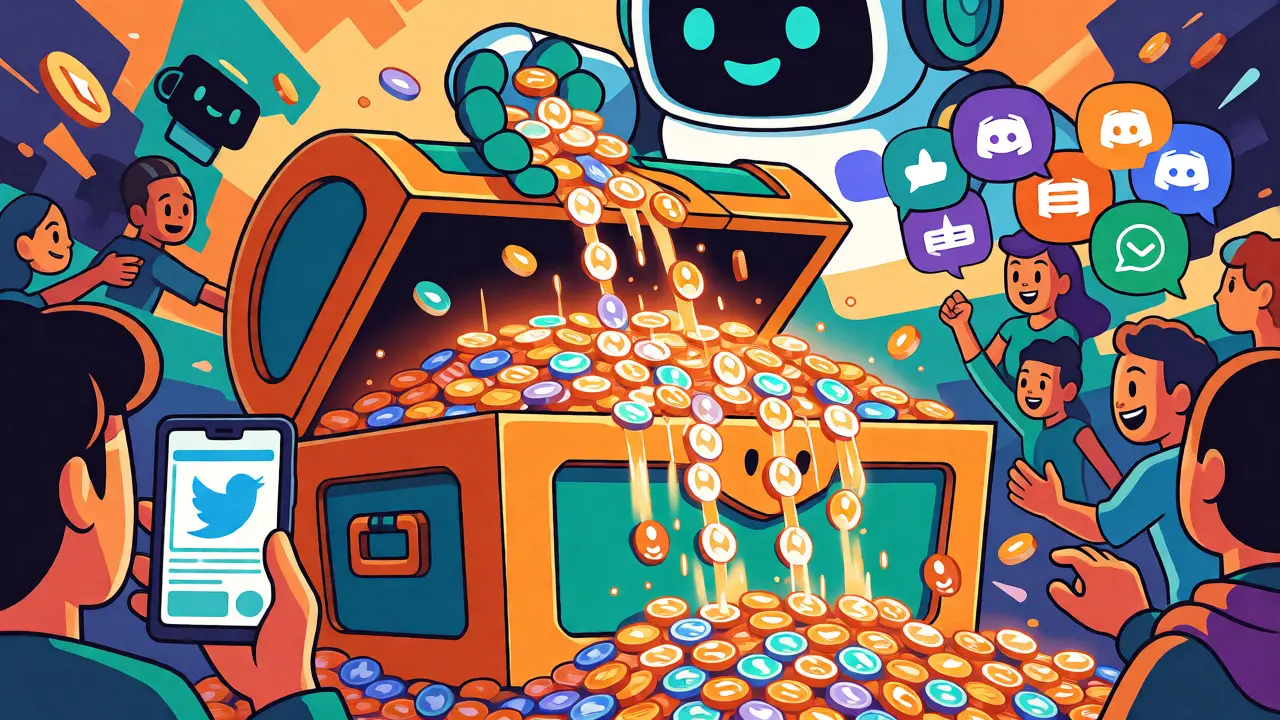
If you follow crypto news, you’ve likely seen headlines about massive giveaways. The most significant recent campaign involved distributing nearly 45.5 billion NFT tokens. Yes, billions. To put that in perspective, individual winners received up to 4.5 billion tokens each. While the per-token price is low, the sheer volume makes these prizes substantial for active community members.
This wasn’t a random lottery. The CoinMarketCap partnership required specific user actions to qualify. You couldn’t just sit there and wait. Participants had to add APENFT to their watchlists, follow the official Twitter account @apenftorg, engage with pinned tweets by liking and retweeting them while tagging three friends, and join both the Telegram and Discord communities.
Why go through all that trouble? Because APENFT wants engaged users, not ghosts. By forcing social interaction, they ensure that the people receiving tokens are actually part of the community. This strategy has proven effective. Winners were announced via official social channels, and the airdrops were sent directly after event completion. If you participated, check your wallet history. If you didn’t, don’t worry-these campaigns tend to recur, especially around major exchange listings or product launches.
How Exchange Listings Trigger New Airdrops
New exchange listings often come with attached rewards. When APENFT listed on Kraken in March 2025, it wasn’t just about trading pairs. They launched a $90,000 Reef Program airdrop specifically for users who traded or held during the listing period. Similarly, the Binance Alpha launch included conversion incentives for BNB holders.
Here is the pattern to watch: Tier-1 exchanges like HTX, OKX, Poloniex, Kraken, and Binance frequently collaborate with APENFT for promotional events. These aren’t always publicized loudly. Sometimes, simply holding the token in your exchange wallet during a snapshot period qualifies you. Other times, you need to complete a small task, like depositing a minimum amount or making a trade.
KuCoin also supported the project through its fifth airdrop completion, showing that multi-exchange coordination is common. If you keep your assets spread across multiple platforms, you increase your chances of catching these hidden drops. Always check the "Announcements" section of your favorite exchanges when you see APENFT trending.
The Systematic Holder Rewards Program
Beyond flashy marketing campaigns, APENFT runs a quiet, consistent reward system for existing holders. Since May 2021, the foundation has completed 17 rounds of distribution to TRON (TRX) and BitTorrent (BTT) holders. This program concluded its initial phase by July 2025, but the precedent remains.
The logic is simple: if you hold the underlying network tokens, you get the ecosystem tokens. This aligns incentives. TRX holders want the network to succeed because their asset gains value from usage. Giving them NFT tokens encourages them to explore the marketplace, mint art, and participate in governance. It creates a flywheel effect. More holders mean more activity, which means more demand for NFT tokens, which drives up the price, attracting more investors.
If you are a long-term TRX holder, you should have already received some of these distributions automatically. Check your transaction history on Tronscan. Look for incoming transfers labeled "Airdrop" or "Distribution." Many users miss these because they happen silently in the background. No claim button, no gas fee payment-just free tokens appearing in your balance.
Emerging Opportunities: AI and GameFi Integration
The future of APENFT airdrops isn’t just about handing out tokens for clicking buttons. The project is evolving into a comprehensive metaverse platform. Recent developments include the launch of NFT Pump in collaboration with SunPump. This is crypto’s first fair NFT launchpad, offering "one click and zero barriers" issuance capabilities.
Furthermore, the introduction of the TRC404 standard allows for fractional NFT trading. This dramatically boosts liquidity. Instead of needing thousands of dollars to buy a piece of high-value art, you can buy fractions using NFT tokens. This lowers the barrier to entry and expands the user base.
AI integration is the next frontier. The team is exploring AI-generated content (AIGC) to accelerate creative workflows. Imagine earning NFT tokens for training AI models or curating AI-assisted art collections. These new utility layers will likely drive future airdrop cycles. Keep an eye on announcements regarding AI partnerships, as early adopters in these niches often receive preferential treatment in subsequent distributions.
Checklist: Are You Eligible for Future Drops?
You don’t need to be a tech wizard to catch these opportunities. Here is a simple checklist to ensure you are positioned correctly:
- Hold TRX or BTT: Maintain a balance in your personal wallet (Ledger, Trust Wallet, etc.). Exchange holdings sometimes get excluded from direct on-chain snapshots.
- Follow Official Channels: Subscribe to @apenftorg on X (Twitter). Enable notifications so you don’t miss time-sensitive tasks.
- Join Community Groups: Be active in the official Telegram and Discord servers. Some airdrops require proof of membership.
- Monitor Exchange Announcements: Check HTX, OKX, Kraken, and Binance regularly for APENFT-related promotions.
- Engage with the Marketplace: Even small transactions on the APENFT marketplace can signal active participation, which may weigh in eligibility algorithms.
Missing out on the 45-billion-token giveaway stings, but the ecosystem is far from finished. With strategic backing from industry giants like HashKey and continued innovation in GameFi and AI, APENFT remains a key player in the digital collectibles space. Stay alert, keep your wallet secure, and you might find yourself richer than you expected.
Do I need to pay gas fees to claim APENFT airdrops?
Generally, no. Most systematic distributions to TRX and BTT holders are sent directly to your wallet address on-chain. However, if you need to interact with a smart contract to claim a specific campaign prize, you might pay a small TRON network fee. Always check the specific rules of the current promotion.
Can I lose my airdropped tokens if I move them to an exchange?
No, once the tokens are in your wallet, they are yours. Moving them to an exchange like Binance or Kraken is safe, provided the exchange supports the NFT token. Just ensure you select the correct network (usually TRON/TRC-20) when withdrawing to avoid sending funds to the wrong chain.
What happens if I miss a CoinMarketCap airdrop deadline?
You miss that specific round, but APENFT frequently runs new campaigns tied to exchange listings or product updates. There is no permanent penalty for missing one event. Continue following their social media channels to stay informed about upcoming opportunities.
Is the APENFT token the same as an NFT artwork?
No. The NFT token is a fungible utility token used for governance and payments within the APENFT ecosystem. An NFT artwork is a unique digital asset stored on the blockchain. You use the NFT token to buy, sell, or govern the ownership of those artworks.
Which blockchains support APENFT airdrops?
The primary distribution occurs on the TRON blockchain. However, due to the multichain nature of the ecosystem, bridged versions exist on Ethereum and BSC. Most direct holder rewards target TRON native addresses, so keeping assets on TRON maximizes eligibility.