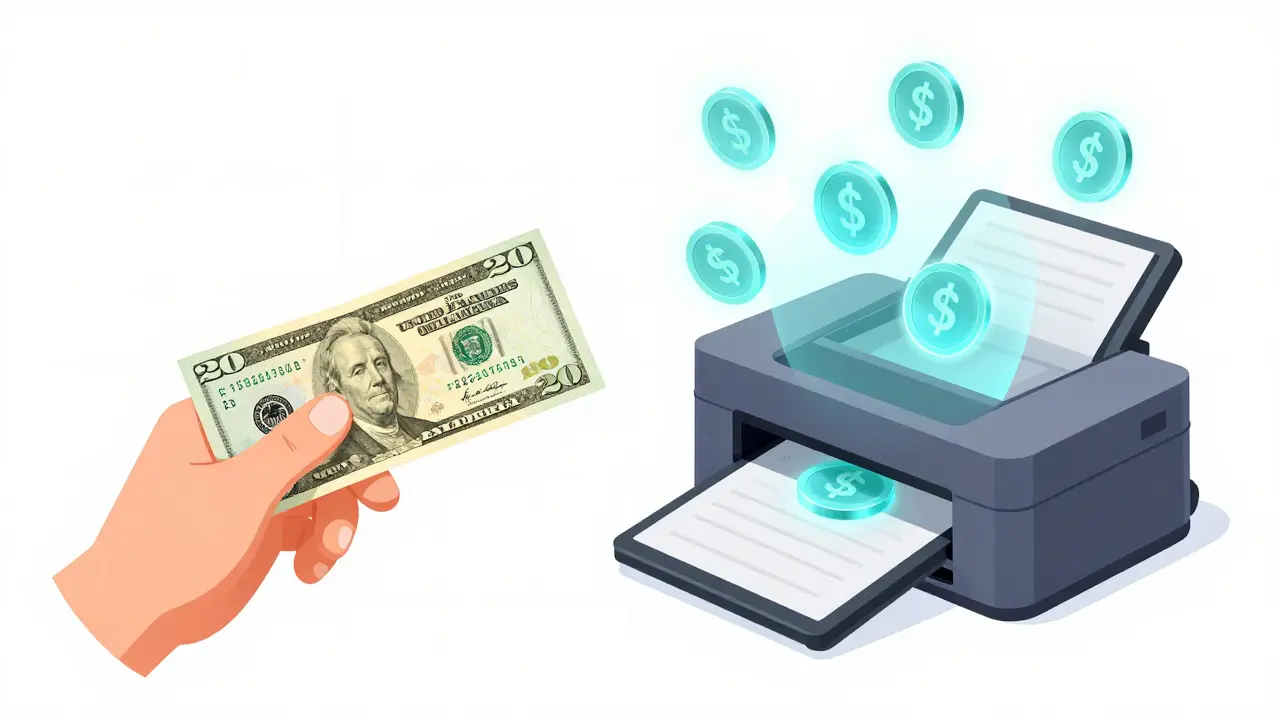

Imagine you have a $20 bill. You hand it to a coffee shop owner for your latte. That physical bill is now in their register. It cannot simultaneously be in your pocket paying for lunch at another restaurant. Physical cash has a built-in safeguard: it exists in only one place at a time.
Digital files don't work that way. If you have a photo on your computer, you can copy it, email it to ten friends, and still keep the original. The file isn't "used up" when you send it. This simplicity of copying data creates a massive headache for money. If digital currency could be copied like a photo, you could spend the same coin twice, three times, or a hundred times. This risk is known as the double-spending problem.
Quick Summary
- The double-spending problem occurs when a user tries to spend the same digital currency unit more than once by exploiting network delays.
- Before blockchain technology, preventing this required a central authority like a bank to verify transactions in real-time.
- Bitcoin solved this using a decentralized public ledger (blockchain) and a consensus mechanism called Proof-of-Work.
- Once a transaction is confirmed and added to multiple blocks, reversing it becomes computationally impossible, securing the currency's value.
- Understanding this problem explains why cryptocurrency transactions take time to confirm and why network security matters.
Why Digital Money Is Different from Cash
To understand why double-spending is such a big deal, you first need to look at how traditional money works versus digital information. When you withdraw cash from an ATM, you are exchanging a digital record in a bank's database for physical paper. That paper has a unique serial number and physical presence. You can't duplicate it easily without sophisticated equipment, and even then, counterfeiters get caught because the supply is tracked.
Cryptocurrency, however, is purely digital. It is essentially code. In the early days of computer networks, if Alice sent a digital token to Bob, she could simply copy that token file and send it to Charlie before Bob realized he had received it. Without a central referee to say, "Hey, Alice already spent those tokens with Bob!" both Bob and Charlie would think they owned valid money. This would effectively allow users to create infinite money out of thin air, causing hyperinflation and destroying trust in the system.
This issue isn't just theoretical. It was the primary reason previous attempts at digital cash failed in the 1980s and 1990s. Systems like DigiCash existed, but they relied on a central server to track every transaction. If that server went down or was hacked, the whole system collapsed. The challenge for developers like Satoshi Nakamoto was to solve this without a central boss watching over everyone.
How Double-Spending Happens in Practice
You might wonder, "Can I actually try to double-spend my Bitcoin today?" The short answer is no, not successfully. But understanding the attack vector helps explain why crypto transactions aren't instant.
Let’s walk through a hypothetical scenario where the safeguards fail. Imagine Alice wants to buy a rare digital watch from Bob for 1 Bitcoin (BTC). She initiates a transaction sending 1 BTC to Bob’s wallet. At the exact same moment, she sends another transaction from her wallet sending that same 1 BTC to herself (or to a different merchant, Charlie).
Because the internet has latency-delays in data transmission-Bob’s computer might receive Alice’s payment transaction first. He sees the pending transaction and, trusting it will go through, hands over the watch. Meanwhile, the rest of the network receives both transactions. Since they conflict (Alice only has 1 BTC to spend), the network must decide which one is valid.
In a weak system, if Bob accepts the transaction too quickly without waiting for network confirmation, Alice could broadcast the second transaction to other nodes. If those nodes accept the refund-to-self transaction instead, Bob ends up with a worthless IOU, and Alice keeps her Bitcoin. This exploit relies on speed and timing, taking advantage of the gap between "sending" a transaction and it being permanently recorded.
The Blockchain Solution: A Public Ledger
Blockchain is a distributed, immutable ledger that records all transactions across a network of computers. Also known as distributed ledger technology (DLT), it serves as the foundational infrastructure for cryptocurrencies like Bitcoin. Think of it as a shared Google Doc that everyone can read, but no single person can edit alone. Every participant (node) in the network holds a copy of this ledger.
When Alice tries to send her Bitcoin to Bob, her transaction is broadcast to all these nodes. Each node checks its own copy of the ledger to see two things:
- Does Alice actually have the Bitcoin she claims to send?
- Has she already spent this specific Bitcoin in a previous transaction?
If the ledger shows the coins are unspent, the nodes accept the transaction as valid. If they see a conflicting transaction (like the one sent to Charlie), they reject it. Because thousands of independent computers are checking the same history, it is nearly impossible for a malicious actor to trick the entire network simultaneously. The transparency ensures that once a coin is marked as "spent," every node updates its records, making it unavailable for future use.

The Role of Consensus Mechanisms
Having a shared ledger is great, but who decides which version of the ledger is correct if two people submit conflicting transactions at the same time? This is where Consensus Mechanisms come into play. They are protocols that allow decentralized networks to agree on the state of the ledger without a central authority.
Bitcoin uses a method called Proof-of-Work (PoW). Here’s how it prevents double-spending:
- Mining: Specialized computers (miners) compete to solve complex mathematical puzzles. The first one to solve it gets to add the next block of transactions to the blockchain.
- Validation: Before adding a block, miners verify that none of the transactions inside it involve double-spending. They check against the existing chain.
- Immutability: Once a block is added, it is cryptographically linked to the previous block. To change a past transaction (like reversing Alice’s payment to Bob), an attacker would need to redo the work for that block AND all subsequent blocks faster than the rest of the honest network combined.
This computational effort makes attacks prohibitively expensive. For an attacker to successfully double-spend a large amount, they would need to control more than 50% of the network’s computing power-a scenario known as a 51% attack. On major networks like Bitcoin, this is currently economically and technically unfeasible for any single entity.
Confirmations: Why You Should Wait
You’ve probably noticed that when you send crypto, it doesn’t appear in the recipient’s wallet instantly. It says "Pending." This delay is a feature, not a bug. It is the network’s way of protecting against double-spending.
A transaction is considered "confirmed" when it is included in a new block. However, there is a small chance that a competing block (one that excludes your transaction) could be mined next, creating a temporary fork in the chain. As more blocks are added on top of your transaction, the likelihood of it being reversed drops exponentially.
| Number of Confirmations | Security Level | Recommended Use Case |
|---|---|---|
| 0 (Mempool) | Very Low | None; high risk of double-spend |
| 1 | Low | Small peer-to-peer transfers only |
| 3 | Medium | Standard retail purchases |
| 6+ | High | Large exchanges, institutional trades |
For small amounts, one confirmation might be enough. But if you’re buying a car with Bitcoin, merchants wait for six confirmations. By that point, the transaction is deeply embedded in the blockchain, and the cost to reverse it would exceed the value of the transaction itself.

Alternative Solutions: Proof-of-Stake
While Bitcoin’s Proof-of-Work is energy-intensive, newer cryptocurrencies like Ethereum have moved to Proof-of-Stake (PoS). In PoS, validators are chosen to create blocks based on the amount of cryptocurrency they hold and are willing to "stake" as collateral.
Does PoS prevent double-spending? Yes, but differently. Instead of burning electricity to secure the network, validators risk their own money. If a validator tries to approve a fraudulent double-spend transaction, the protocol detects the inconsistency and slashes (destroys) their staked funds. This economic penalty discourages bad behavior. Both PoW and PoS achieve the same goal: making double-spending more costly than following the rules.
Centralized vs. Decentralized Prevention
It’s worth noting that centralized systems like Visa or PayPal also prevent double-spending, but they do so through a different model. When you swipe your card, Visa’s central server checks your balance in real-time. If you try to spend the same funds elsewhere, the server rejects the second request immediately.
The key difference is trust. With Visa, you trust that their servers are accurate and unhacked. With Bitcoin, you trust the mathematics and the distributed network. The decentralized approach removes the single point of failure. No government can freeze your ability to transact, and no company can manipulate the ledger. This trade-off-slower speeds for greater sovereignty-is the core value proposition of cryptocurrency.
Can double-spending happen on Layer 2 solutions?
Layer 2 solutions like the Lightning Network are designed to handle small payments quickly off-chain. While they significantly reduce the risk of double-spending by locking funds in multi-signature channels, users must still ensure the underlying base layer (Layer 1) confirms the channel closure. Fraudulent closures can be challenged on-chain within a specific time window, preserving security.
What happens if a miner includes a double-spend transaction?
If a miner attempts to include a transaction that spends coins already used in a previous block, other nodes will reject the block as invalid. The miner will not receive the block reward or transaction fees, wasting their computational resources. This economic disincentive keeps miners honest.
Is double-spending possible on smaller cryptocurrencies?
Yes, smaller networks with low hash rates or few validators are more vulnerable to 51% attacks. An attacker could theoretically rent mining power to rewrite recent history and double-spend. This is why relying on deep confirmations is crucial for less established chains.
Why did early digital cash systems fail?
Early systems like DigiCash relied on central servers to timestamp transactions. If the server was offline or compromised, double-spending could occur. They lacked the decentralized consensus mechanism that allows Bitcoin to function without a trusted third party.
How does the blockchain prevent counterfeiting?
The blockchain enforces a strict monetary policy coded into the protocol. New coins are only created according to predefined rules (e.g., Bitcoin’s halving schedule). Any attempt to create extra coins or duplicate existing ones results in an invalid block that the network rejects, ensuring scarcity.