
When a multinational company moves money across borders, it doesn’t just deal with banks and exchange rates. It deals with international tax reporting standards-rules that force companies and financial institutions to reveal where money is held, who owns it, and how much tax they owe. These aren’t suggestions. They’re mandatory. And failing to follow them can cost millions.
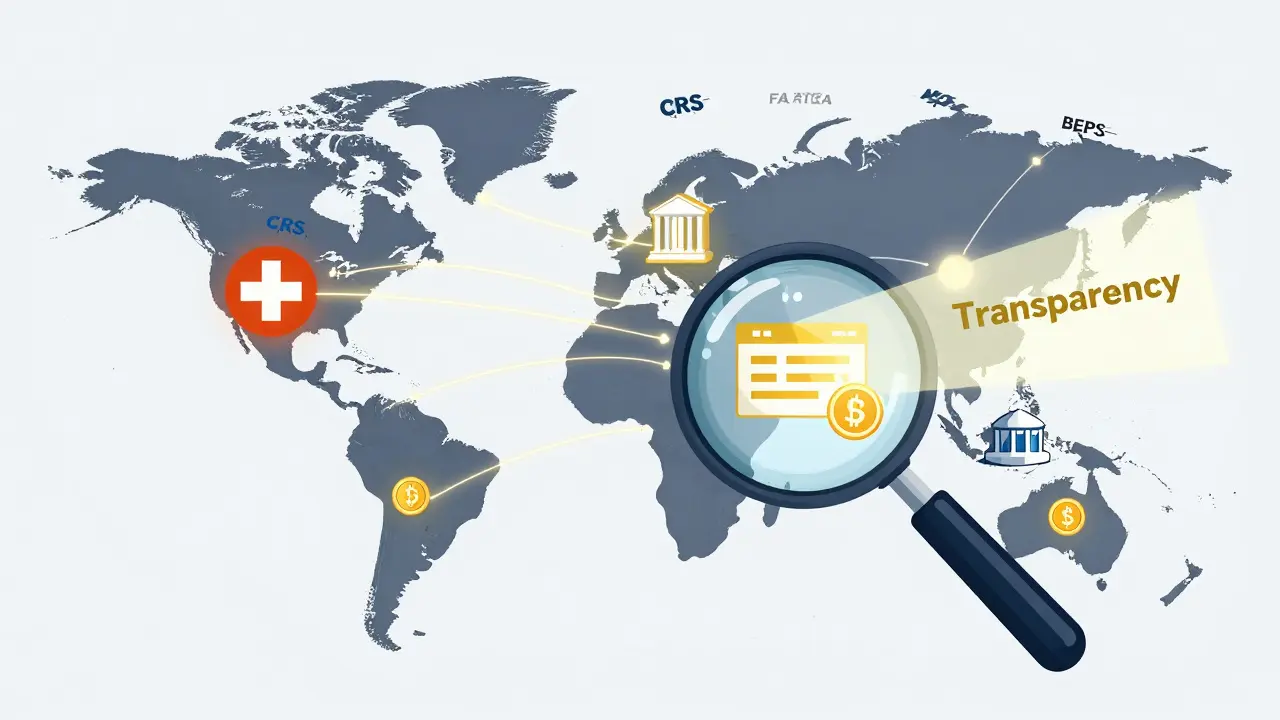
Before 2014, offshore accounts were largely hidden. Taxpayers could stash cash in Switzerland, the Cayman Islands, or Luxembourg without anyone knowing. But that changed when the Organization for Economic Cooperation and Development (OECD) an international body that sets global standards for economic policy and tax transparency launched the Common Reporting Standard (CRS) a global framework requiring financial institutions to automatically exchange financial account information between participating countries. By July 2014, over 100 countries agreed to share data on foreign account holders. Today, that number has grown. And it’s not just about individuals-it’s about corporations, trusts, and investment funds.
How CRS Works: The Global Data Exchange
CRS isn’t a law. It’s a system. Every financial institution in a participating country-banks, brokerage firms, insurance companies, even some fintech platforms-must identify account holders who are tax residents of other countries. They collect:
- Name, address, and tax identification number (TIN) of the account holder
- Account number and balance at year-end
- Total payments made during the year: interest, dividends, proceeds from asset sales
Then, they send this data to their local tax authority. That authority shares it automatically with the tax authority where the account holder lives. No request. No delay. Just a yearly digital dump of financial activity.
CRS covers more than 100 jurisdictions. It’s broader than FATCA because it applies to anyone-not just U.S. citizens. A German resident with a Swiss account? Reported. A Brazilian living in Singapore with a U.K. brokerage account? Reported. A Canadian holding crypto assets through a Luxembourg-based exchange? Also reported.
FATCA: The U.S. Exception
The U.S. didn’t wait for the OECD. Back in 2010, it passed the Foreign Account Tax Compliance Act (FATCA) a U.S. law requiring foreign financial institutions to report information about financial accounts held by U.S. persons. FATCA was aggressive. It didn’t ask politely-it demanded compliance or else.
Non-compliant foreign institutions face a 30% withholding tax on all U.S.-source payments. That includes dividends from Apple stock, interest from U.S. Treasury bonds, even payments from U.S. clients to foreign freelancers. The penalty is so harsh that most global banks chose to comply.
CRS and FATCA now run side by side. But they’re not the same. FATCA only cares about U.S. tax residents. CRS cares about anyone who’s a tax resident in a participating country. So if you’re a French citizen with a Swiss account, CRS catches you. FATCA ignores you. But if you’re a U.S. citizen living in France? Both systems report you.
BEPS: Closing Corporate Loopholes
While CRS targets individuals, the Base Erosion and Profit Shifting (BEPS) a set of OECD initiatives designed to prevent multinational corporations from exploiting gaps in tax rules to shift profits to low-tax jurisdictions framework targets big companies. BEPS isn’t one rule-it’s 15 action points that fix how taxes are calculated across borders.
Before BEPS, companies like Google or Amazon could route profits through Ireland or Luxembourg, where tax rates were near zero. They’d book sales in those countries-even if no employees worked there. BEPS changed that.
Now, multinational corporations with annual revenues over €750 million must file Country-by-Country Reporting (CbCR) a requirement for large multinationals to disclose financial and tax information on a country-by-country basis. This report shows:
- Where revenue is earned
- Where profits are booked
- How much tax was paid in each country
- Number of employees and physical assets in each jurisdiction
Tax authorities use this to spot mismatches. If a company reports €2 billion in sales in Ireland but only 10 employees there? Red flag. If profits are booked in a country with a 1% tax rate but zero real activity? That’s BEPS in action.

The Tech Behind Compliance
Manual reporting? Impossible. With thousands of accounts, dozens of countries, and constantly changing rules, companies rely on software. Tax compliance isn’t just legal work-it’s IT work.
Modern systems integrate:
- Customer onboarding tools that auto-detect tax residency using TIN validation
- Data lakes that pull account balances from core banking systems
- APIs that push reports directly to tax authority portals
- Alerts for changes in local rules-like when Argentina updated its CRS implementation in 2024
One global bank told us they cut reporting errors by 82% after switching to an automated CRS platform. They now process 4.7 million accounts across 87 jurisdictions in under 72 hours.
But tech alone isn’t enough. You still need people who understand the rules. A single misclassified account can trigger penalties. And penalties aren’t small.
Penalties: The Cost of Getting It Wrong
Non-compliance doesn’t just mean a warning. It means fines, audits, and reputational damage.
In the EU, fines for CRS violations can hit €50,000 per instance. In the U.S., FATCA non-compliance triggers automatic 30% withholding on all U.S. payments. In Australia, failure to report can lead to criminal charges. And if you’re a multinational caught hiding profits? You’ll face public scrutiny, shareholder lawsuits, and loss of banking relationships.
Even small mistakes matter. A typo in a TIN. A missed self-certification form. A failure to update residency status after a client moves. These aren’t minor clerical errors-they’re compliance failures.
Sustainability Reporting: The New Frontier
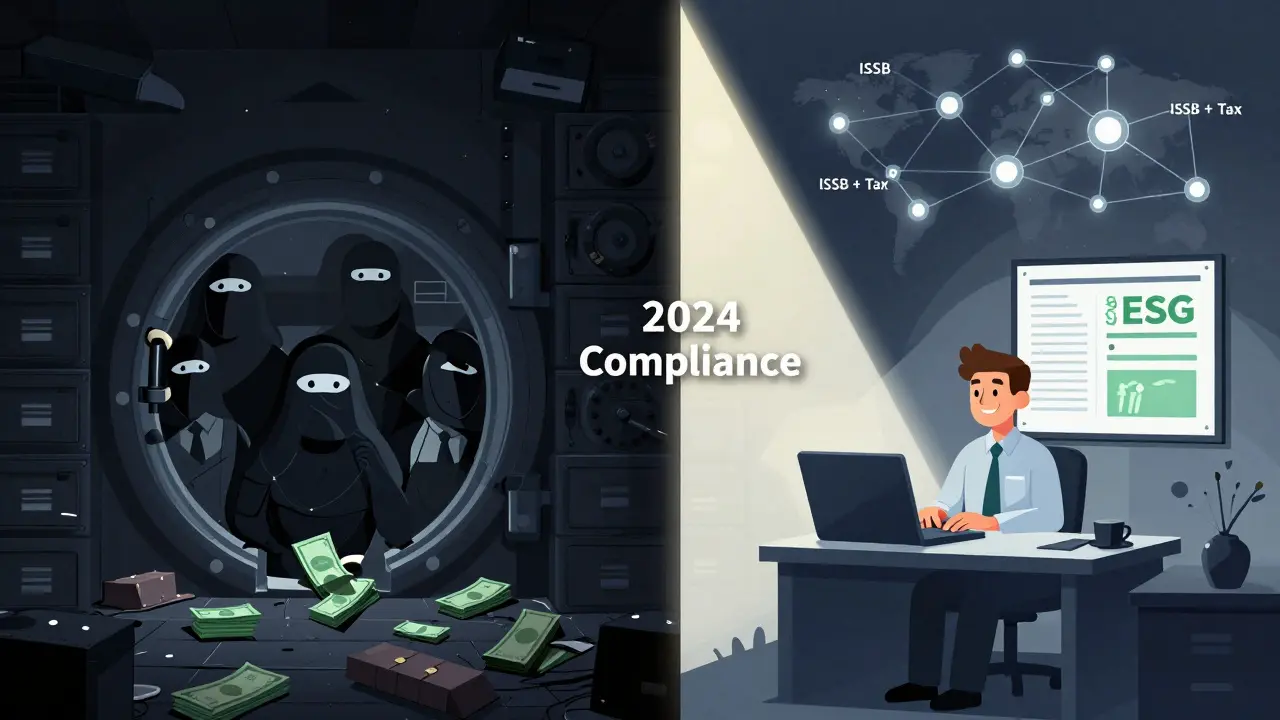
Just as tax reporting evolved from manual forms to automated systems, it’s now expanding again. The International Sustainability Standards Board (ISSB) a global body that sets standards for sustainability-related financial disclosures launched in 2021 and released IFRS S1 and S2 in 2023. These standards require companies to report climate risks, emissions, and environmental impacts-not as optional CSR reports, but as part of financial statements.
Why does this matter for tax? Because governments are linking tax policy to sustainability. Countries like the Netherlands and France now offer tax credits for companies with verified low-carbon footprints. Others are planning carbon taxes based on reported emissions. If you’re reporting sustainability data under ISSB, you’re also feeding data into future tax calculations.
It’s not just about taxes anymore. It’s about trust. Investors, regulators, and customers now expect full transparency-on profits, on people, and on planet.
What You Need to Do
If you’re an individual with foreign accounts:
- Know your tax residency status
- Provide accurate TINs to your bank
- Report foreign income to your home country’s tax authority
If you run a business with international operations:
- Map where you have economic presence-not just legal registration
- Implement automated CRS and CbCR reporting systems
- Train finance, legal, and IT teams on cross-border compliance
- Monitor updates from OECD, IRS, and local tax agencies
The days of hiding money or shifting profits to tax havens are over. The system is global, connected, and relentless. The only way to win is to be transparent.
What countries participate in CRS?
Over 100 countries participate in the Common Reporting Standard (CRS), including all EU members, the UK, Canada, Australia, Japan, Singapore, Switzerland, and most major economies. The list is updated annually. The OECD publishes the full list on its website, and financial institutions are required to check it regularly. Even countries not listed may still report under bilateral agreements.
Is FATCA still active?
Yes, FATCA is fully active and enforced. It’s not optional. Foreign financial institutions must register with the IRS, obtain a GIIN (Global Intermediary Identification Number), and report U.S. account holders annually. The IRS publishes monthly lists of compliant institutions. Non-compliant entities face 30% withholding on all U.S.-source payments, which makes compliance unavoidable for any institution doing business with Americans.
Do I need to report crypto accounts under CRS?
Yes-if the crypto exchange or platform is based in a CRS-participating country and treats crypto assets as reportable financial accounts. Many exchanges now classify digital assets like Bitcoin or Ethereum as financial instruments under CRS rules. If you hold more than $50,000 in crypto on a platform in Switzerland or Germany, that account will be reported to your tax authority. Always check with your provider.
What happens if I don’t provide my TIN to my bank?
If you refuse to provide a valid Tax Identification Number (TIN), your bank will classify you as a "non-cooperative account holder." This triggers enhanced due diligence, account restrictions, or even closure. In some jurisdictions, the bank may be required to report you to tax authorities as a high-risk case. In extreme cases, you could be flagged for tax evasion investigations.
Are small businesses affected by CbCR?
No, Country-by-Country Reporting (CbCR) only applies to multinational enterprises with consolidated revenue exceeding €750 million in the previous fiscal year. Smaller companies, even those operating in multiple countries, are not required to file CbCR. However, they may still be subject to CRS reporting if they hold financial accounts abroad or provide services through foreign subsidiaries.
Comments (10)

- Tanvi Atal
- February 20, 2026 AT 23:48 PM
This is why I hate taxes. Just give me the money and let me live. Why do I need to tell some government in Switzerland what I own?
So annoying.

- Colin Lethem
- February 22, 2026 AT 23:11 PM
Bro this is wild. I didn’t realize crypto was even caught in CRS. I’ve got a few BTC on a Swiss exchange and I just assumed it was "off the grid". Guess not. My bad.
Now I gotta file something else? Seriously?

- Kaitlyn Clark
- February 24, 2026 AT 22:36 PM
YESSSS this is so important!! 🙌 I work in fintech and trust me, the automation behind this is insane. One tiny typo in a TIN and boom - your whole client’s account gets flagged. We had a client from Brazil who moved to Canada and didn’t update his address. Took 3 weeks to fix. The system doesn’t forgive. Ever.
Also crypto reporting? YES. If you’re holding >$50k on any exchange in a CRS country, they’re reporting you. No exceptions. Don’t be that person who gets audited because they thought "crypto is anonymous" 😅

- Derek Sasser
- February 26, 2026 AT 01:46 AM
Honestly, I’m impressed. The tech side of this is way more advanced than most people realize. Automated TIN checks, real-time API feeds to tax authorities, dynamic rule updates - it’s like the financial world finally stopped using Excel and started using actual software.
Big banks are still messy, but the ones who invested in compliance systems? They’re running lean, clean, and way less stressed. Kudos to the devs behind this.

- Nadia Shalaby
- February 27, 2026 AT 14:14 PM
I read this whole thing. It’s long. But I’m glad I did. Feels like the world is finally getting serious about fairness. No more hiding money in the Caymans while the rest of us pay our taxes.
Still weird how FATCA is this one-sided monster though. Why does the US get to demand this from everyone else?

- John Fuller
- March 1, 2026 AT 12:45 PM
CRS FATCA BEPS all just government overreach

- Samantha Stultz
- March 2, 2026 AT 20:27 PM
You guys are missing the real story - this isn’t about transparency, it’s about control. The OECD is basically building a global tax surveillance state. CbCR doesn’t just track profits - it tracks *economic presence*, which means if you have a single employee or server in a country, they’ll tax you. That’s not fair tax policy - that’s economic imperialism disguised as compliance.
And don’t even get me started on the ISSB. Now we’re supposed to report carbon emissions to get tax breaks? Next they’ll audit your recycling habits. This is dystopian.

- McKenna Becker
- March 4, 2026 AT 14:44 PM
It’s not about fear. It’s about integrity. We used to live in a world where the rich hid money and the middle class got stuck with the bill. This system? It’s the first real attempt to fix that imbalance.
Yes, it’s complex. Yes, it’s bureaucratic. But if we want a world where everyone pays their share - even the ones with Swiss bank accounts - this is the price. And honestly? Worth it.

- George Suggs
- March 5, 2026 AT 22:07 PM
Solid breakdown. I work with small businesses and people always ask me if they’re affected. Answer: if you’re not a giant corp with €750M+ revenue, you’re mostly safe from CbCR. But CRS? Yeah, if you’ve got a foreign bank account - even a simple savings account - you’re in the system.
Just make sure your bank has your TIN. Easy fix. Don’t overthink it.

- Dianna Bethea
- March 6, 2026 AT 23:45 PM
I love how this post explains the tech side - seriously, most people think this is all manual forms and paperwork. Nah. It’s all APIs and data lakes and auto-validation. One bank I worked with automated CRS and went from 3 months of manual work to 72 hours. Game changer.
Also - crypto reporting is real. If you’re on a Swiss exchange and hold more than $50k? They’re reporting you. No if’s and’s or but’s. Don’t wait for a letter from the IRS - check with your provider now. Seriously. Do it.