

Since January 1, 2025, Russia has enforced a strict, fully implemented cryptocurrency tax system under Federal Law No. 418-FZ. This isn’t a guideline or a suggestion-it’s the law. If you’re buying, selling, mining, or even holding crypto in Russia, you’re now legally required to report it. And the penalties for ignoring it are real.
How Crypto Income Is Taxed in Russia
For Russian residents, cryptocurrency profits are treated as personal income. The tax rate depends on how much you make in a year. If your total crypto gains (including sales, mining rewards, staking, and airdrops) are under 2.4 million rubles ($32,653), you pay 13%. That’s the same rate as regular salary income. But if you earn more than that, the rate jumps to 15%. There’s no middle ground. No deductions. No exemptions.
Here’s the catch: your crypto income is now grouped with stock trading profits. That means if you made 1 million rubles from Bitcoin and 1.5 million from stocks, the system adds them together. You’re now over the 2.4 million threshold, so the entire amount is taxed at 15%. This consolidation was meant to close loopholes, but it’s caught many small investors off guard.
Non-residents? You’re hit with a flat 30% tax on all crypto income earned in Russia. No exceptions. No thresholds. Just 30%.
Corporate Crypto: Mining Is Heavily Regulated
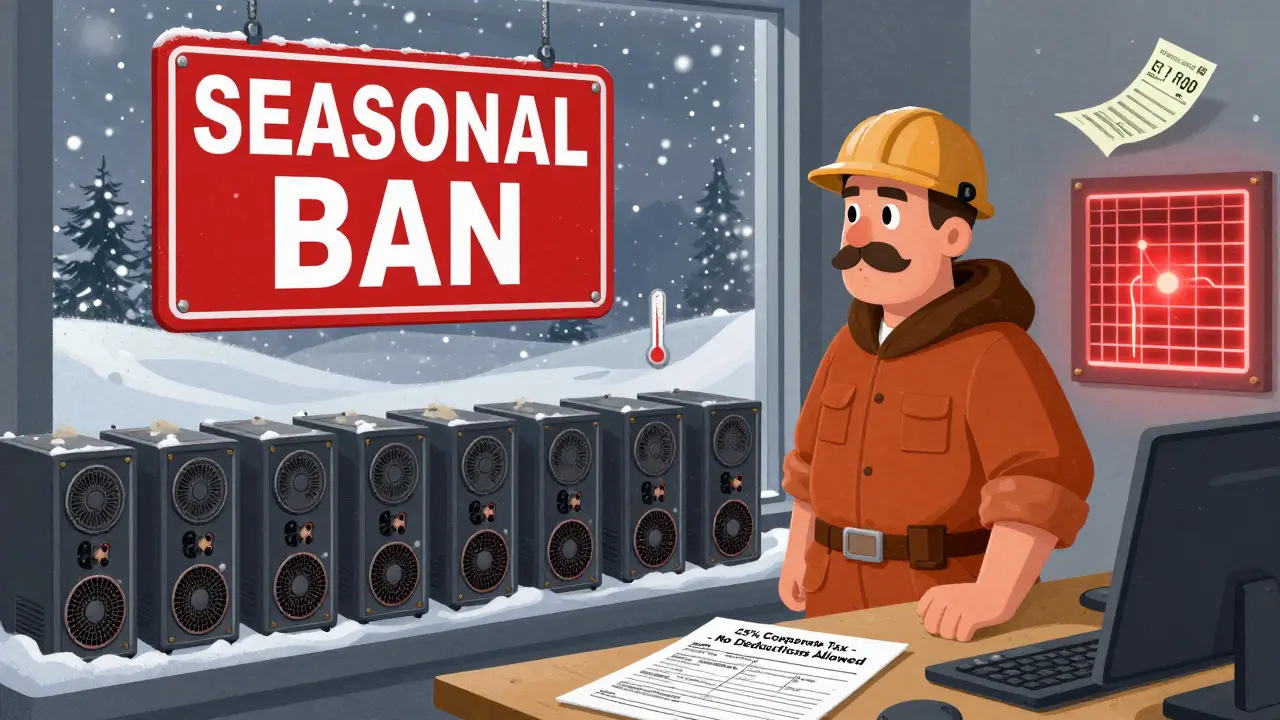
Companies can’t use simplified tax systems anymore. If you’re running a crypto mining operation, you must register under the General Taxation System (OSNO). That means paying a 25% profit tax-20% higher than the standard corporate rate. There’s no way around it. Even if you’re a small business, you can’t use the USN or ESHN regimes anymore.
And mining isn’t just taxed-it’s restricted. In Dagestan, Chechnya, and the DPR/LPR regions, all mining is banned until 2031. In Siberia and the Far East-areas like Irkutsk, Buryatia, and Zabaykalsky Krai-you can only mine during certain months when energy supply isn’t strained. These seasonal bans are enforced by regional energy authorities. Many miners in these zones have shut down operations entirely.
How to Calculate Your Tax: It’s Not Simple
You can’t just look at your wallet balance and guess. The law requires you to use market prices from specific foreign exchanges. Only those with:
- Daily trading volume over 100 billion rubles ($1.36 billion)
- At least three years of publicly available price data
are approved. That means you can’t use local Russian exchanges-they don’t meet the criteria. You have to pull prices from Binance, Kraken, or Coinbase, even if you never used them. The Federal Tax Service (FTS) doesn’t accept your own records or local trade data.
Each transaction-whether you bought 0.01 BTC on one day and sold it weeks later-must be tracked with:
- Wallet addresses
- Transaction IDs
- Exact date and time
- Exchange rate used
One miner from Novosibirsk told a local news outlet he spent 37 hours just calculating his January 2025 tax. He had 142 transactions. No software in Russia can fully automate this. Most accountants had to take special training to handle it.
Reporting Requirements and Penalties
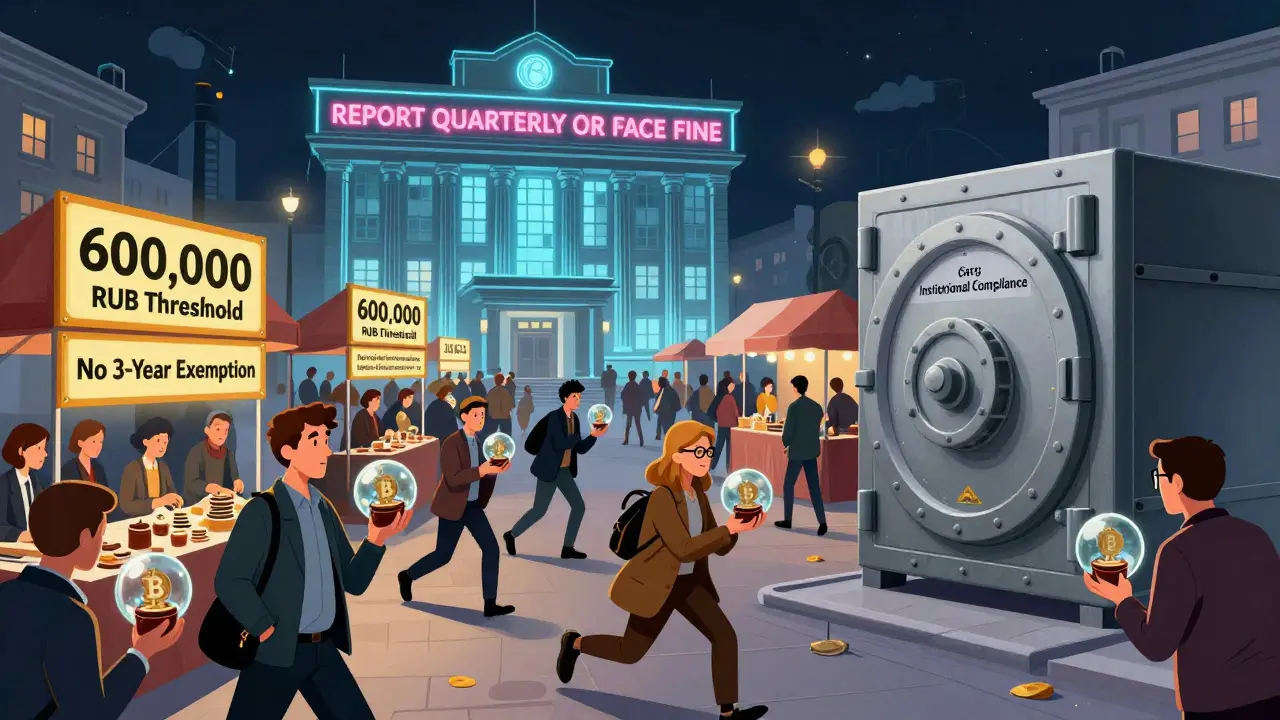
You must file a report every quarter-even if you didn’t make any money. The FTS expects submission by April 30, July 31, October 31, and January 31. Failing to file carries a fine of up to 40,000 rubles ($544). But if you file late and owe taxes? That’s worse. Penalties range from 15% to 40% of the unpaid amount, plus daily interest.
And here’s something most people don’t realize: there’s no ownership exemption. In Russia, if you own a car or a piece of jewelry for three years, you don’t pay tax when you sell it. Crypto doesn’t get that. Sell it after one day? Pay tax. Hold it for ten years? Still pay tax. The law specifically removed the three-year exemption for digital assets.
Who’s Affected the Most?
Small investors are feeling the squeeze. A 600,000 ruble ($8,163) annual reporting threshold sounds harmless-until you realize it applies to total transaction volume, not profit. That means if you bought $7,000 worth of Ethereum in January and sold it for $7,500 in March, you’ve hit the threshold. Even if your profit was only $500, you still have to report. According to Garantex exchange data, 78% of their users had annual volumes below this line. But now, even those small traders are forced into the system.
Miners are hit hardest. The 25% corporate tax, combined with energy restrictions and the lack of expense deductions (no write-offs for electricity, hardware, or cooling), has forced many out of business. A survey of 127 accounting firms found 89% of them needed weeks of training just to understand the new rules. And 62% said verifying foreign exchange prices was nearly impossible without manual cross-checking.
What’s Changed Since January 2025?
Since the law went live, the Russian crypto market has shifted dramatically:
- Domestic mining dropped 22%-mostly in Siberia and the Far East.
- Active users fell from 1.8 million to 1.4 million in just three months.
- 38% of users moved to peer-to-peer (P2P) platforms to avoid reporting.
- But institutional interest grew: 47 banks and financial firms registered as crypto service providers by February 2025.
Why? Because the law created clarity for big players. The VAT exemption on crypto transactions removed a major cost barrier. For hedge funds and trading firms, that’s worth the hassle of compliance. For individuals? Not so much.
What’s Coming Next?
The government isn’t done. In April 2025, the Central Bank announced a pilot program for digital ruble payments-starting with welfare transfers in October 2025. That could change how crypto is used long-term. Meanwhile, the State Duma plans to debate amendments in July 2025, specifically targeting the 600,000 ruble reporting threshold. Many lawmakers admit it’s too vague and is catching innocent users.
The Ministry of Finance expects to collect 12 billion rubles ($163 million) in crypto taxes this year. But experts at the Higher School of Economics say that number is likely 30-40% too high. Why? Because the law is pushing activity underground. P2P trading is growing. Wallet-to-wallet transfers are rising. And many are simply leaving the system.
Bottom Line: Compliance Is Mandatory
If you’re in Russia and holding crypto, you’re not just a user-you’re a taxpayer. The system is complex, the penalties are steep, and the reporting is burdensome. But ignoring it won’t work. The FTS has tools to track foreign exchange data, and they’re already cross-referencing wallet addresses with bank transfers.
There’s no legal way to avoid it. No loopholes. No gray zones. The law is clear: if you profit from crypto, you pay tax. Period.
Do I have to pay tax if I didn’t sell my crypto?
No, you only pay tax when you realize a gain-meaning you sold, traded, or converted crypto into rubles or goods. Holding crypto without selling doesn’t trigger tax. But if you use crypto to buy a car or pay for services, that counts as a sale and is taxable.
Can I use Russian exchanges for tax reporting?
No. The law requires you to use price data from foreign exchanges that meet strict criteria: daily volume over 100 billion rubles and three years of public data. Russian exchanges don’t qualify. You must pull prices from Binance, Kraken, Coinbase, or similar platforms-even if you never used them.
What happens if I don’t report my crypto income?
You’ll face fines up to 40,000 rubles for failing to file quarterly reports. If you owe taxes and don’t pay, penalties are 15-40% of the unpaid amount, plus daily interest. The FTS can freeze bank accounts and seize assets. There’s no statute of limitations on crypto tax evasion in Russia.
Can I deduct mining expenses like electricity or hardware?
No. The law does not allow any expense deductions for mining or trading activities. Your entire profit is taxable-even if your electricity bill cost more than your profit. This is one of the most criticized parts of the law, especially by miners.
Is there a way to legally avoid crypto taxes in Russia?
No. The law applies to all Russian residents, regardless of how you earn or hold crypto. Even if you use P2P platforms, foreign wallets, or non-Russian exchanges, you’re still required to report. The only legal option is to become a non-resident by living outside Russia for more than 183 days per year-but that’s not practical for most people.
Does the law apply to NFTs and other digital assets?
Yes. The law defines cryptocurrency broadly to include all digital assets traded on blockchain networks, including NFTs, tokens, and stablecoins. Any sale, trade, or conversion of these assets is taxable. Even if you received an NFT as a gift and later sold it, you owe tax on the profit.
Comments (10)

- maya keta
- February 26, 2026 AT 21:39 PM
Okay but let’s be real-Russia’s crypto tax law is just state control dressed up as fiscal responsibility. 15%? 25%? NO DEDUCTIONS? 😒 I mean, if you’re mining in Siberia and your electricity bill eats 80% of your profit, why are you still taxed on the ‘gain’? That’s not taxation-that’s extortion with a spreadsheet. And don’t even get me started on using Binance prices when you never touched Binance. This isn’t compliance, it’s performative bureaucracy. 🤷♀️

- Curtis Dunnett-Jones
- February 28, 2026 AT 06:33 AM
While I acknowledge the complexity of implementing such a comprehensive regulatory framework, I must emphasize that the Russian Federation has demonstrated commendable fiscal discipline in codifying cryptocurrency taxation. The alignment of crypto income with traditional income streams, coupled with the elimination of loopholes, reflects a mature approach to digital asset governance. The penalties, though severe, are proportionate to the systemic risks posed by unregulated financial activity. This is not overreach-it is responsible statecraft.

- Sean Logue
- March 1, 2026 AT 08:07 AM
Bro, I live in Austin and I’m just vibin’ with my BTC, but hearing this Russian law made me check my own wallet. Like… you can’t deduct mining costs? That’s wild. My rig’s a money pit and I’m not even taxed on it here. Russia’s going full dystopia with this ‘no exemptions’ nonsense. And forcing you to use foreign exchange data? That’s like making me use the London weather report to decide if I need a jacket in Texas. 😅

- Carl Gaard
- March 2, 2026 AT 06:49 AM
WHY IS THIS EVEN A THING?? 😭 I just wanted to buy some DOGE and chill… now I have to track 142 transactions?? With timestamps?? And prices from exchanges I’ve NEVER used?? I’m not an accountant, I’m a graphic designer!! 🥲 I spent 3 hours last night trying to figure out if my 0.002 ETH trade counted… and I still don’t know. Someone please help me before the FTS finds me… 🙏 #CryptoTaxHell

- bella gonzales
- March 2, 2026 AT 11:49 AM
Ugh. I’m not even going to read this whole thing. Just tell me: if I didn’t sell anything, do I owe anything? No? Okay, good. I’m done.

- Paul Reinhart
- March 4, 2026 AT 04:06 AM
There’s a deeper philosophical tension here that I think is being overlooked. The law treats crypto not as a speculative asset but as a financial instrument-equating it with labor income and capital gains. This is a paradigm shift. It doesn’t just tax transactions; it asserts state authority over digital identity and economic behavior. The burden of proof, the foreign exchange requirement, the lack of deductions-they’re not merely administrative hurdles. They’re symbolic. They say: ‘You do not own this. The state defines its value, its movement, its legitimacy.’ And that’s… unsettling. Not because it’s unfair, but because it’s inevitable. We’re entering an era where every digital transaction is a potential audit trail. We should be discussing the implications of that-not just the rates.

- Samantha Stultz
- March 4, 2026 AT 12:28 PM
Let me just say-this 600k ruble reporting threshold is a disaster. It’s not based on profit, it’s based on volume. So if you’re a normal person doing dollar-cost averaging, buying $500/month, you hit the threshold in 12 months. That’s not a reporting rule-it’s a trap for middle-class savers. And the fact that you can’t use Russian exchanges? That’s just a way to force people into Western platforms so the FTS can monitor them. It’s surveillance capitalism with a tax stamp. Also-NFTs? Really? You’re taxing digital art? What’s next, taxing your Twitter likes?

- Alyssa Herndon
- March 5, 2026 AT 03:05 AM
I think there’s something beautiful in how Russia is treating crypto as real money. Not as a rebellion, not as a gimmick, but as something that must be integrated into the economy. The lack of deductions hurts, sure. But maybe that’s the point. Crypto shouldn’t be a tax haven. Maybe this is what financial maturity looks like. No loopholes. No excuses. Just truth. And if it’s too hard for you to track your transactions… maybe you weren’t meant to be trading anyway.

- Ifeanyi Uche
- March 5, 2026 AT 08:45 AM
USA? You think you’re free? You think you’re not being watched? Russia at least has the guts to say: ‘You earn, you pay.’ You Americans cry about taxes but you still use PayPal, Venmo, and Coinbase-each one tracking you like a dog on a leash. At least in Russia, they don’t pretend to be nice. They say: ‘This is law.’ No sugarcoating. No woke capitalism. Just straight-up state power. And honestly? I respect that. You want freedom? Then pay your damn tax. No whining. No excuses. Just do it.

- Elana Vorspan
- March 7, 2026 AT 04:54 AM
This is actually kind of inspiring. I know it sounds weird to say that about a tax law, but think about it-Russia is trying to build a system that works. Even if it’s harsh, it’s consistent. No gray zones. No ‘it depends.’ And for once, the rules are the same for everyone. I wish more countries did this. Maybe if we stopped treating crypto like a wild west and started treating it like money, we’d all be better off. The pain is real, sure. But maybe the clarity is worth it. 💛