Mining Difficulty Algorithm: How Crypto Networks Adjust Mining Pressure
When you mine cryptocurrency, you’re not just running software—you’re competing in a constantly shifting race. The mining difficulty algorithm, a self-adjusting mechanism in proof-of-work blockchains that controls how hard it is to find a valid block hash. It’s what stops Bitcoin from getting too easy or too hard to mine, no matter how many miners join or leave. Without it, blocks would come too fast when mining power spikes, or too slow when miners drop off. That’s why every 2,016 blocks on Bitcoin, the network checks how long it took to mine them and adjusts the target accordingly. If it took less than two weeks, difficulty goes up. If it took longer, it goes down. Simple. Automatic. Unstoppable.
This isn’t just a Bitcoin thing. proof of work, the consensus method that requires miners to solve complex puzzles to validate transactions. It’s the backbone of Bitcoin, Ethereum Classic, and dozens of smaller coins. But not all networks handle difficulty the same way. Some adjust every block. Others use moving averages. Some even tie difficulty to hash rate estimates from external data. The best systems are transparent, predictable, and resistant to manipulation—because if miners can game the algorithm, the whole chain becomes unstable. That’s why you’ll see posts here about failed projects like Juicebox or LifeTime: their mining or tokenomics broke down because they ignored basic rules like difficulty adjustment. Meanwhile, coins that stick to clean, well-tested models—like Bitcoin’s 2-week cycle—keep running for over a decade.
What you’ll find in this collection isn’t theory. It’s real-world cases where mining difficulty played a role—sometimes as the hero, sometimes as the villain. You’ll see how North Korean hackers target mining pools not just for coins, but for the computational power they offer. You’ll learn why some exchanges banned mining-related tokens outright, and how projects like Taraxa and THORChain built systems that avoid mining entirely because they knew the risks. You’ll even find guides on how to spot fake airdrops that pretend to reward miners—because when difficulty spikes, scammers always show up looking for easy money.
Understanding the mining difficulty algorithm isn’t about becoming a miner. It’s about knowing why your favorite crypto stays alive—or dies. It’s the invisible hand that balances supply, security, and fairness. And if you’re trading, holding, or just trying to avoid scams, you need to know how it works. The posts below don’t just explain it. They show you what happens when it fails, who exploits it, and how the smartest players stay ahead of the curve.
Future of Adaptive Mining Difficulty in Blockchain Networks
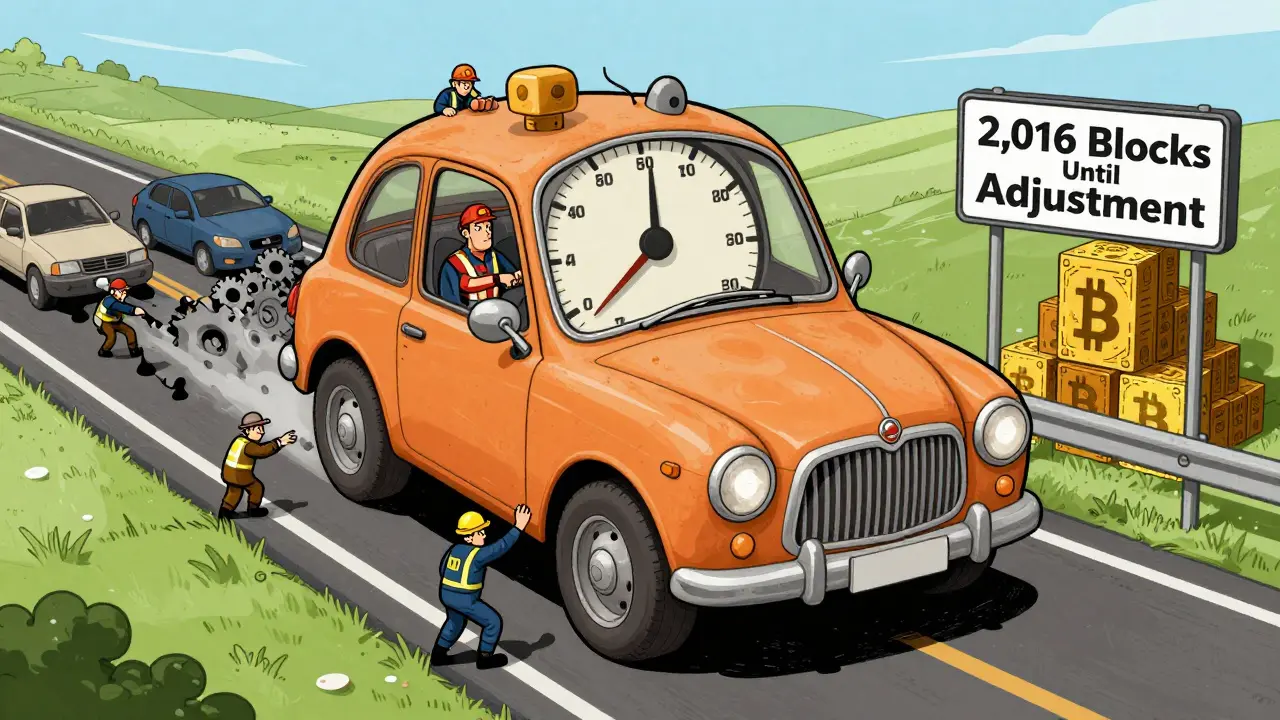

Adaptive mining difficulty is transforming blockchain networks by replacing slow, two-week adjustments with real-time tuning. It improves security, cuts energy waste, and stabilizes block times - but adoption faces resistance from miners and conservative networks like Bitcoin.